
X-ray Astronomy Is Still Blurry. A Seven-Satellite Concept Could Sharpen It Up to a Millionfold
A new study maps how a proposed microarcsecond X-ray interferometer could directly image black-hole coronae, binary supermassive black holes, stellar flares, and jet-launching regions, if its sensitivity and design hurdles can be met.
Nov 18, 2026
X-ray astronomy has a sharpness problem. The Chandra X-ray Observatory, still the finest X-ray imager flying, resolves details about half an arcsecond to an arcsecond across. An arcsecond is 1/3,600 of a degree. A microarcsecond is one millionth of an arcsecond. Radio, optical, and infrared facilities regularly reach milliarcsecond scales, and radio interferometry can reach microarcseconds. X-rays have plateaued.
That gap is more than a technical annoyance. It keeps astronomers from directly seeing the innermost regions of the most energetic objects in the universe. A new study by Jenna M. Cann and colleagues lays out what a microarcsecond X-ray imager could do and what capabilities it would need. The paper centers on a science traceability matrix, a table that links specific science questions to the instrument performance required to answer them.
A millionfold leap in sharpness
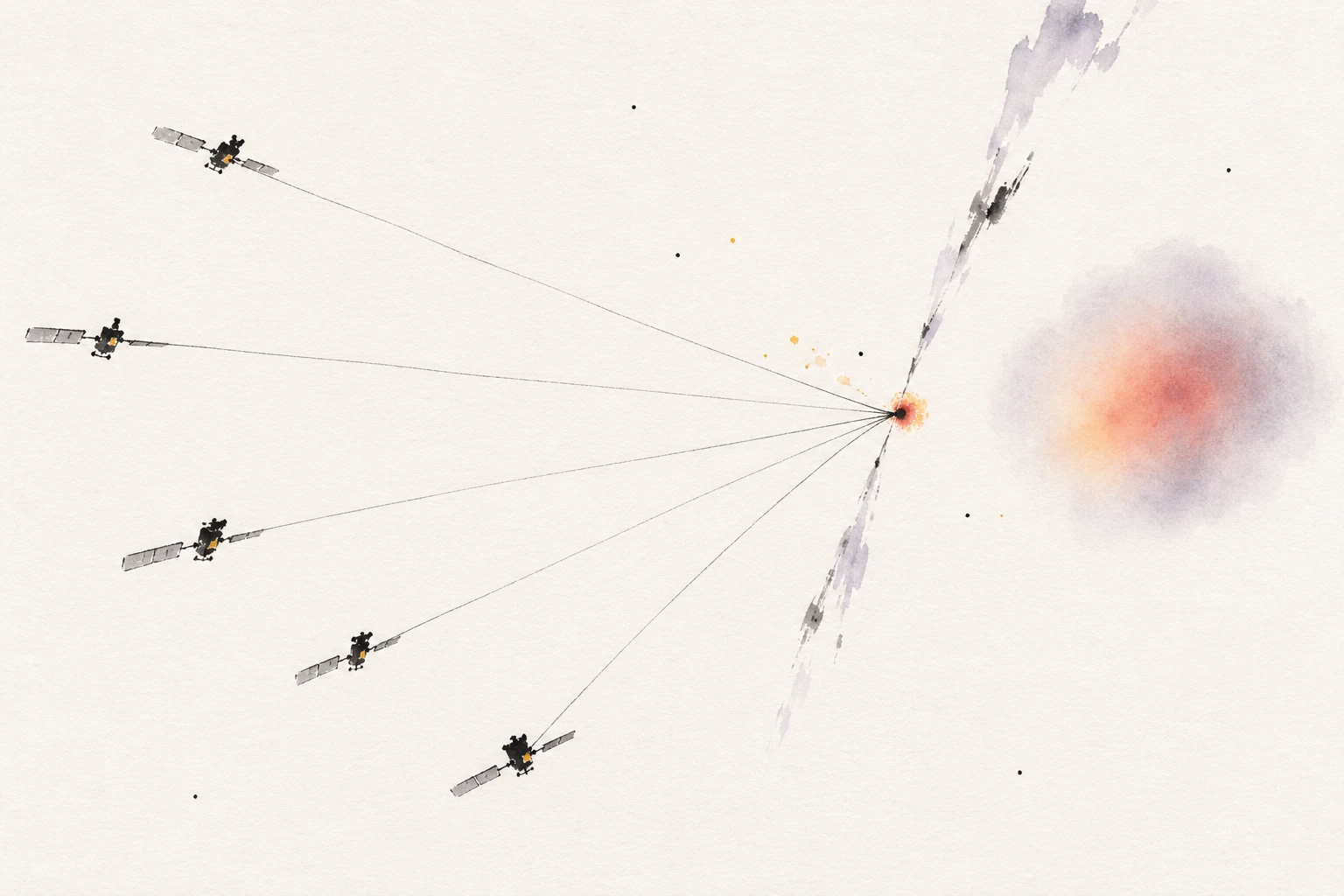
The concept is called the Accretion Explorer Interferometer (AEI). It comes from a NASA Innovative Advanced Concepts study. AEI would use seven satellites: one detector spacecraft and three pairs of collector spacecraft, with the collectors about 2 km in front of the detector. Each pair would form an interferometer baseline. An interferometer combines separated light paths to sharpen resolution. The current baselines are 21.6 m, 157 m, and 279 m. Grazing-angle mirrors would catch X-rays and direct them to a combiner optic on the detector satellite, where the wavefronts would interfere. The design targets three energy bands around 0.7–1.2, 1.5–2.5, and 6–7 keV. Its field of view is about 400 microarcseconds.
The potential payoff is a jump of five to six orders of magnitude in angular resolution. That is up to a million times finer than current X-ray images.
Four targets for a sharper X-ray eye
The paper organizes the case around four science areas. The first is the central engine of an active galactic nucleus (AGN), the bright feeding black hole at a galaxy's center. Even for a nearby AGN, the accretion disk can be only about 50 microarcseconds across. That is far too small for Chandra or proposed X-ray successors to image. The X-ray-emitting corona, a cloud of billion-degree electrons, sits within a few tens of gravitational radii of the black hole. A gravitational radius is a mass-based distance scale around the black hole. For a 100-million-solar-mass black hole, one gravitational radius is about 300 million kilometers. Astronomers infer the corona's shape from spectra, timing, and polarization. They cannot see it directly. AEI could distinguish a compact corona from one spread above and below the disk. It could compare disk, continuum, and wind emission and image the iron K-alpha line at 6.4 keV, a fingerprint of reprocessed X-rays.
The second area is gravitational-wave territory. The paper notes that only one close supermassive black hole binary has been robustly confirmed so far. That pair is about 7 parsecs apart. At smaller separations, systems are expected to spiral together and eventually emit gravitational waves. AEI could resolve milliparsec-scale pairs. It might also image the accretion flows behind quasi-periodic eruptions (QPEs), hour-scale X-ray bursts more than ten of which are now known. Their origin is debated. Models include disk instabilities and extreme mass ratio inspirals. Direct imaging could complement LISA, the planned space gravitational-wave observatory, though the paper cautions that LISA's sky localization may be poor and its lead times short.
The third area is stellar activity. Beyond the Sun, the coronae of other stars remain unresolved point sources. AEI could isolate flare footprints on nearby M dwarfs, map active regions, and measure how high-energy radiation varies across a planet-hosting star's surface. That matters for habitability. Flares and coronal mass ejections can erode atmospheres or drive prebiotic chemistry. The paper gives Proxima Centauri as a target and stresses that its simulated flare image is illustrative, not an observation.
The fourth area is relativistic jets. How black holes launch these jets remains unsettled. Competing ideas extract energy from the black hole's spin, from the accretion disk, or through magnetic reconnection in the ergosphere, a region near the spinning black hole where spacetime is dragged around. AEI could image the jet-launching region at scales of about 1 microarcsecond. For M87 and Sagittarius A*, one gravitational radius subtends only 3.8 and 5.0 microarcseconds, respectively. That is the scale where the jet base and corona meet.
The X-ray count problem sets the real limit
The science traceability matrix distills the requirements to two essentials. The first is angular resolution of 0.1–1 microarcsecond. The second is sensitivity around 10^-15 erg per square centimeter per second or better. Those numbers come with a large caveat. No X-ray image exists at these scales, so the team had to scale from larger-scale fluxes. They call the linear scaling a significant oversimplification. They treat the sensitivities as lower limits, and the true requirement could be orders of magnitude higher. Faint, extended targets would need days to weeks of exposure.
The mission design has practical hurdles too. The observatory must avoid the Sun. The paper describes a solar exclusion angle of about plus or minus 20 degrees from the ecliptic plane. Propellant limits may cap the mission lifetime near two years, short of the five-year goal. Scheduling would be strict. Each six-month block would be devoted to one quadrant of the sky, and primary mission targets must be selected before launch.
This is a concept study, not a discovery paper. The authors created no new data. They do not claim AEI is an approved or guaranteed mission. They are mapping the discovery space and the uncertainties that future work must address. Those include better models of how X-ray emission is distributed at tiny scales, a larger sample of binary black hole candidates, and new computational tools for ray-tracing X-rays around black holes.
Still, the paper makes the scientific case vivid. For decades, the highest-energy universe has been studied through blurry pixels, with the smallest structures inferred rather than seen. AEI's goal is to turn that inference into an image. It could resolve the corona around a black hole, the flare on a nearby star, or the root of a jet. The question is no longer only what such an image would show. It is whether X-rays can be gathered in enough numbers to make it sharp.