
A Black Hole’s Disk Cast a Shadow at 10–20 Percent of Its Eddington Limit
Observations of MAXI J0637−430 suggest its inner disk puffed up and shielded the outer disk at roughly 10–20% of the Eddington luminosity, with implications for black hole spin, X-ray polarization and disk winds.
Nov 13, 2026
On November 2, 2019, an all-sky X-ray monitor caught a new transient. The source, MAXI J0637−430, was classified as a black hole pulling gas from a low-mass companion star in an X-ray binary. A transient is a sudden, temporary brightening. It was already in the disk-dominated soft state, when the accretion disk dominates the X-ray light. Over the next six months, Swift and NICER tracked the X-ray decay, while the VLT/X-shooter spectrograph on the Very Large Telescope recorded optical and near-infrared spectra at three moments. The combination would reveal a disk that behaved in the opposite way to the simple expectation.
When the outer disk cooled as the source faded
Black hole X-ray binaries are natural laboratories for accretion. Gas spirals inward and forms a disk. The inner disk glows in X-rays. The outer disk emits optical and infrared light. The Eddington luminosity is the point where outward radiation pressure would balance the inward pull of gravity. Classical thin-disk theory says the inner disk should stay geometrically thin until luminosity approaches that limit and then puff up. The threshold and its observable signs have been uncertain.
At the outburst peak, about 0.2 L_Edd, VLT/X-shooter recorded strong double-peaked recombination lines of hydrogen and neutral helium. These lines are light emitted when electrons rejoin atoms. The paper treats them as emission from a relatively cool, weakly irradiated outer disk. Two and four weeks later, when X-rays had fallen below about 0.1 L_Edd, those lines had almost vanished. The spectrum instead showed weak, high-excitation emission from ionized helium. That indicated a hotter, strongly irradiated disk.
The change cannot be blamed on a brighter continuum. The optical and near-infrared continuum dropped along with the X-rays. The spectra indicated stronger ionization at lower luminosity. That was the puzzle.
A thick inner disk in the X-ray reflection
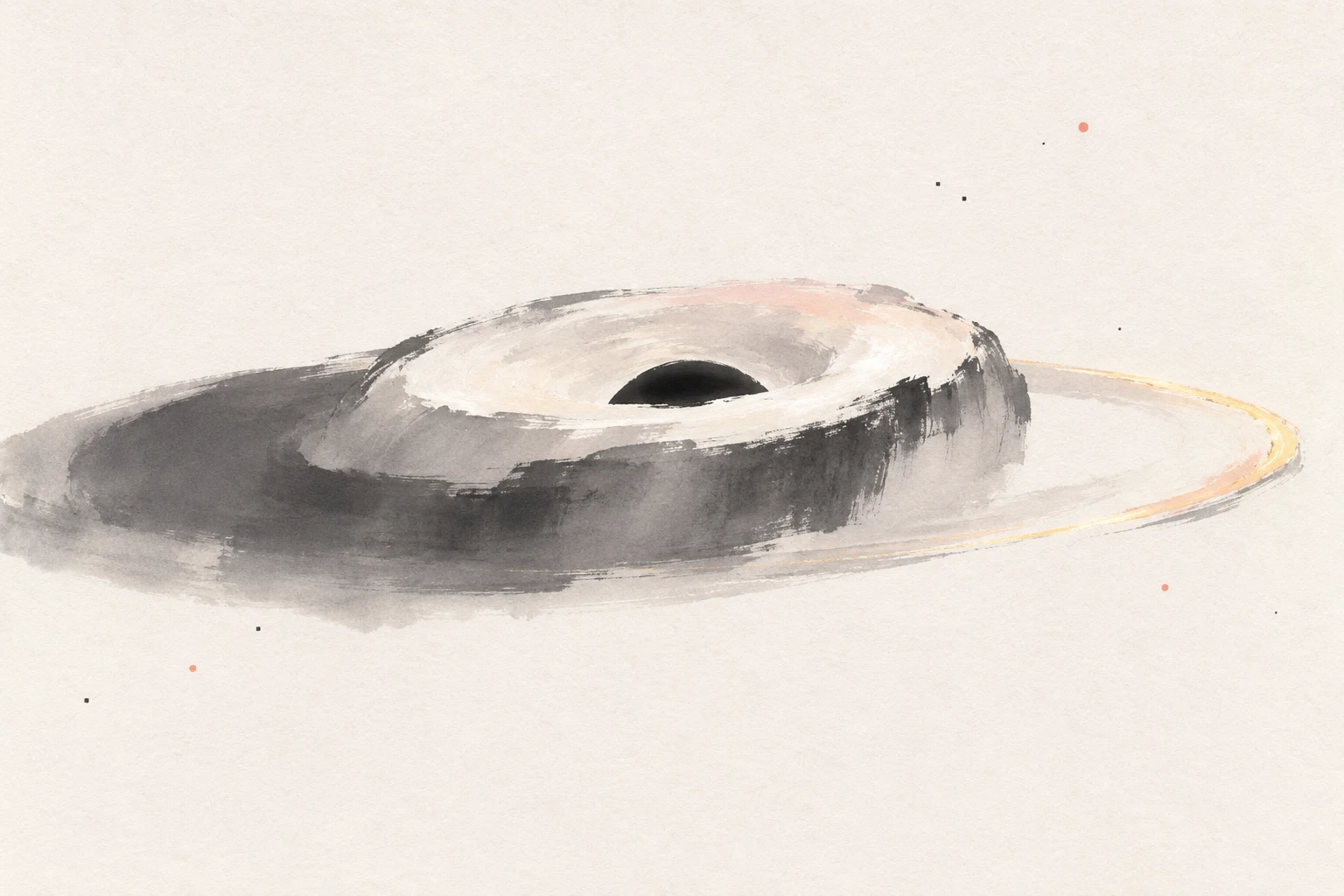
At the outburst peak, the paper argues, the inner disk was not a flat sheet. It was vertically extended, or puffed up, and thick enough to cast a shadow over the outer disk. With less high-energy radiation reaching the outer disk, hydrogen and neutral helium could remain cool enough to emit the observed lines. In this scenario, radiation pressure eased as the black hole faded. The inner disk collapsed back toward a thin configuration and the outer disk was exposed. X-rays stripped electrons from the gas and suppressed the lines. At still lower luminosities, irradiation drops enough for lines to reappear, as commonly seen in quiescence.
Three broadband X-ray epochs, combining NuSTAR with NICER or Swift around the optical observations, support this geometry. Standard thin-disk plus corona models failed. The authors' preferred fit includes an extra reflection component. X-rays from the inner flow return to the disk and are reprocessed there. At the peak, this component was about 30% of the total X-ray flux. For a moderately spinning black hole, a razor-thin disk returns only about 10–15%. A funnel-like, geometrically thick inner disk can produce the higher fraction. The reflection contribution fell to about 18% and then about 4% as the outburst decayed. The way the disk’s temperature changes with radius also shifted from an index of about 0.58 toward the standard thin-disk value of 0.75. The authors caution that the X-ray fits are simplified.
A five-hour orbit and a low threshold
Classical theory expected such vertical structure near the Eddington limit, where radiation pressure becomes comparable to gravity. This source was at roughly 10–20% of that limit when the shadow appeared. The paper argues that self-shadowing can begin much earlier than often assumed.
Orbital period helps explain why. MAXI J0637−430 appears to have a period shorter than about five hours, so its accretion disk is compact. The outer disk is closer in and more homogeneous. That makes it sensitive to changes in illumination. In a longer-period system, the outer disk lies farther out and can keep emitting low-ionization lines even when the inner disk becomes ionized. The paper notes similar line behavior in MAXI J1803−298, about 7 hours, and a milder version in Swift J1727.8−1613, about 10.8 hours. The 16.5-hour MAXI J1820+070 retained strong lines through its soft state. That pattern suggests the effect may be common, but easiest to see in small disks.
Geometry matters beyond the optical spectrum. If the inner disk is thick, models that assume a thin disk can overestimate black hole spin. Thick disks can also raise X-ray polarization, with predictions up to five times higher than thin-disk values. That could help explain high polarization seen in some soft states. Self-shadowing may also preserve low-ionization gas in disk winds. That could make those outflows easier to detect in optical and infrared light. The authors say the implications stretch from Galactic X-ray binaries to active galactic nuclei.
MAXI J0637−430 is a single, unusual case. Its X-ray interpretation depends on spectral models with simplified assumptions. Inclination and spin are not known precisely. The authors say the X-ray results should be read qualitatively rather than as exact parameter values. Alternative explanations for the excess soft X-ray emission include the plunging region just inside the innermost stable circular orbit, where matter spirals into the black hole, an ionized outflow, warm Comptonization, where hot electrons boost soft X-rays, or a different shape for the hot corona around the black hole. Those ideas do not readily explain the optical and near-infrared line disappearance.
Direct comparison is also limited because few short-period black holes have optical spectroscopy during the disk-dominated state. The peak luminosity is inferred from the luminosity at which the source switched from the disk-dominated soft state to the hard state and from its distance. A lower distance would imply an even lower peak luminosity and make the self-shadowing scenario more extreme. More systems and more sophisticated reflection models will be needed to test it.
The authors interpret MAXI J0637−430 not as simply growing dimmer but as a disk whose own geometry changed and cast a shadow that they could read in both optical and X-ray light.