Spiral Arms Can Fool a Single Test. A New Study Shows Why Astronomers Need Several.
A study tests two kinematic diagnostics on toy models and TNG50 mock data, finds one is strongly orientation-dependent, and uses both to argue that NGC 3938 may host multiple spiral modes.
Oct 30, 2026
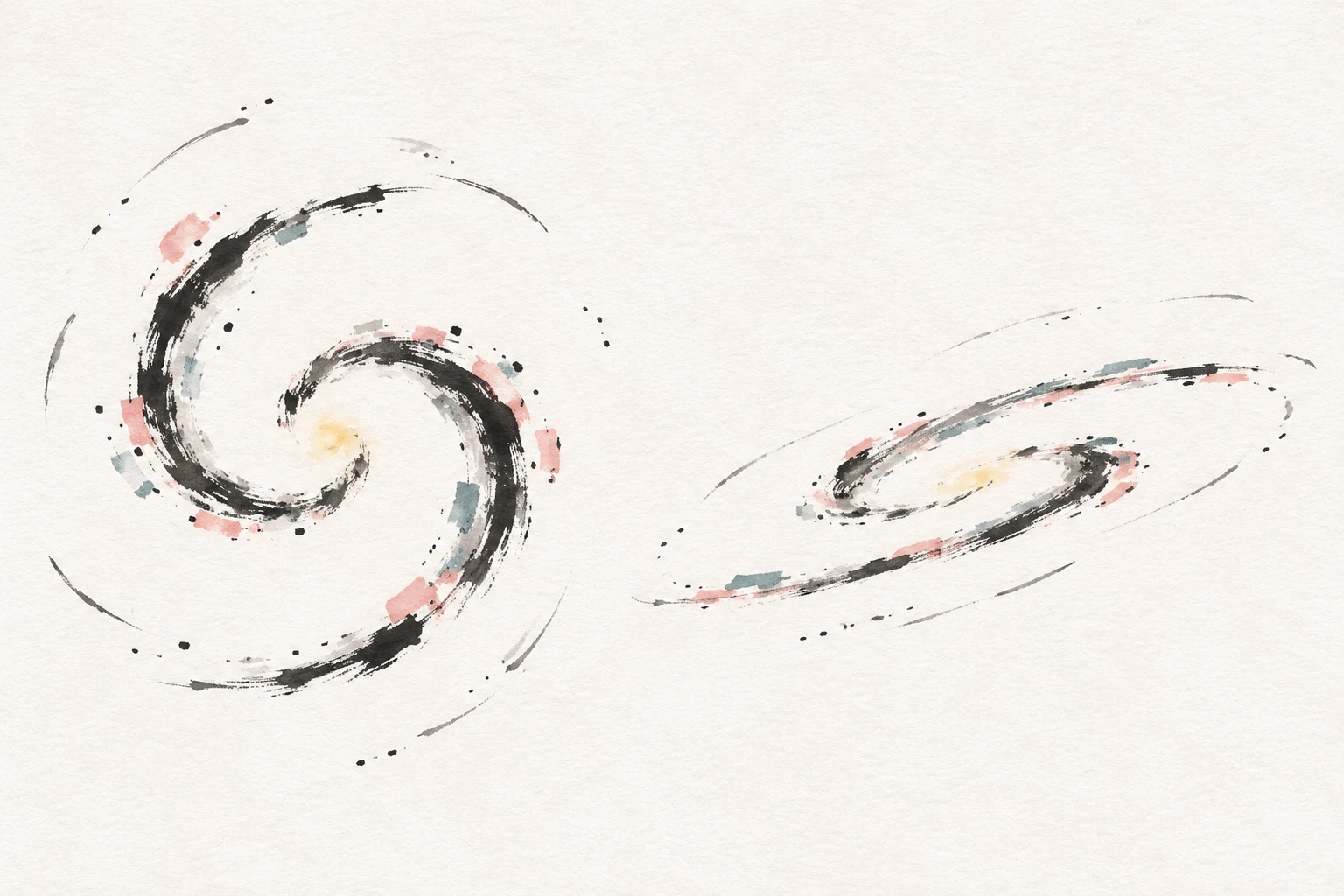
A spiral galaxy is easy to recognize and hard to explain. Its arms are bright in gas and star-formation tracers, yet they may not be permanent material structures. They could be a density wave sweeping through the disc, a kinematic pattern induced by a passing companion, a short-lived dynamic feature that shears with the disc, or a series of recurrent modes that grow and fade. The pinwheel is visible. The mechanism is not.
That ambiguity is the subject of a study by Valeria S. Kostiuk and colleagues. The team tested two ways astronomers infer spiral-arm nature from a galaxy's velocity field, the map of gas moving toward and away from the observer. Their conclusion is a warning as much as a result. One popular test can mislead, and reliable classification requires several independent checks.
Most massive disc galaxies in the nearby universe have prominent spiral arms, and spirals are common at high redshift at least up to redshift z of about 2 to 3. If arms are long-lived, some process must maintain them over several rotations. If they are transient, the visible pattern may be continually rebuilt. The corotation radius is a key marker. It is the radius where the spiral pattern's rotation speed, its pattern speed, matches the disc's own angular speed. In density-wave theory, a quasi-stationary wave should have a well-defined corotation radius. In other scenarios, the pattern speed can vary with radius or equal the disc's speed. Dynamic spirals rotate with the disc itself. Kinematic spirals can be induced by a companion's gravity.
The Phase-Reversal Peak Can Move With Viewing Angle
The first method, phase reversal, looks for places in the residual velocity map where gas motions change sign along a radius. Residual velocity is what remains after subtracting the average rotating-disc motion. A peak in the distribution of those sign changes is interpreted as a resonance. The second method, velocity harmonic dominance, decomposes the velocity field into Fourier components. These are wave patterns with different numbers of cycles around the disc. For a two-armed spiral, the method compares the first and third harmonics. A density wave should switch from first-harmonic dominance inside corotation to third-harmonic dominance outside. Kinematic and dynamic spirals leave different signatures.
The team did not rely on observations alone. They built simple synthetic galaxies, or toy models, representing density-wave, kinematic, and dynamic spirals. They also generated mock H-alpha observations from galaxies in TNG50, a large cosmological simulation. H-alpha is a hydrogen emission line from ionized gas. The mock data mimicked the resolution and noise expected from the scanning Fabry-Perot instrument on the 6-meter BTA telescope. For barred models the authors could compare the method's answer with true resonance locations from the simulation. For spirals the exact scenario could not be settled independently in TNG50, and the toy models supplied the controlled cases.
The phase-reversal method could fail in a revealing way. For barred galaxies, it gave reliable corotation estimates only when the bar was aligned with the disc's projected minor axis. At other orientations, peaks shifted or vanished, even when the true rotation curve was used. For spirals, the histograms could show prominent peaks for a kinematic-spiral toy model that has no corotation radius by construction. The authors conclude that phase reversal should be used in tandem with another kinematic test, not as a standalone classifier.
Harmonic Dominance Works in Toy Spirals but Not All TNG50 Models
Velocity harmonic dominance held up better. In toy models, it separated the three scenarios. Density waves showed a change in harmonic dominance. Kinematic spirals showed first-harmonic dominance across the disc. Dynamic spirals showed nearly equal first and third harmonics. The method remained sensitive to viewing angle, and vertical gas motions, meaning motions perpendicular to the disc, could contaminate the signal. Rotation-curve errors, by contrast, did not strongly distort the result.
Applying the methods to three TNG50 spiral galaxies produced a mixed picture. One model, id502995, looked consistent with a tidally induced kinematic spiral, and the simulation shows an interaction with a companion. Another, id500577, resembled a dynamic spiral. A third, id452978, did not fit any simple toy case and may host multiple co-existing modes. The authors stress that the identifications for id500577 and id452978 remain hypotheses because the methods cannot independently settle every simulated case. The tidally induced id502995 is the clearest exception.
NGC 3938 Shows Three Candidate Corotation Radii
The observed galaxy NGC 3938 serves as an illustrative test. Using H-alpha velocity data, the phase-reversal method yielded three candidate corotation radii at about 25, 64, and 91 arcseconds. The two inner values agree with some independent measurements in the literature. The harmonic analysis ruled out a single density wave, a single kinematic spiral, and a purely dynamic pattern. It did not identify a specific scenario by itself. Three harmonic crossings near the phase-reversal peaks, plus an overlap of resonances, point toward multiple spiral modes. The paper reports that the outer Lindblad resonance of one candidate mode aligns with an ultraharmonic resonance of the next, and another ultraharmonic resonance aligns with the third corotation radius. This interpretation is consistent with the recurrent-modes scenario, but it is built from indirect evidence and needs further verification.
NGC 3938 is nearly face-on, at an inclination of about 10 degrees. That geometry lets vertical motions leak into line-of-sight velocities. The galaxy shows no clear sign of interaction, which helps, but the mode interpretation is not direct proof. The TNG50 models also have limitations, including insufficient time resolution to extract the kind of pattern-speed histories available in some other simulations.
The practical result is a strategy rather than a final answer. Combine multiple independent tests. Use different corotation measurements, harmonic signatures, resonance overlaps, and morphological clues. Then apply that battery to a larger sample. The spiral arms may be one visible pattern, but their nature may be a conversation among several rhythms. Astronomers will need more than one way of listening.