
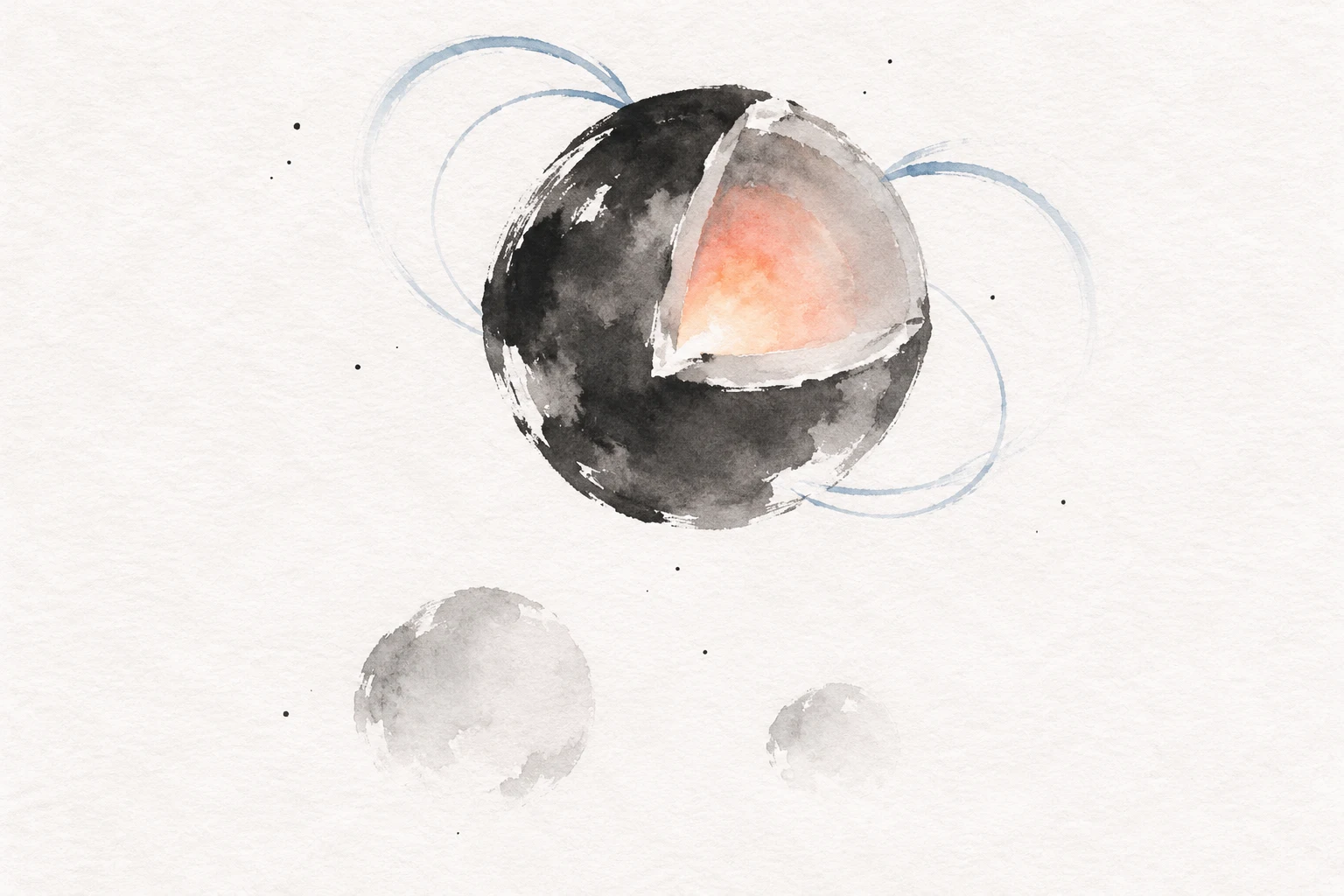
A Hot, Magnetized Strange Quark Star Could Reach 2.19 Suns in a New Model
A thermodynamically consistent quasiparticle model predicts that hot, spin-polarized strange quark matter could support a 2.19-solar-mass star at 50 MeV and 10^15 G, while stronger magnetic fields lower the maximum mass.
Oct 28, 2026
PSR J0952–0607 has an inferred mass of 2.35 ± 0.17 solar masses in the paper's discussion. The paper also names PSR J0740+6620 as an ultra-massive pulsar benchmark. Both put pressure on dense-matter models to explain how matter can resist gravity without collapsing to a black hole.
The new study asks whether the answer could be strange quark matter. Under the strange matter hypothesis, up, down, and strange quarks would be free rather than confined inside protons and neutrons. If that hypothesis holds, some compact stars could be strange quark stars. The study develops a theoretical model. It is not an observation.
The model predicts a maximum stable gravitational mass of up to 2.19 solar masses for hot, magnetized, spin-polarized strange quark matter. The result depends on the assumed temperature, magnetic field, and static spherical structure.
The Bag Constant Breathes With the Quark Medium
The mass of a compact star is a contest between gravity and pressure. In general relativity, pressure itself contributes to gravity. The equation of state, or the relationship between pressure and energy density, must be stiff enough to resist collapse. It must also remain causal, so the speed of sound does not exceed the speed of light.
In the standard bag model, quarks move freely inside a region bounded by a vacuum pressure called the bag constant. Earlier treatments often fixed that constant or adjusted it by hand. This paper makes it change with the medium.
The authors treat quarks as quasiparticles. These are excitations whose effective masses depend on the surrounding density, temperature, and magnetic field. The team couples the bag constant directly to the same medium-dependent reduction of quark masses. This coupling is meant to keep pressure, entropy, and particle number consistent with a single free-energy description.
The model also includes spin polarization. Quark spins are aligned rather than random, and all flavors are assumed to share the same polarization. It enforces local electric charge neutrality and weak beta equilibrium, a balance among quark and electron chemical potentials when neutrinos have escaped. The star is treated as static and spherically symmetric.
The paper reports a non-monotonic squared speed of sound. For the 50 MeV isotherm it describes a transient peak near the low-density activation threshold. At high density the sound-speed curves approach the conformal limit of one-third of the speed of light squared from below. The authors link this behavior and the moving bag constant to a stiffer high-density equation of state. They do not claim that the lower-density bump alone holds up the star.
Temperature Raises the Maximum Mass to 2.19 Suns
The authors integrate the Tolman–Oppenheimer–Volkoff equations. These are general relativity's equations for a static, spherical star. They start at the center and move outward until the pressure falls to zero.
At a baseline magnetic field of 10^15 G, the maximum stable mass rises with temperature. The paper reports 1.66 solar masses at 0 MeV, 1.87 at 30 MeV, and 2.19 at 50 MeV. The 2.19-solar-mass configuration has a radius of about 11.82 kilometers.
The authors compare this with a holographic Einstein–Maxwell–Dilaton model. That model reaches about 2.03 solar masses at 150 MeV. The quark model's 2.19-solar-mass case requires 50 MeV and a 10^15 G field.
Stronger Fields Shrink the Star, and Questions Remain
Strong magnetic fields are not a simple mass booster in this model. At 50 MeV, raising the field from 10^15 G to 5 × 10^18 G lowers the maximum mass to 1.57 solar masses and the radius to 8.50 kilometers. At 10^19 G, the maximum mass falls to 0.99 solar masses and the radius to 5.41 kilometers.
The paper points to the Maxwell energy-density term, proportional to B squared over 8 pi, as the driver of this drop. The 2.19-solar-mass result therefore depends on a field near 10^15 G, not on an arbitrarily strong field.
This is a theoretical prediction, not evidence that strange quark stars exist. The calculation uses fixed-temperature isotherms, equal spin polarization for all flavors, strict local charge neutrality, beta equilibrium with escaped neutrinos, and a static spherically symmetric star. It does not include rotation, a crust, a full magnetic-field geometry, or a fit to pulsar data. The work has not completed peer review.
The paper argues that the magnetized quark model reaches heavy masses at lower temperatures than the holographic comparison. It does not show that a 50 MeV interior persists in real compact objects.
The authors also suggest that a thermalized, magnetized strange quark star could be a candidate for the secondary object in the GW190814 merger. They contrast it with an unusually light black hole. This is an implication of the model, not a conclusion drawn from the gravitational-wave data.
The study's core is a mechanism. A vacuum term changes with its surroundings. Quark masses shrink in dense matter. The sound-speed curve bends before approaching the conformal limit. Together they sketch a way for strange quark matter to be stiff enough for the heaviest pulsars under the model's assumptions. For now, the work leaves a testable theoretical question. How much weight can a star made of quarks carry before gravity wins?