
Pandora's Prime Targets: How to Tell a Planet's Atmosphere from Its Star's Spots
A new study describes how NASA's Pandora SmallSat selected 20 exoplanets around 19 K and M dwarf stars for repeated transit observations meant to separate planetary atmospheric signals from stellar contamination.
Oct 22, 2026
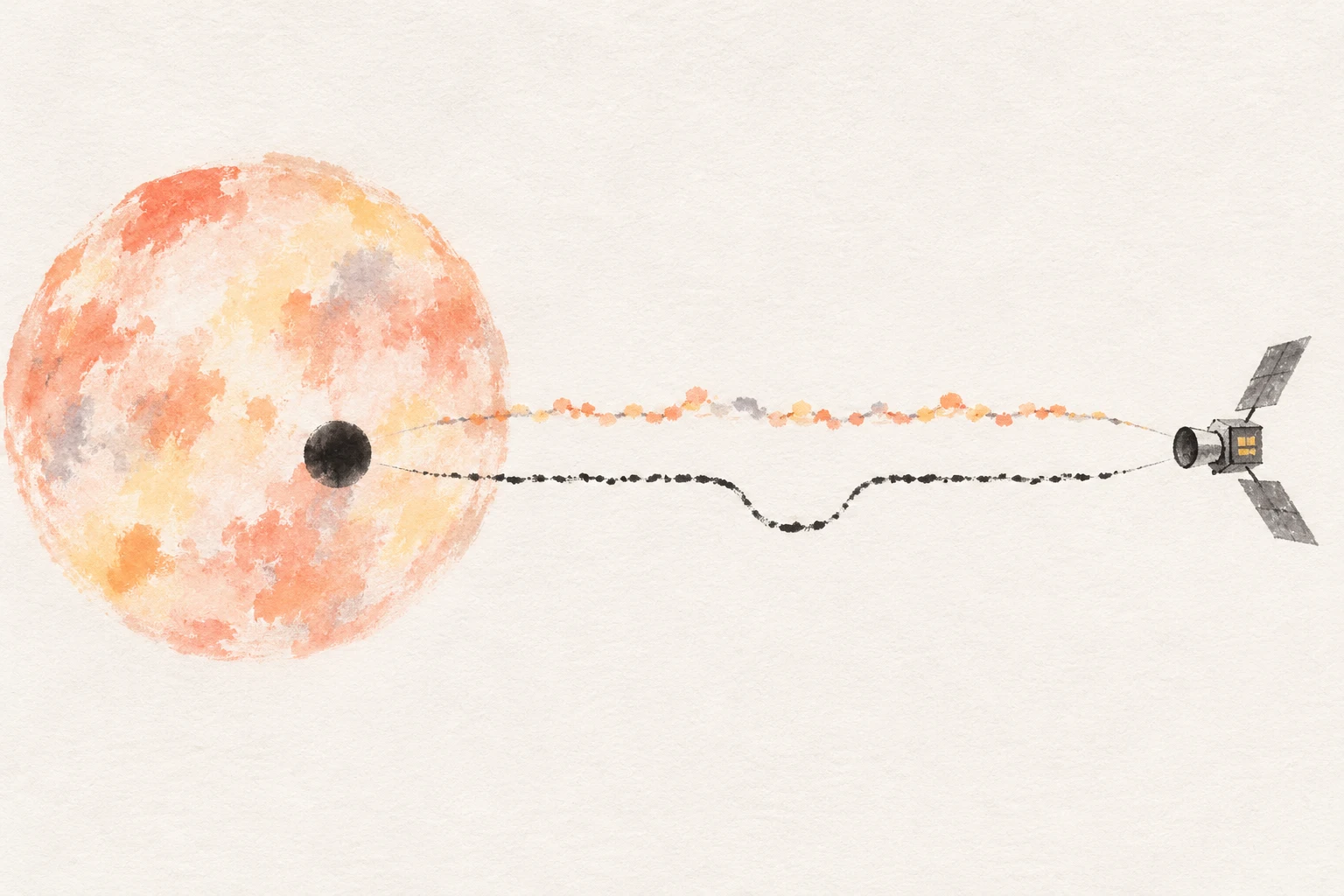
When a planet crosses the face of a small, cool star, a thin ring of its atmosphere is backlit by starlight. Gases in that ring absorb specific wavelengths. The resulting dips can reveal water, carbon dioxide or methane. This is transmission spectroscopy, a way to read a planet's atmosphere from the colors of light that pass through it during a transit.
The star can confuse the reading. Cool spots and bright patches called faculae can mimic or mask the molecules astronomers seek. NASA's Pandora SmallSat was designed to address that contamination. In a study, Emily A. Gilbert and colleagues describe the prime mission target list and the planning behind it. Pandora was selected in NASA's inaugural Astrophysics Pioneers class in 2021. It launched on Jan. 11, 2026, on a Falcon 9 into a Sun-synchronous low-Earth orbit.
Twenty planets, nineteen host stars
The prime mission calls for 20 confirmed exoplanets orbiting 19 K and M dwarf hosts. The team started with confirmed planets in the NASA Exoplanet Archive and filtered for host stars cooler than 5,300 K, orbital periods under 18 days, and hosts bright enough for Pandora but not so bright that they saturate its detector. It then used the Transmission Spectroscopy Metric, a feasibility score that weighs planet size and mass, stellar radius and brightness, and planet temperature. A second score, described below, helped rank the candidates.
The team drew a line at 1.9 Earth radii to separate roughly rocky worlds from larger gaseous ones. It picked the top 10 planets by score on each side of that line. The result is 20 planets around 19 stars because one star, TOI-942, hosts two targets. The planets range from 1.5 to 15 Earth radii, with orbital periods from 1.7 to 11.5 days. The team also kept 20 secondary targets as backups. Each prime target is planned for 10 transit observations, each spanning 24 hours and including baseline monitoring.
A second score for stellar contamination
Low-mass stars are attractive targets because a planet blocks a larger fraction of a small star's light, making the atmospheric signal proportionally stronger. JWST has therefore focused on planets around low-mass stars such as M dwarfs. JWST has shown that carbon-bearing molecules are common in some exoplanet atmospheres. But low-mass stars are also magnetically active. Cool spots can be cool enough for water vapor to form, so a water signal during a transit can be hard to trace to the planet rather than the star. Early JWST results have run into this interpretation problem.
Pandora's plan is to observe visible light and near-infrared light, just beyond the red end of the visible spectrum, at the same time. Visible-light photometry measures the star's changing brightness. Near-infrared spectroscopy looks for the planet's atmospheric fingerprint. The simultaneous view is meant to let astronomers model the stellar contamination and separate it from the planetary signal.
The team added the Signal Detectability Metric to prioritize targets with stellar variability in mind. It builds on the Transmission Spectroscopy Metric and uses TESS observations of each star's rotational brightness changes. In the paper's formula, a star with 1% peak-to-peak variability can double its score. The metric can favor stars with larger brightness swings, making stellar contamination a central test for Pandora rather than a nuisance to avoid.
A calendar, an auxiliary program, and a caveat
Pandora's near-infrared channel spreads starlight into a spectral trace on the detector. A nearby star can overlap that trace. The team simulated the overlaps with Gaia DR3 data on brightness and temperature and PHOENIX model spectra, then tested how the traces would move as the spacecraft rolled. Targets with significant overlap at the 1% level across more than half of possible spacecraft rolls were dropped. So were binary systems on the top-40 list. The paper says the choice simplifies data analysis for a low-cost mission and reduces the risk that a subtle spectral change comes from subtracting a neighboring star.
The team also built visibility software that balances Sun, Earth and Moon keep-out angles, star-tracker pointing and solar power. The resulting calendar centers prime targets on their transits and fills remaining time with auxiliary science. In low-Earth orbit, Earth occultations and gaps between prime transits leave time for other work. The paper lists stellar flares and spots, young systems, transit timing variations, brown dwarf rotation and composition, exoplanet phase curves, and helium escape. Pandora can also observe Solar System occultations, monitor near-Earth objects, and follow up supernovae or gravitational-wave counterparts, which the team says will be useful with the Rubin Observatory's first light. Fast slews and flexible readout support those switches.
This study focuses on target selection, scheduling and planned auxiliary science. Its abstract mentions early science results, but the text reviewed does not present measured spectra or a new atmospheric detection. The selection metrics are feasibility scores, not guarantees. Stellar activity varies in space and time. The target list is current as of July 30, 2025, and some planet masses were estimated from mass-radius relationships or private communications. Extended mission science is possible but not assured. The performance of the simultaneous observations in orbit is not reported here.
Pandora's stated aim is to disentangle stellar activity from planetary transmission spectra. The prime list deliberately spans a range of stellar activity levels, so the mission can test that method where contamination matters.