
A Faint Arc Around VX Sagittarii Is Too Slow to Be a Bow Shock
A newly found parsec-scale H-alpha arc around VX Sagittarii is the largest known circumstellar shell around a red supergiant, pointing to externally ionized mass loss and disfavoring a super-AGB identity, though a Thorne–Żytkow object remains possible.
Oct 16, 2026
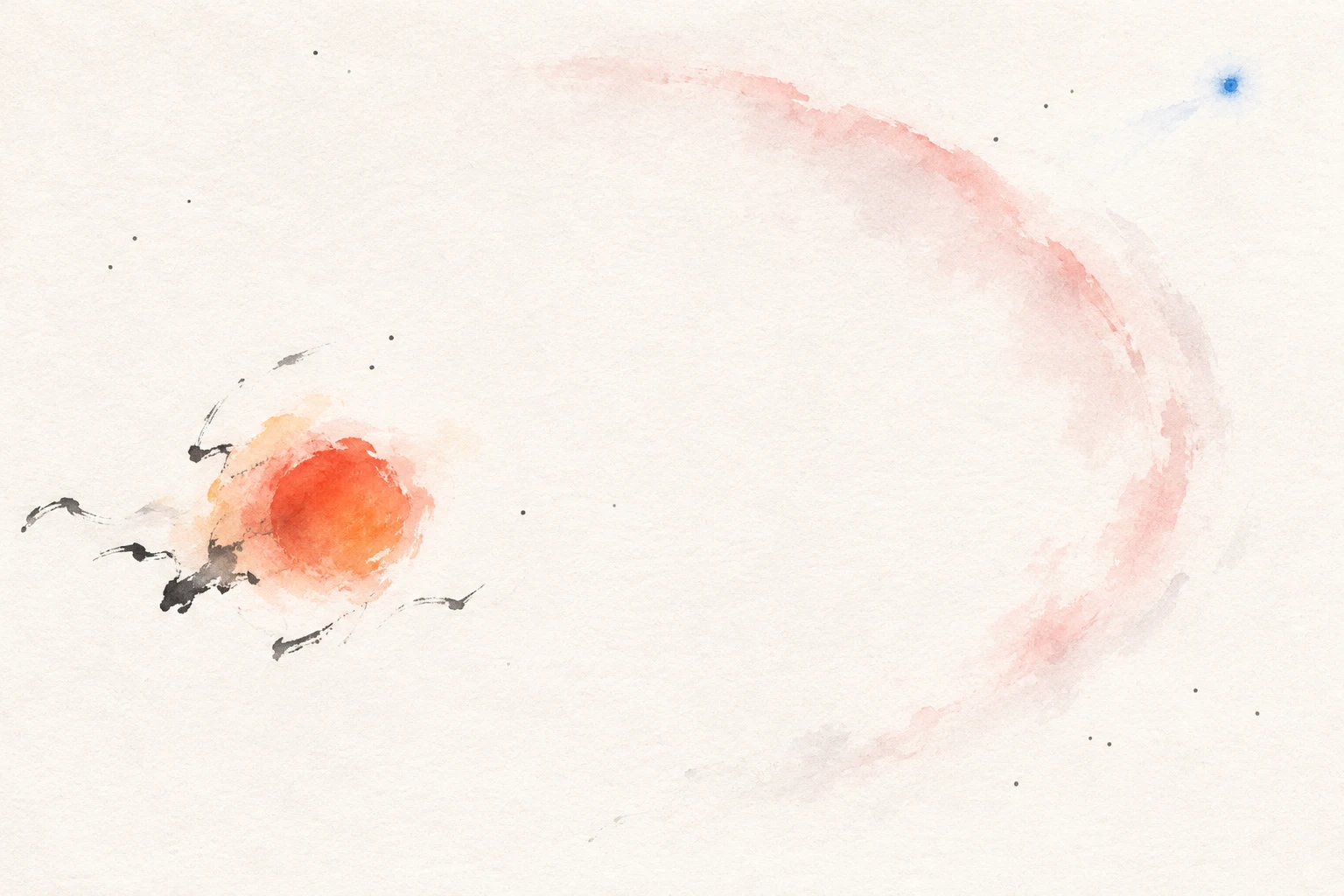
Somewhere in Sagittarius, the cool luminous star VX Sagittarii is shedding its outer layers. In H-alpha survey images, which record a red emission line from hydrogen gas, that lost material appears as a thin arc with a radius of about 0.59 parsec, or roughly 1.2 parsecs across. The study by Julian Shapiro of the University of California, Berkeley, reports the arc and asks what makes it glow. The answer is not the obvious one. VX Sagittarii is not moving fast enough through interstellar space to make the bright bow shock seen around stars such as Betelgeuse. The shell was most likely lit from outside by a hot neighbor.
A 0.59-parsec arc that is not a bow shock
VX Sagittarii has been watched for nearly a century. It is an extremely cool evolved star with temperature estimates between about 2,900 and 3,700 kelvin, and it pulsates irregularly. Its distance has been disputed. The study adopts a water-maser parallax of about 1.56 kiloparsecs, placing it near the young Sagittarius OB1 association. The H-alpha arc has an extinction-corrected surface brightness of about 38 rayleighs at its apex. A rayleigh is a unit of diffuse-light brightness. The ionized mass is near 0.1 solar masses. At radius 0.59 parsec it is the largest known circumstellar shell around a red supergiant.
Bow shocks form when a star moves swiftly through interstellar gas, much like a boat pushing water aside. Betelgeuse and μ Cephei have such shocks. VX Sagittarii’s peculiar velocity, its motion relative to expected Galactic drift, is only about 12 kilometers per second. Its motion points in a different direction from the arc’s symmetry axis. Bow shocks heat dust and produce far-infrared emission. The arc has none in archival far-infrared data. Those points argue against a bow shock.
HD 313822 can light the arc
The simplest picture is that the arc is steady red-supergiant wind or ejecta made visible by ionizing radiation from a hot neighbor. Shapiro identifies HD 313822, an O7–O7.5 giant about 1.5 kiloparsecs away, as a strong candidate. The star is aligned with the arc and can supply enough ultraviolet photons to keep the hydrogen ionized. The projected separation is at least 12.4 parsecs, so the exact geometry remains uncertain. The required ionizing flux is about 4.4×10⁷ photons per square centimeter per second. HD 313822 could deliver roughly 6×10⁸ at VX Sagittarii if the 12.4-parsec separation is used. That is larger than the required flux at that projected separation, but the lower-limit distance means the match is not a precise measurement.
Under the steady-wind assumption, a wind speed of 24.3 kilometers per second and a hydrogen density near 10.7 per cubic centimeter give a mass-loss rate of about 3.9×10⁻⁵ solar masses per year, or roughly 3×10⁻⁵ to 5×10⁻⁵. If the density is instead inferred from the arc’s shape, the estimate rises to about 1.3×10⁻⁴ solar masses per year. That is similar to recent dust-based estimates for VX Sagittarii and higher than an empirical red-supergiant mass-loss relation would predict. The number depends on assumptions, including the ratio of a nitrogen-ion line to H-alpha, the dust extinction, and especially the steady-wind picture. The arc could be a distinct ejection episode rather than a continuous wind. A spectrum could measure its velocity directly and help distinguish between those possibilities.
The super-AGB clock misses by millions of years
The shell also bears on a long-running identity question. VX Sagittarii has been classified as a red supergiant or hypergiant, a super-asymptotic-giant-branch star, or even a Thorne–Żytkow object. A super-AGB star here means a highly evolved star in the narrow mass range around 8 to 9.8 solar masses. Models for such stars between about 8 and 9.8 solar masses need 25 to 44 million years to reach that stage. The Sagittarius OB1 association is much younger. Its expansion age is about 7 million years, and a backtracking estimate is under 1 million years. Even allowing for rough ages, the super-AGB clock does not fit. That model is disfavored.
A Thorne–Żytkow object, a hypothetical star with a neutron star inside a red-supergiant envelope, is not ruled out. Some models overlap with ordinary red supergiants in mass and appearance. VX Sagittarii’s unusual rubidium absorption is hard to explain in a normal red supergiant and could be a clue. The rubidium is primarily circumstellar, however, and not all models produce it. Shapiro proposes a high-resolution spectrum of the arc to search for chemical fingerprints of rapid proton-capture processes, which could be preserved in ejected material.
The shell also offers a rough preview of the star’s future supernova. Shapiro estimates the ratio of shell mass to supernova ejecta mass. The ionized shell is about 0.1 solar masses, and neutral gas trapped by the photoionized layer may add a similar amount. With an assumed ejecta mass of about 15 solar masses, the ratio is about 0.02 to 0.04 after applying the paper’s half-shell scaling. At that ratio, the shell would probably not significantly alter the supernova’s forward shock. This is an order-of-magnitude forecast, not a hydrodynamic simulation.
The arc may belong to an emerging class of large, faint, externally photoionized shells around red supergiants. NML Cygni has a similar shell, though VX Sagittarii’s is about 2.1 times larger in diameter and fainter. Both stars sit near young associations whose hot stars could supply the ionizing light. For now the arc is a quiet record of mass lost long before the star’s final collapse. It is not a dramatic shock front or a confirmed exotic object. It is a thin curve of glowing hydrogen and, if follow-up spectra bear it out, a rare direct probe of how a massive star sheds its outer layers before going supernova.