Two Tiny Cameras Could Help Hera Track a Wobbling Asteroid Moon
Simulated navigation images from Hera's Milani and Juventas CubeSats could cut some spacecraft position uncertainties by up to a factor of 1,000 and improve estimates of key Didymos-Dimorphos parameters, especially if Dimorphos is tumbling.
Oct 14, 2026
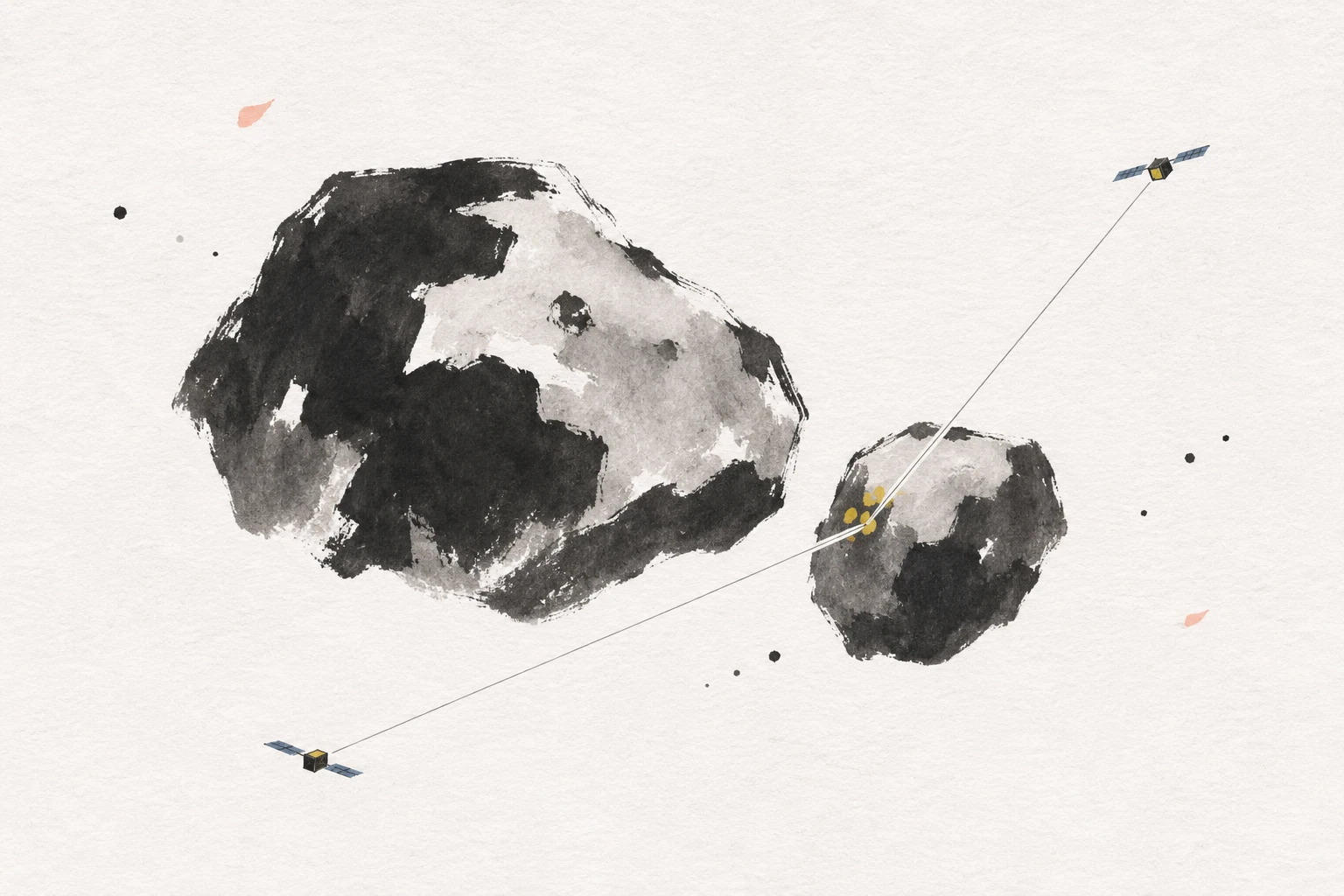
Some of the most valuable navigation images for the European Space Agency's Hera mission may not come from Hera itself. When the spacecraft reaches the Didymos binary asteroid system in late 2026, two small box-shaped CubeSats, Milani and Juventas, are designed to operate near the asteroids and photograph them. A study asks a practical question: what would those CubeSat images add to Hera's radio science, the experiment that reconstructs asteroid masses, spins, and orbits from spacecraft tracking and imaging?
The answer, in simulations, is a lot, with important limits.
Simulated CubeSat images tighten Hera's tracking
NASA's DART spacecraft struck Dimorphos, the smaller member of the Didymos pair, on September 26, 2022. The impact was the first asteroid deflection experiment and may have left the moonlet excited or tumbling. Hera's job is to survey the aftermath and help determine how efficiently the impact transferred momentum. That requires close spacecraft tracking to estimate the Didymos system's gravity and rotation.
Radio science uses tracking data to reconstruct a spacecraft's orbit and the gravity field acting on it. Hera's setup includes two-way Doppler and range measurements at X-band through its Earth link. It also uses a miniature inter-satellite radio link to the CubeSats, described in the paper as the first miniaturized satellite-to-satellite transceiver ever flown in deep space, and optical navigation images from Hera's Asteroid Framing Camera. The CubeSat NavCams add more optical navigation images, often called opnav.
Radio tracking and inter-satellite ranging can leave a scaling ambiguity in Hera's radial position relative to Didymos. Images from different vantage points add triangulation. The CubeSats can view the asteroids from additional angles. Their images add triangulation and help break a scaling ambiguity that otherwise blurs Hera's radial position.
The factor-of-1,000 gain is in spacecraft position
The team simulated images from both CubeSats and fed them into NASA-JPL's MONTE orbit-determination software. They used a covariance analysis, which forecasts how tightly a set of measurements can pin down parameters under stated assumptions. This is a forecast, not a measurement from Hera.
In the reference scenario, each CubeSat took one image every three hours, with two-pixel image noise and 0.13-degree pointing uncertainty. The images mostly targeted surface landmarks on Didymos and, when visible, the center of Dimorphos's visible disk. Adding them to Earth radio tracking, inter-satellite ranging, and Hera's own images improved the CubeSats' position knowledge dramatically. Milani's position uncertainty dropped by up to three orders of magnitude, a factor of 1,000. Juventas's dropped by up to one order. Juventas stayed at sub-meter position uncertainty through the simulated mission. Milani reached meter or sub-meter accuracy. Hera's own radial distance from Didymos improved by up to 80%.
Why such a large gain? The CubeSats view the asteroids from additional angles. Their images add triangulation and help break a scaling ambiguity that otherwise blurs Hera's radial position.
The science payoff is more nuanced. Estimates of the asteroids' gravitational masses improved by factors of roughly 1.1 to 1.4. The uncertainties in the principal moments of inertia, a measure of how mass is distributed inside a body, fell by about 10%. Those are useful gains, but not thousandfold ones.
A tumbling Dimorphos is where the images matter most
The bigger difference appears if Dimorphos is tumbling chaotically after DART. The paper models two post-impact possibilities: an excited but non-chaotic system, and a chaotic case with large, short-term wobbles. In the non-chaotic case, CubeSat images improved Dimorphos's orbital position by about 10% on average, peaking at 15%. In the chaotic case, they cut orbital uncertainty by up to 80% in the first month after release and by about 50% on average. For Dimorphos's spin, the improvement in one angular-velocity component reached up to 90%.
That matters because Hera scientists will not know the system's actual dynamical state until arrival. If the system is relatively calm, Hera's own images may already do much of the work. If Dimorphos is still reeling, the CubeSats' extra sightlines become essential for interpreting its motion.
The simulations also show what future mission planners should worry about. The dominant error source is pointing accuracy, or how well each CubeSat knows where its camera is aimed. Image noise matters less. In a best-case test with 0.01-degree pointing, hourly images, and 0.1-pixel noise, the gains grew substantially. Masses improved by factors of about 5 to 7, and principal moments of inertia by factors of about 4 to 11, compared with the no-CubeSat case.
Dedicated Dimorphos imaging could add more. If Milani photographs Dimorphos during close flybys, or Juventas slews its camera toward the moonlet, chaotic-case rotational and orbital estimates improve further, especially near the times of the images. Those pictures would also support surface geology, crater studies, and landing-site selection.
What the covariance forecast cannot settle
Several caveats keep this from being a final answer. The work uses simulated images, not actual CubeSat data. The reference cadence, noise, and pointing errors are assumptions. The chaotic-case analysis uses a local orbit-estimation approach with unconstrained priors at the start of each radio-science arc. The authors plan a more realistic constrained multi-arc analysis. The true state of Dimorphos after DART remains uncertain until Hera arrives.
Still, the result changes how the mission's small companions should be viewed. Milani and Juventas have technology goals, but the paper treats their images as science and navigation data. Their images could make Hera's radio science sharper, especially if the asteroid moon is wobbling.