
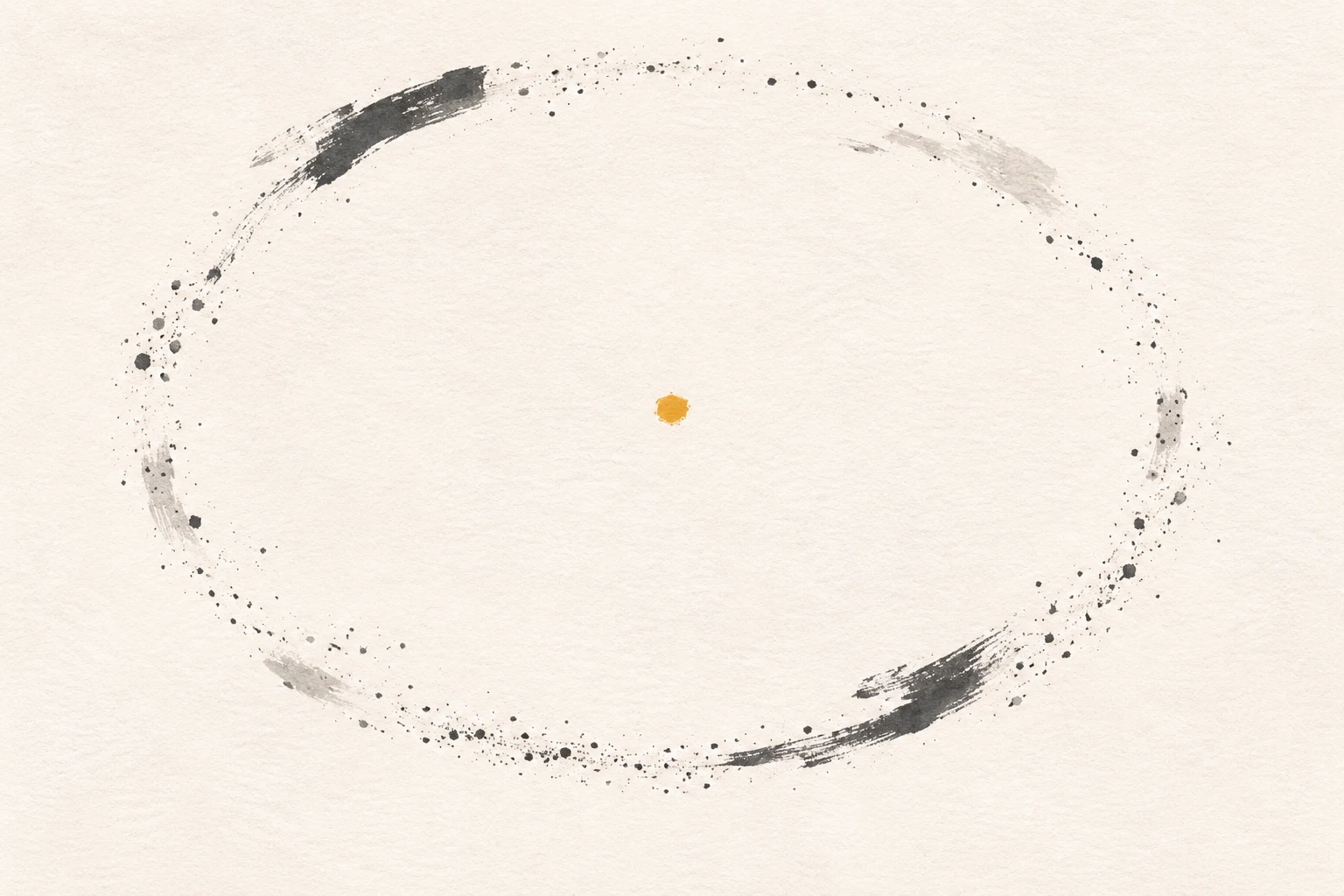
Epsilon Eridani's Outer Dust Belt Looks Nearly Circular — and That Narrows Where a Hidden Planet Could Be
A reanalysis of published ALMA millimeter image products puts 99.7% upper limits on epsilon Eridani's outer debris belt of 2.6% for forced eccentricity and 6.8% for proper eccentricity, the lowest millimeter-derived forced-eccentricity limit yet, while a 4-sigma hint is treated only as tentative.
Oct 2, 2026
The closest detected debris disk belongs to epsilon Eridani, a K2V star about 3.2 parsecs away, or roughly 10.5 light-years. The star is a young solar cousin with about 0.82 times the Sun's mass and an estimated age of 400 million to 1.2 billion years. Its outer belt appears at millimeter wavelengths as a narrow ring of cold dust centered near 70 astronomical units. One astronomical unit is the Earth-Sun distance, so the belt lies more than twice as far from its star as Neptune does from the Sun.
A new reanalysis uses published image products from the Atacama Large Millimeter/submillimeter Array, or ALMA, in Band 6 at 1.29 millimeters to ask whether that ring is lopsided. The observations were made in December 2019, with 4.7 hours on source split over a six-pointing mosaic because the disk is large on the sky. The team fitted synthetic ring images to the ALMA map and tested three descriptions: a circular ring, a ring with forced eccentricity, and a ring with proper eccentricity.
A near-circular belt in ALMA's 1.29-millimeter map
Eccentricity measures how much an orbit departs from a circle. For a debris belt, forced eccentricity is a shared, coherent offset, as if a planet had nudged the whole ring to one side. Proper eccentricity is the random scatter of individual orbits, which broadens the ring rather than shifting its center.
The circular model already described the ALMA map well. The forced-eccentricity fit returned a best value of 1.62% with an uncertainty of about 0.4 percentage points, a hint at the 4-sigma level. The team did not call that a detection. It adopted a conservative 99.7% upper limit of 2.6% for forced eccentricity, meaning 99.7% of the model samples lay below that value. The proper-eccentricity fit gave a 99.7% upper limit of 6.8%, looser partly because a slightly wider ring and a slightly eccentric ring can look similar at this resolution. The authors report 2.6% as the lowest millimeter-derived upper limit on forced eccentricity for any debris disk. For comparison, the paper cites well-studied eccentric rings including Fomalhaut, HD 202628, and HD 53143 with reported forced eccentricities around 12% to 21%, visible by eye in ALMA maps.
A four-sigma hint that stops short of a detection
The 1.62% signal is intriguing but tentative. A Bayesian information criterion comparison, which penalizes extra model complexity, gave only a mild preference for the forced-eccentricity model over a circular ring. It gave a clearer preference for the forced model over the proper-eccentricity model. The paper also tested a possible confounder. Two background galaxies appear in the ALMA image, and one lies within the disk's footprint. The preferred offset direction, about 125 degrees, pointed roughly toward that galaxy. When the team masked the galaxy and refitted the data, the eccentricity and direction stayed consistent. The authors suggest the alignment is coincidental, though a random alignment could not be ruled out.
The known planet can explain the hint, and another planet could still hide
Epsilon Eridani b has about Jupiter's mass and orbits at 3.53 au with an eccentricity of 0.06 ± 0.04, consistent with a near-circular orbit. The team calculated the secular timescale, the time for the planet's gradual gravitational nudges averaged over many orbits to reach the belt. The answer is about 292 million years, shorter than the system's minimum estimated age of 400 million years. If epsilon Eridani b has an eccentricity as high as 10%, it would force the belt to about 0.63% eccentricity. That is below the ALMA upper limit and within the tentative fit's distribution. The known planet alone can therefore account for the hint without requiring a second planet.
Even so, the paper combines the ALMA shape with Spitzer/IRAC, JWST/NIRCam F444W, and JWST/MIRI F2550W data, stellar-wind dust-drag models, and dynamical arguments to map where an additional planet could be. The allowed space extends at least from about 6 to 60 au in orbital distance and from about 2×10⁻⁴ to 0.3 Jupiter masses. That includes planet masses and orbits comparable to Neptune or Saturn. The upper mass bound comes mainly from JWST/NIRCam direct-imaging sensitivity, which measures how faint a planet JWST can see next to the star's glare. The lower bound comes from requiring a planet massive enough to perturb the belt over the system's lifetime. Sufficiently massive planets inside the belt's radial span would stir or scatter the ring, and a massive enough planet near the inner edge would carve a gap. No gap is obvious, though a gap narrower than about 5 au and half-empty could escape detection.
Earlier studies proposed epsilon Eridani c at roughly 42 or 53 au with about 0.2 Jupiter masses. The new analysis does not confirm that planet. Its broad allowed space also does not banish it. It narrows the terms of the debate.
The result is an upper limit, not a measurement of exactly zero eccentricity. The 4-sigma hint could be real or a statistical fluctuation. The planet constraints rely on simplified analytic dynamics, assume a massless disk in places, and depend on the system's uncertain age. A different age would shift the mass limits. The direct-imaging conversions assume planets orbit in the disk plane, and the stellar-wind clearing argument depends on the sizes of dust grains being dragged inward. Epsilon Eridani's outer belt is a quiet, nearly circular belt, not a strongly lopsided one. Its roundness makes the system's hidden architecture a sharper question, not a settled one.