
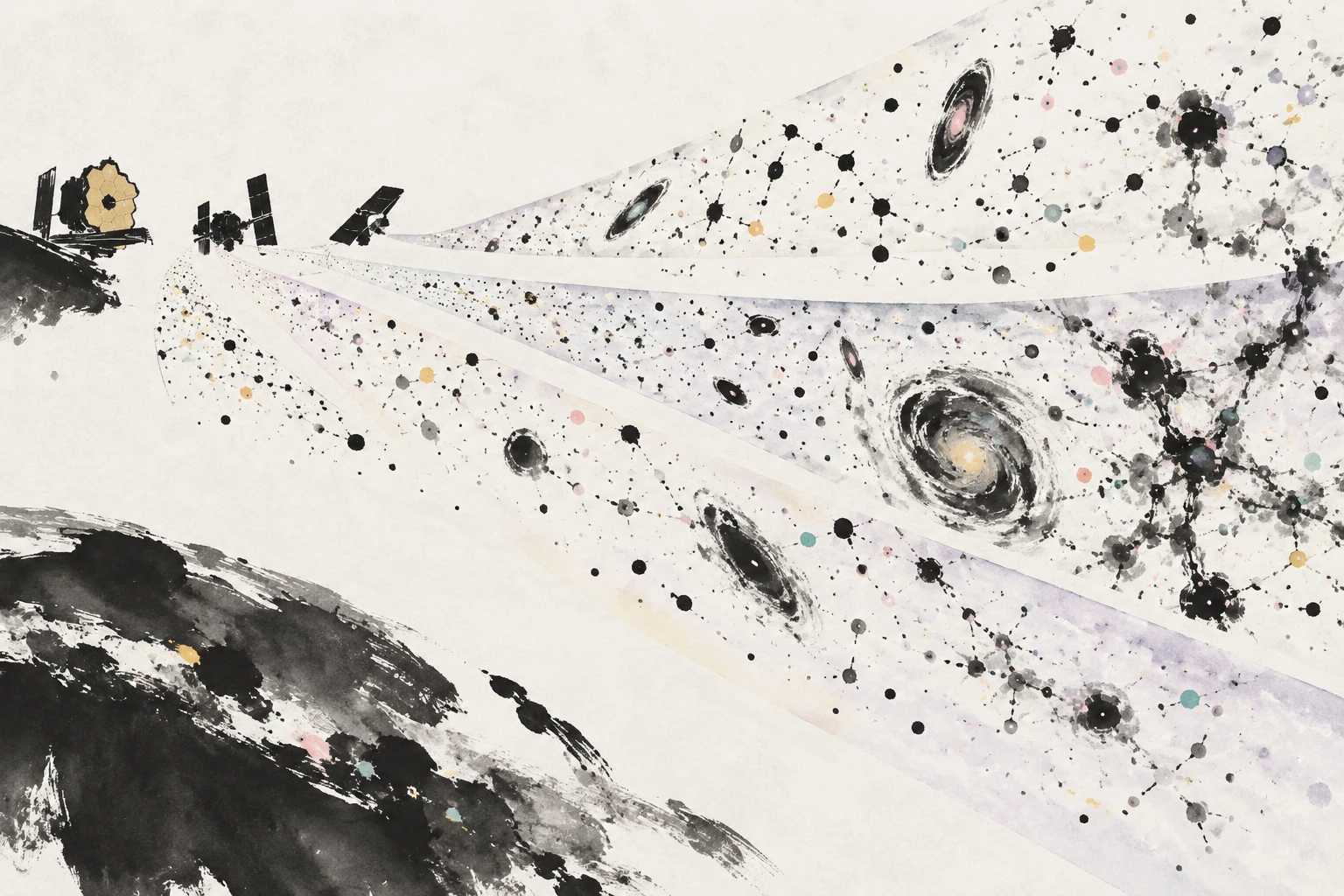
Can a Messy Spectrum of Everything Beat Cosmic Variance?
A new workshop report maps how wide-field slitless spectroscopy from Hubble, JWST, Euclid, and Roman could turn overlapping spectral traces into a statistical view of galaxy evolution, transients, and rare objects—if shared tools and benchmarks catch up.
Sep 19, 2026
Imagine pointing a telescope at a patch of sky and getting not a neat portrait of galaxies but a field crossed by hundreds of tiny rainbow smears. Each smear is a spectrum. A prism or grism has spread the light of every star, galaxy, and quasar across the detector at once. This is wide-field slitless spectroscopy, or WFSS—a technique that can turn a single pointing into a spectral survey.
That is the promise behind a new workshop report from the Space Telescope Science Institute. The report summarizes Surveying the Universe in 4D: Beating Cosmic Variance with Wide-Field Slitless Spectroscopy from HST, JWST, Euclid, Roman, and Beyond, held August 24–28, 2026. Rather than announce one discovery, it maps where the field stands, what simulations suggest is coming, and what must change to make the data useful. The work is an arXiv preprint and a community summary; many results it cites are still in preparation.
A spectrum for everything, and a puzzle for everything
The core problem is both simple and stubborn. Astronomers want to study rare objects—little red dots, dual active galactic nuclei, distant protoclusters—and they want to know whether galaxies evolve differently in dense environments than in the field. But any single patch of sky is a finite sample. Cosmic variance is the statistical uncertainty that comes from looking through one window on the universe: a small field may happen to contain an unusually rich cluster or an unusual void. Wide surveys reduce that risk by covering more volume.
WFSS attacks cosmic variance by observing without choosing targets in advance. Traditional spectroscopy points a slit or fiber at known objects. A slitless survey disperses everything in the field, so even objects that were not predicted to be interesting leave a detectable trace. That makes it sensitive to rare populations and to emission-line-selected samples that targeted surveys can miss. The trade-off is that the traces overlap. In crowded fields, one galaxy's spectrum can fall across another's, and an extended galaxy's own light can contaminate different parts of its spectrum.
From Hubble grisms to MIRI's new mid-infrared mode
The workshop report highlights three broad themes. First, WFSS is already changing how astronomers study galaxy evolution. From Hubble's grisms to JWST's NIRISS, NIRCam, and MIRI, it is delivering spatially resolved maps of star formation, dust, and chemical enrichment. Those maps show galaxies growing inside out, clumps with diluted metals that suggest fresh gas inflow, and quenching that can occur rapidly in some galaxies and environments. MIRI's wide-field slitless mode, formally offered to the community starting in JWST Cycle 5, extends this work into the mid-infrared, where warm molecular gas and dust features can reveal hidden activity.
Second, the survey era will be defined by synergy. Euclid and Roman will provide wide fields and huge samples; Rubin-LSST will monitor the sky for changing objects; JWST will supply depth and detailed follow-up; high-resolution integral-field spectrographs will anchor the physics. The report describes simulations for Roman's High-Latitude Time-Domain Survey that recover Type Ia supernova spectra as faint as 25th magnitude at redshift 1.1 in isolated cases. But when host galaxies and neighbors are included, contamination degrades the extraction. Accurate host subtraction is not a detail; it is essential.
Overlaps, pipelines, and the people who build them
Third, the bottleneck is no longer only telescope time. It is software, calibration, and people. Spectral overlap, crowded fields, and coming data volumes demand forward modeling—building a model of the whole scene and fitting it—and physics-informed machine learning. The report calls for shared benchmarks, science-ready data products, cloud-based analysis tools, and robust tests of reduction pipelines. It also makes a pointed community request: early-career researchers who build pipelines, write calibration code, and create public data products need proper recognition. Without that, the field risks duplicating work and underrewarding the people who make the science possible.
Caveats: forecasts, simulations, and one preprint
The caveats matter. This is a workshop summary and arXiv preprint, not a single peer-reviewed discovery paper. Forecasts for Euclid and Roman depend on assumed survey strategies, source populations, and calibration. Machine-learning methods must be tested against real data, not only simulations. And WFSS is a statistical and spatial complement to targeted spectroscopy.
Still, the direction is clear. The next generation of surveys will not just take pictures of the sky. It will spread the light of millions of objects into spectra, then try to untangle them. If the community can build the tools and the culture to handle that mess, cosmic variance may finally stop being the ceiling on what rare objects can teach us. The universe in 4D is not a slogan; it is a data challenge with a cosmos inside.