
In a Pulsating Galaxy Disk, Rotation Makes Small-Scale Instabilities Oscillate
A new theoretical study finds that in a pulsating galaxy disk, rotation changes whether small-scale instabilities grow steadily or oscillate, and faster spin widens the unstable range.
Sep 11, 2026
A disk that breathes
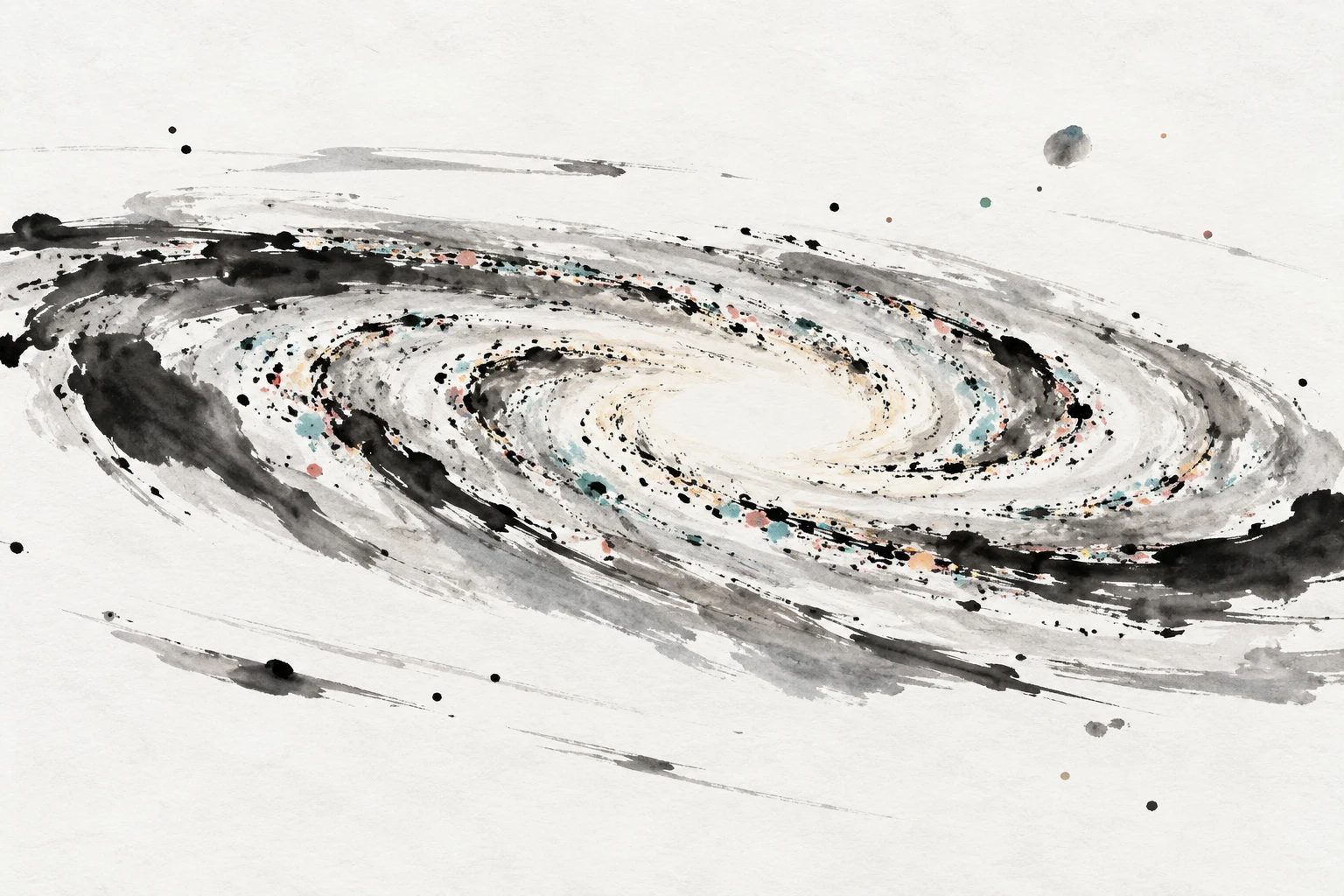
Galaxy disks are often drawn as stately pinwheels. But in their early, nonstationary stages, a self-gravitating disk can undergo global radial pulsations, with the whole disk expanding and contracting. A new preprint asks what happens to the smallest ripples in such a restless disk. Could they be related to open star clusters, molecular clouds, and other small-scale structures? The answer depends on rotation in a way that changes the character of the instability.
The smallest structures are the hardest to explain
Galactic disks contain structure on many scales: spiral arms, bars, and also smaller features. Gravitational instability is a leading explanation. A small overdensity pulls in more matter, becoming denser still. But earlier detailed studies of these particular small-scale instabilities often assumed the disk was in equilibrium, balanced and unchanging. Real disks, especially young ones, are not. They evolve, and global radial motions can be important. The paper by K. T. Mirtadjieva, J. M. Ganiev, and S. N. Nuritdinov, posted to arXiv, focuses on horizontal perturbations, ripples within the disk plane, during that early nonstationary stage.
Building a disk that breathes and spins
The authors use a nonlinear pulsating anisotropic model of a self-gravitating disk. Nonlinear here means the model treats finite-amplitude radial pulsations, parameterized by the pulsation amplitude. Anisotropic means the velocity spread of disk material is not the same in every direction. The model generalizes a classic equilibrium disk by letting the disk radius pulse in time. The team studied four small-scale modes: (m;N)=(12;20), (14;20), (16;20), and (18;20). Here m is the azimuthal wavenumber, roughly how many lobes or arms wrap around the disk, and N is the radial wavenumber, describing ripples from the center outward. High values of both mean small-scale structure.
For each mode, they derived a nonstationary analogue of the dispersion equation. A standard dispersion equation tells whether a wave grows or fades. The nonstationary version must track how that answer changes as the disk pulsates. Because the equations are integral equations, the team converted them into differential form and solved them numerically. They varied two key parameters: the dimensionless disk rotation parameter, which measures how much the disk rotates like a rigid body, and the pulsation amplitude. They then determined critical values of the initial virial ratio, 2T/|U|—twice the kinetic energy compared with the magnitude of the gravitational binding energy—that mark where unstable regions begin, with stable islands appearing in some rotating cases. They also calculated the instability increment, or growth rate.
Rotation silences one kind of instability
In a non-rotating disk, the model shows two flavors of instability. At some virial ratios, the mode grows aperiodically, a steady non-oscillatory runaway. At others, the instability is oscillatory, growing while it oscillates. That mix changes when the disk rotates. For all four modes studied, rotation leaves only the oscillatory instability. Rotation does not simply stabilize or destabilize the disk. It changes the physical character of how small-scale ripples fail.
Spinning up the disk widens the unstable zone
As the rotation parameter increases, the region of instability generally expands. That means a broader range of initial virial ratios can lead to growing small-scale perturbations. For a fixed radial wavenumber N=20, the instability region narrows as the azimuthal wavenumber m increases from 12 to 18. At high rotation rates, the first three modes develop one or more stable islands, small patches where the mode does not grow, while the (18;20) mode does not. In other words, the smallest-scale, most tightly wound patterns are less likely to find a safe harbor.
Not all ripples grow at the same speed
The growth rates add another twist. When the disk is non-rotating, and for rotation parameters up to about 0.6, the instability increment decreases as m increases: lower-m modes grow faster. But as rotation approaches its maximum, the (14;20) mode becomes dominant. The fastest-growing small-scale pattern can therefore shift with the disk spin. The authors also found that increasing rotation expands the range of critical initial virial ratios, and they determined characteristic timescales for the development of small-scale disk structures as functions of the model's main parameters.
Where the model stops and the galaxy begins
These results are theoretical. The model is an idealized self-gravitating disk with a prescribed radial pulsation and anisotropic velocities, not a full galaxy simulation. The virial ratio and rotation parameter are model inputs, not direct measurements of a specific galaxy. So the work does not claim to have observed the birth of open clusters or molecular clouds. Instead, it maps out conditions under which small-scale horizontal perturbations can grow during a disk's nonstationary early stage, and it shows that rotation matters not just for how much instability occurs but for what kind.
A beating disk's smallest fingerprints
The smallest structures in galaxy disks could be shaped by the disk's early, nonstationary state. If a young disk pulses radially while it spins, the competition between rotation, pulsation, and self-gravity could select which small-scale patterns grow, which oscillate, and which remain stable. The paper's message is that equilibrium pictures are not enough: to understand small-scale structure in a galactic disk, astronomers may need to watch the disk breathe.