
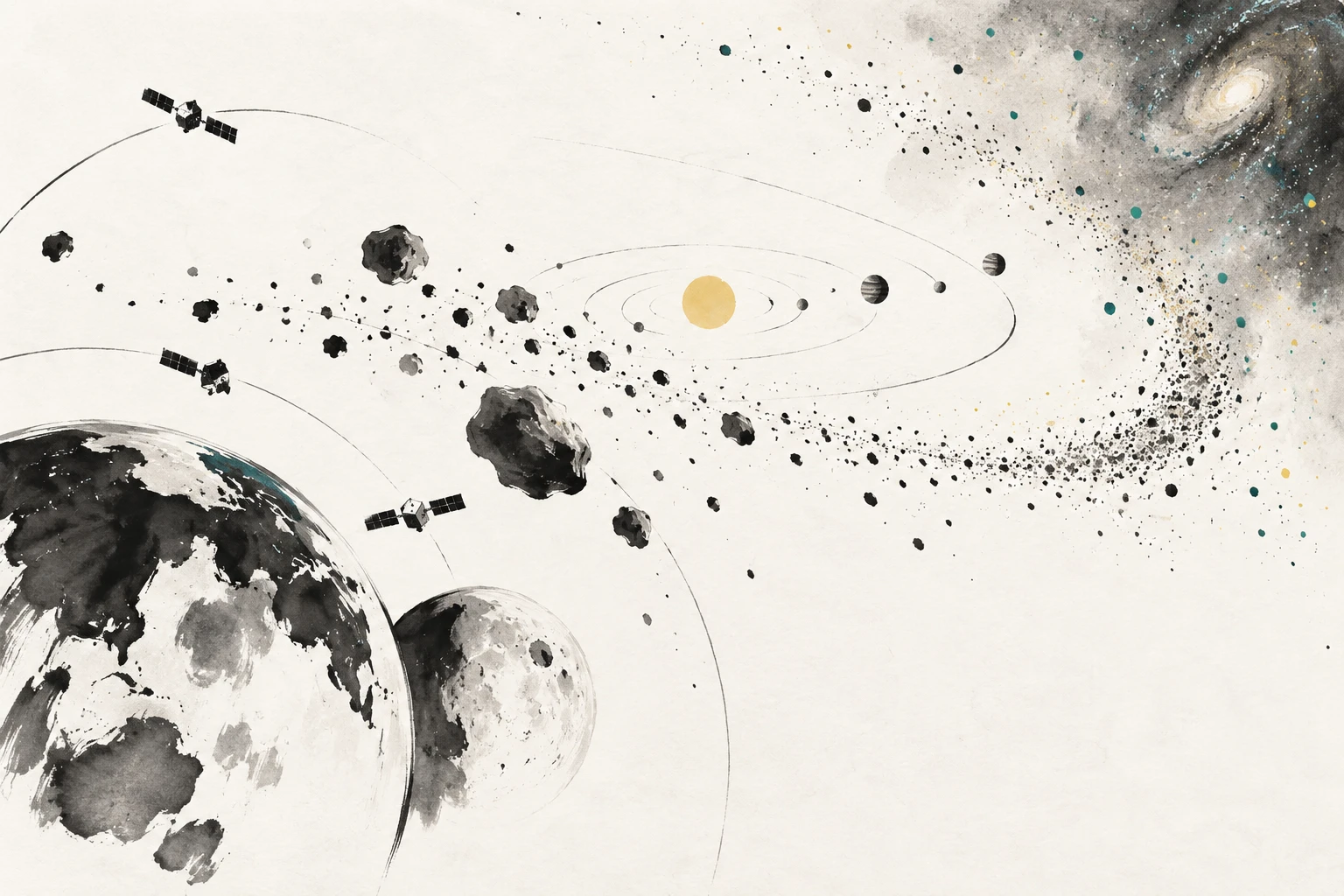
Can a Two-Layer Space Observatory Characterize Small Bodies From Cislunar Space to the Oort Cloud?
A new white paper proposes pairing a distributed cislunar telescope layer with a 4-meter Nautilus deep-search unit to characterize nearby natural objects and fading planetary-defense targets, and to test the largely unexplored Kuiper Belt-to-Oort Cloud transition.
Sep 9, 2026
Somewhere between Earth and the Moon, a meter-wide rock can move by several to more than ten arcseconds per second. Farther out, beyond Neptune, an icy world hundreds of kilometers across may sit undiscovered. Both are small bodies, but they are hard to observe for different reasons: nearby objects are faint and fast, while distant objects are faint and slow, requiring deep, repeated, motion-aware imaging.
A new white paper, posted as an arXiv preprint and part of the Nautilus Science Case Workshop series, explores whether a proposed space observatory architecture could tackle both problems at once. The paper, by J. de Wit and colleagues, is not a report of a new detection. It is a design study: a two-layer small-body program built around Nautilus, a proposed scalable space observatory architecture, plus a separate distributed network of small telescopes closer to Earth.
The Nearby Problem: Rocks We Rarely See Coming
An illustrative implementation of the local layer would use about five to eight 50-centimeter-class wide-field optical telescopes placed in complementary high-Earth and/or cislunar viewing geometries. Cislunar means the space around Earth and the Moon. From separated viewpoints, they would provide parallax and complementary Sun/Earth/Moon visibility, then combine rapid short exposures into motion-aware sequences to catch objects moving several to more than ten arcseconds per second, fast enough to trail in a single long exposure.
The paper's illustrative design case is sensitivity to a roughly 1-meter potential lunar impactor with about 6 to 12 hours of warning. That is not a universal hazard threshold. It is a demanding test for local lunar and low-lunar-orbit operations. The same system would also detect the much larger population of non-impacting or still-ambiguous objects, help distinguish lunar impactors, possible Earth impactors, temporarily captured objects, and non-impacting flybys, and monitor lunar impacts and ejecta.
The operational logic is not simply about counting objects. The paper argues that relevance depends on object size, encounter geometry, exposed infrastructure, warning time, and available response. Smaller, more frequent events may matter locally or in low lunar orbit. Larger, sufficiently energetic and favorably configured events could affect broader cislunar operations.
A Deep Search for the Objects That Fade Away
The second layer would be a single 4.0-meter Nautilus Quattro Imaging unit. Its job is to go faint. The paper targets shifted-and-stacked sensitivity reaching V around 30, below what routine ground-based surveys can recover. In shifted-and-stacked imaging, many short exposures are shifted along a suspected object's motion and added together, so the moving point adds coherently and grows brighter while background stars shift between frames and do not stack coherently.
One motivation comes from asteroid 2024 YR4. The paper cites JWST observations that reached V around 30.5, extended the object's observational arc by eight months, and resolved the 2032 lunar-impact question by ruling out an impact, roughly two years before ground-based recovery would have been possible. That success came from an observatory not designed for routine rapid-response moving-object follow-up. Nautilus would aim to make such recovery a dedicated, flexible target-of-opportunity mode.
The goal is not to find every object. It is to close orbits for ambiguous, fading cases that retain non-negligible impact probabilities. The paper estimates that a deep-recovery program might handle up to several targets per year if future discovery rates, self-recovery by survey facilities, follow-up performance, and triage create that workload. This is a planning range, not a measured cadence.
The Last Unexplored Frontier
At the other end of the Solar System, the deep layer could survey ecliptic and off-ecliptic fields to probe the transition from the Kuiper Belt to the Oort Cloud. The Kuiper Belt is the flattened disk of trans-Neptunian objects beyond Neptune. The Oort Cloud is a far more distant, more isotropic reservoir inferred from long-period comets. Only about 6,000 trans-Neptunian objects and Centaurs are cataloged. The paper contrasts the cataloged population with an inferred, much larger Kuiper Belt population and a modeled Oort Cloud reservoir with order 10^6 bodies at least about 100 kilometers across, yet no object has been detected in its native distant reservoir.
The region from roughly 100 to 1,000 au is essentially unsampled. One au is Earth's average distance from the Sun. The known object 2018 AG37, nicknamed FarFarOut, was discovered at about 132 au and marks a current frontier. For a representative geometric albedo (reflectivity) of 0.10, the paper's idealized photometric estimates suggest that V around 30 could reach a 100-kilometer object near 150 au, a Charon-size object near 500 au, and a Pluto-size object near 750 au.
Those numbers are sensitivity limits, not predictions of what is there. If a survey did detect the expected population, it could test whether the distant small-body population shifts from a flattened, planet-shaped disk toward a more isotropic reservoir. That transition would mark where planetary perturbations give way to Galactic tides and stellar encounters.
Design Study, Not a Detection
The paper is a white paper preprint. Nautilus is proposed, not built, and the two-layer architecture is a concept to be tested. The specific numbers in the paper are preliminary design drivers, not optimized mission requirements. The authors state that final requirements should come from end-to-end simulations of coverage, photometric yield, injection-recovery, linking, and orbit determination.
There are other caveats. The sensitivity estimates assume favorable geometry and representative albedos. Visible photometry alone cannot uniquely determine an object's diameter and albedo. The effects of lunar ejecta depend on the fragment distribution and on what infrastructure is exposed. The 2024 YR4 case is an observational demonstration from JWST; the Nautilus benefits are forecasts that depend on a future mission and on how discovery surveys evolve.
Still, the white paper sketches a coherent idea: the same moving-object skills needed to catch a rock passing near the Moon could be turned outward to find the Solar System's forgotten edge. If such an observatory is ever built, it would not merely add to a catalog. It would watch two frontiers at once: the increasingly busy space around Earth and the Moon, and the dim boundary where the Sun's planetary realm fades into the Galaxy's tide.