
A Companion Galaxy 28 Times Less Massive May Have Triggered a Star-Forming Clump
JWST observations of a galaxy pair at redshift 3.33 suggest that an interaction with a companion only 1/28th the host's stellar mass may have triggered the formation of a compact star-forming clump.
Sep 4, 2026
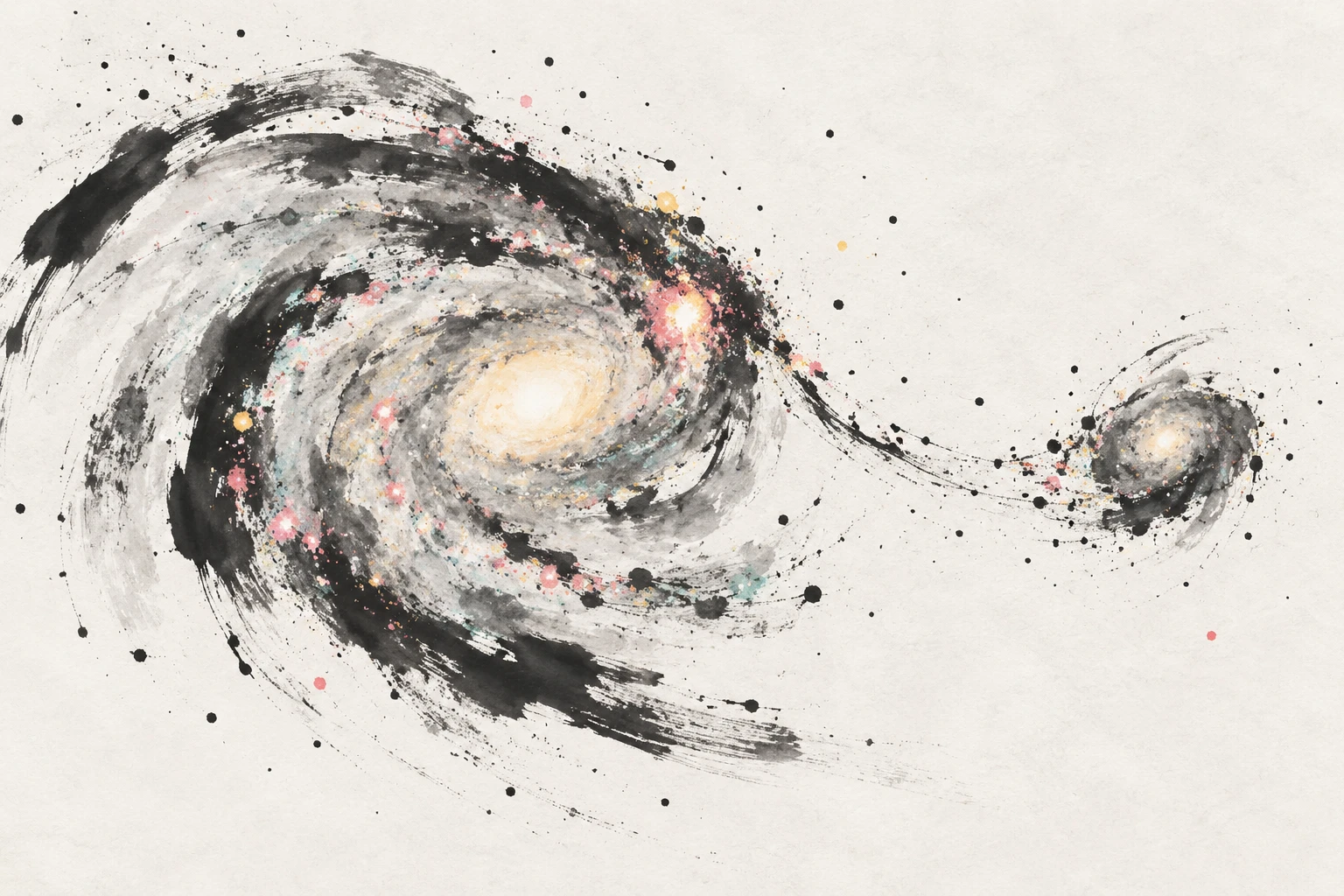
In JWST images from NIRCam, a distant galaxy called JADES 1034862 appears as a star-forming system at redshift z = 3.33. Redshift measures how much cosmic expansion has stretched a galaxy's light; z = 3.33 is the measured redshift of this high-redshift system. To its upper left sits a less massive companion, JADES 1034865, about 8.7 kiloparsecs away in projection. A kiloparsec is roughly 3,260 light-years. A faint tidal feature—a streamer pulled out by gravity—links the two.
That faint feature is the first clue that these galaxies are not just neighbors. The second is their velocity difference. Using JWST's NIRSpec spectrograph, which splits infrared light into wavelengths, the team measured hydrogen and oxygen emission lines from both galaxies. The host sits at z = 3.3330; the companion at z = 3.33465. The difference corresponds to a line-of-sight velocity of only 114 kilometers per second. The small velocity difference, small projected separation, and tidal feature together make a strong case that the pair is interacting.
The Compact Blue Knots That Build Galaxies
High-redshift galaxies often look knotty. They contain clumps: compact regions, roughly a kiloparsec across, where star formation is intense. These clumps can account for a large share of a galaxy's stars and star formation, and they may help build central bulges. So how they form is a central question in galaxy evolution.
Two broad mechanisms compete. One is internal: a gas-rich disk becomes unstable and fragments. The other is external: a gravitational encounter with another galaxy compresses gas and triggers star formation. For the external route, astronomers have mostly considered mergers with mass ratios of at least 1:10—meaning the smaller galaxy is no less than one-tenth the mass of the larger. Very minor mergers, below that threshold, are more common, but they have rarely been studied as clump factories.
A Companion Only 1/28th as Massive
JADES 1034862 and its companion are not equal partners. Fits to their starlight across many wavelengths—their spectral energy distributions—give stellar masses of about 10^9.99 and 10^8.55 solar masses. Stellar mass is the mass locked up in stars. That makes the companion roughly 28 times less massive than the host. The ratio is about 1:28, well below the 1:10 limit usually invoked for merger-induced clumps.
The pair was found in JADES, the JWST Advanced Deep Extragalactic Survey, which is mapping deep fields in the sky. The team used NIRCam imaging in 11 near-infrared filters and NIRSpec spectra to measure precise redshifts and reconstruct the galaxies' recent star-formation histories.
The Clump That Grew With the Companion
The team searched for clumps in the rest-frame near-ultraviolet, light emitted by young stars and stretched into JWST's near-infrared filters. They found three candidates. Two—one northeast and one southwest of the host's center—sit at the host's redshift. The third, to the northwest, is probably a low-redshift interloper at z ≈ 0.2, not a true clump in this system.
The southwest clump is the key object. Its inferred stellar mass is about 10^7.2 solar masses. It currently produces roughly 10 percent of the host galaxy's total star-formation rate, the mass of new stars born each year. Its star-formation history, reconstructed from how its brightness varies across wavelengths, rose sharply in the most recent 100–300 million years, from about 10^-4 to 2–3 solar masses per year. The companion's star formation rose sharply over the same period, from about 0.1 to 10 solar masses per year. The host and the northeast clump changed much less.
Three Signs of a Triggered Birth
That parallel rise is one reason the authors argue that the interaction triggered the southwest clump. Two other clues point the same way. The southwest clump is bluer than the northeast one, suggesting a larger share of young stars. It is also less massive, which fits a more recent formation time. The similar shapes of the companion's and the clump's star-formation histories tie the two events together.
The authors sketch a scenario. The companion may have passed by the host, compressing gas in the region that became the southwest clump. Because the companion is still distinct, they suggest this was near the first close passage. The interaction likely began about 100–300 million years before the observed moment, matching the rapid rise in star formation. The companion may have traveled in front of or behind the host, while the host rotated, leaving the clump in its observed position.
A Small Merger Could Still Leave a Mark
Mergers at lower mass ratios are more common than those at higher ratios. If even a very minor interaction can trigger a clump, then a substantial fraction of high-redshift clumps might have formed this way. That would broaden the standard picture, which has focused on disk instabilities and stronger mergers. The result also connects to simulations: researchers using the cosmological TNG50 simulation found that mini-mergers with mass ratios between 1:10 and 1:100 can modestly enhance star formation. The southwest clump makes up about 10 percent of its host's total star-formation rate, a small enhancement of about 0.05 dex, or roughly 12 percent. The clump itself is not the whole story of the host's growth, but it may be a visible signature of a common process.
What This One System Cannot Settle
Caveats matter here. This is a single galaxy pair. The interaction history cannot be tightly constrained with the available data; the path of the companion and the timing of the encounter are inferred from the system's morphology and star-formation histories, not watched directly. The star-formation histories come from fitting models to the galaxies' light, so they depend on assumptions about dust, metallicity, and stellar populations. The authors consider two types of histories and note that the non-parametric models are generally preferred, but the fits still carry uncertainty.
There is also a more specific ambiguity. The companion's stellar mass is similar to that of the northeast clump. That raises the possibility that the companion was not a separate galaxy at all, but a clump ejected from the host. Integral-field spectroscopy, which would map the motions of gas and stars in detail, could help settle the question.
The paper is a preprint posted on arXiv. Its claim is not that every clump forms this way, but that very minor mergers are a plausible and possibly important channel. Testing the idea will require large samples of galaxies across a wide range of redshift and stellar mass, with precise spectroscopic redshifts and deep imaging sensitive to faint clumps.
The Quiet Power of a Gravitational Nudge
The JWST image of JADES 1034862 shows a galaxy and a much less massive companion connected by a faint tidal feature. That feature is easy to overlook. Yet the star-formation histories of the companion and one compact blue clump rise together in the last few hundred million years, as if the larger galaxy felt a gravitational nudge from a partner 28 times less massive. The lesson is not that every clump needs a dramatic collision. It may be that the universe builds some of its massive, star-forming clumps through weak, common interactions—encounters that are subtle in mass but not in consequence.