
Why Is Interstellar Comet 3I/ATLAS's Gas Outflow at Half the Expected Speed?
New VIRUS observations of interstellar comet 3I/ATLAS trace gas and metal atoms out to about 85,000 kilometers in the sunward coma, revealing an unusually slow outflow and strong iron and nickel emission.
Sep 1, 2026
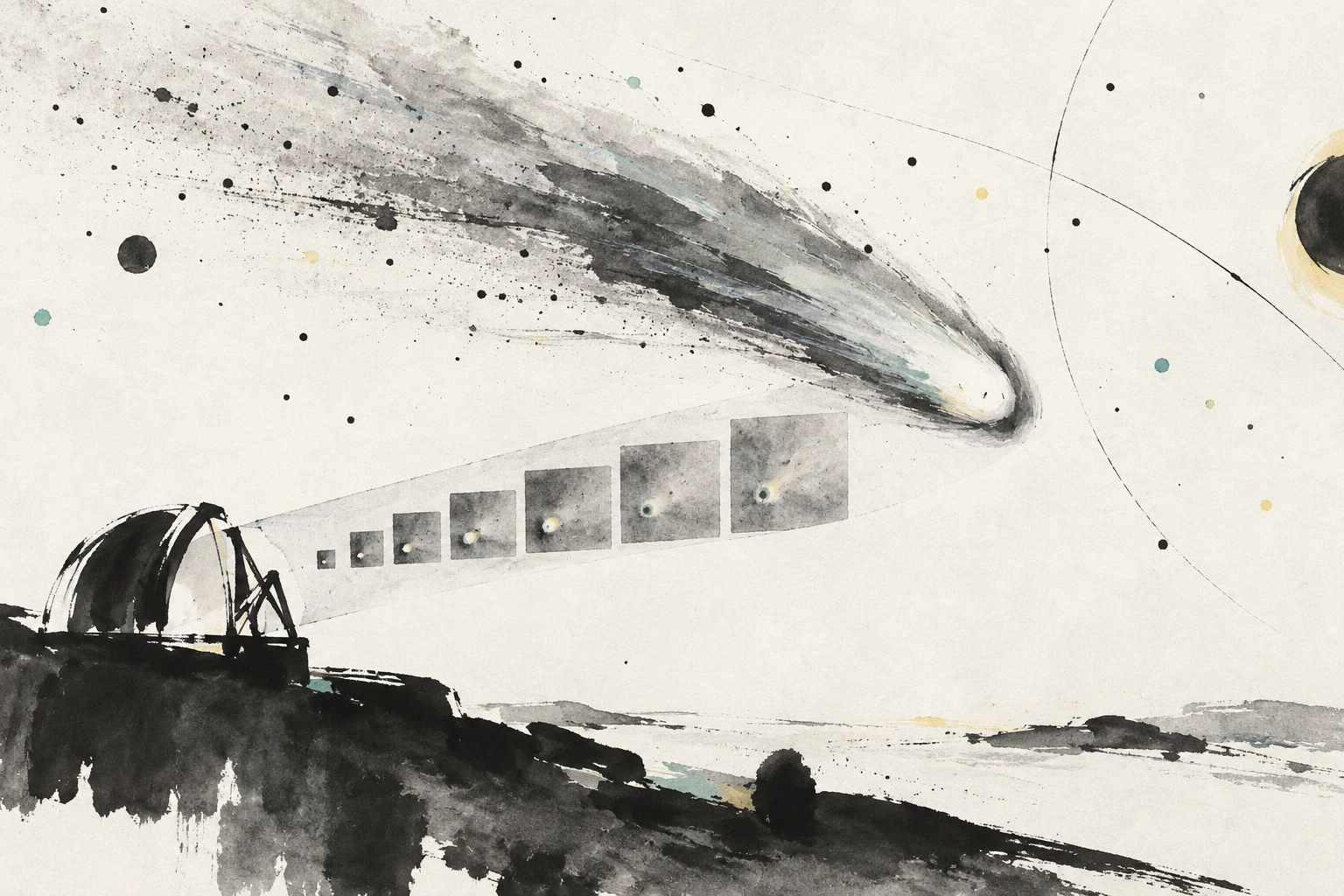
A paper posted on arXiv reports what happened when the Hobby-Eberly Telescope in West Texas pointed at a comet that does not belong to the Sun. The data were obtained on 9 December 2025 UT. The object, 3I/ATLAS, also designated C/2025 N1 (ATLAS), is the third known interstellar object, after 1I/Oumuamua and 2I/Borisov. Discovered on 1 July 2025, it was already moving away from the Sun when astronomers observed it: 2.03 astronomical units from the Sun and 1.83 au from Earth. One au is the average Earth-Sun distance.
The team used VIRUS, a low spectral resolving power optical spectrograph on the 10-meter Hobby-Eberly Telescope. VIRUS is an integral-field spectrograph: it takes a spectrum for each small patch of sky, building a map of where different wavelengths of light come from. A single integral field unit covers 50 by 50 arcseconds. At 3I's distance, one arcsecond corresponded to about 1,327 kilometers. An accidental offset placed the comet's optocenter—the bright center of its coma—on the edge of that field. That mistake turned into an advantage: it let the astronomers sample the coma out to roughly 85,000 kilometers in the sunward direction.
A Comet From Somewhere Else
Comets are frozen leftovers from planet formation. Their precursors formed in the outer Solar System, including beyond Neptune and in the giant-planet region. Some were tossed into the Oort Cloud; many more were ejected entirely. Other planetary systems should have done the same, sending their own icy debris into interstellar space. 3I/ATLAS is one of those escapees.
Its age is not definitively known. Kinematic estimates range from about 3 to 11 billion years, with one study arguing it is at least 7.6 billion years old, and some isotopic work points to formation 10 to 12 billion years ago. If true, 3I could be older than the Solar System. But the paper is careful: we do not know where it formed, when it formed, or what kind of star it orbited.
Mapping Gas Every 1,327 Kilometers
The VIRUS spectra contain both gas emission from the comet and sunlight reflecting off dust. The researchers first removed the reflected sunlight, then measured how much gas was present at each position.
They detected molecules familiar from Solar System comets: CN, C3, CH, and two bands of C2. Those species are daughter products, created when ices from the nucleus break apart or react in the coma. Their spatial distributions looked fairly symmetric in the directions the team could sample.
But when the astronomers tried to fit those distributions with standard Haser models—a widely used simplified picture of a steady, spherically symmetric coma expanding at constant speed—none of the published scale lengths worked. Scale lengths describe how far a molecule travels before it is destroyed, and they depend on outflow speed. To match the data, the gas had to be moving unusually slowly.
The Outflow That Moves at Half Speed
For a comet at 2.03 au from the Sun, the standard relation predicts an outflow speed of about 0.597 kilometers per second. The VIRUS data could only be fit with a speed near 0.3 kilometers per second—roughly half.
VIRUS has low spectral resolving power, so it cannot measure the outflow speed directly from the Doppler shift of spectral lines. The speed is inferred from the shape of the gas distribution through the Haser model. That makes the result model-dependent. But it agrees with independent radio observations. IRAM measurements of HCN and CH3OH gave 0.37 kilometers per second at 1.36 au; scaled to 2.03 au, that becomes about 0.31. ALMA measurements of CO and HCN gave 0.345 and 0.276 kilometers per second at 2.4 au; scaled to the VIRUS distance, they become about 0.38 and 0.30. All three datasets point to the same slow outflow.
One possible explanation is composition. 3I is known to be rich in carbon dioxide. A heavier, CO2-rich gas could slow the flow compared with the water-dominated comas of many Solar System comets. The paper notes this as a suggestion, not a settled answer.
Metal Lines That Should Not Shine So Brightly
A striking difference from ordinary Solar System comets is the presence of strong iron and nickel lines. The spectrum shows many FeI and NiI features. One NiI line at 3525 angstroms appears brighter than the CN feature in the same spectrum.
That is not normal. FeI and NiI are weak in most comet spectra and usually require high spectral resolving power to detect. They had not shown up in large surveys of low-resolution Solar System comet spectra. 3I is exceptional even among interstellar objects for its strong nickel and iron emission.
The team used fluorescence efficiencies—calculations of how sunlight excites these atoms—to convert line strengths into column densities (how much gas lies along a line of sight) for three NiI lines and four FeI line groups. They then fit Haser models to derive scale lengths. The parent scale lengths came out very short, around 3,000 kilometers, comparable to the size of one pixel. The data contain no information below that scale.
The paper argues the very short parent scale lengths require either direct release of metallic iron and nickel from the nucleus or a very short-lived parent. But at the comet's observed heliocentric distances, the surface is too cold to vaporize metallic iron or nickel. A short-lived parent molecule, or material processed during a long interstellar journey, could help explain the atoms.
What the Fit Cannot Tell Us
The results carry important caveats. The observations are a single epoch, taken with one IFU while the comet sat at the edge of the field. That geometry gave a long sunward view but left the tailward side unsampled, so the team cannot say whether the coma is symmetric in that direction.
The Haser model assumes steady, spherical outflow with fixed photodissociation scale lengths. Real comas can be anisotropic, variable in time, and chemically more complex. The production rates are therefore model-dependent estimates, not direct physical measurements.
For iron and nickel, the low spectral resolution blends several lines together, and the fluorescence efficiencies for some transitions are uncertain. The individual spatial profiles are more reliable than the overall production rates. The daughter scale lengths for FeI and NiI also remain imperfectly constrained because the field of view is still smaller than the distances those atoms travel.
A Messenger Without a Return Address
Interstellar objects offer a way to test whether the processes that built our Solar System are universal. If comets are common relics of planet formation, and many are ejected, then the Galaxy should be full of them. 3I/ATLAS arrived with familiar molecules but also with a slow outflow and a surprising amount of metal.
New surveys, including the Rubin Observatory, should find more of these visitors. The more astronomers compare, the better they can separate what is universal from what is peculiar to our own solar nebula. The hardest problem will remain the same: 3I/ATLAS does not carry a return address. Its composition is a message from another planetary system, but we may never know exactly which one.