
Can a Swarm of Small Satellites Open One of Radio’s Last Windows?
A new concept in NASA’s ASTRA Initiative proposes hundreds of mass-produced small satellites flying as a distributed radio interferometer to observe stellar, planetary, and cosmic signals that Earth’s ionosphere blocks.
Aug 26, 2026
The ionosphere makes ground-based radio astronomy increasingly difficult below about 100 MHz. Between roughly 10 and 50 MHz, incoming radio waves suffer phase fluctuations and absorption; below about 10 MHz, the ionosphere is effectively opaque. The MegaWave Radio Surveyor, described in a new arXiv preprint, is a concept developed in the context of NASA’s Astrophysics Strategic Technology & Research Accelerator (ASTRA) Initiative, which focuses on early mission concepts at Concept Maturity Levels 2–3. It is a design study, not a detection; the paper presents a concept rather than a point design.
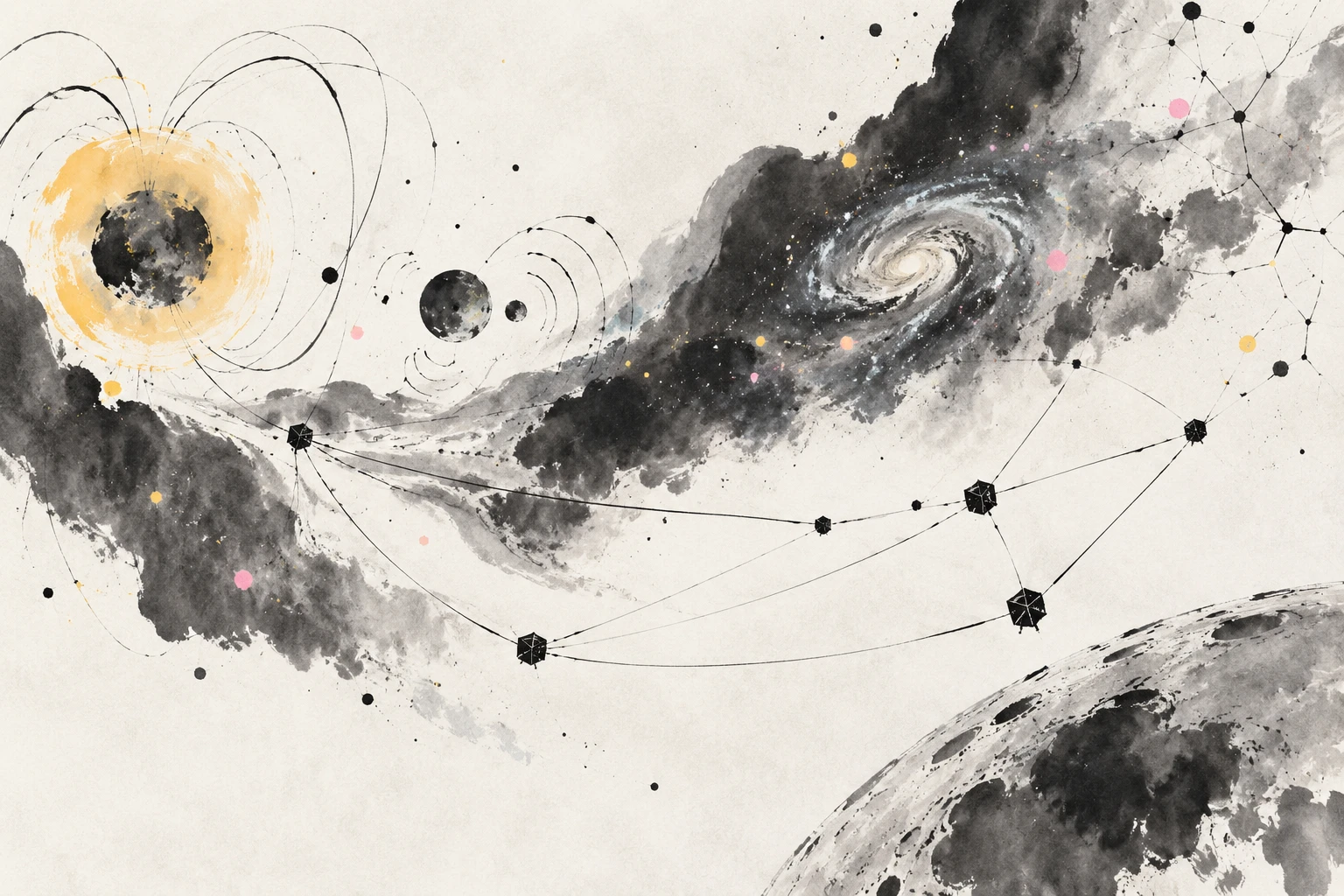
The concept is not a single telescope but a distributed radio interferometer: hundreds of mass-produced small satellites operating together, combining their signals to act like one giant radio dish. Each satellite would measure radio waves with its antenna. By measuring the spatial coherence between pairs of antennas—essentially comparing the wave signals received at different spacecraft—the array can reconstruct the sky brightness, the same principle ground-based radio interferometers use but extended to orbital scale. The paper emphasizes sensitive, simultaneous observations below about 45 MHz and unprecedented angular resolution at those frequencies, capabilities impossible from Earth.
Four Questions Hiding Below the Ionosphere
First, the surveyor would track space weather around other stars. Solar flares can produce beams of energetic electrons that generate Type III radio bursts; coronal mass ejections (CMEs) drive shocks that accelerate electrons and generate Type II bursts. These bursts travel through the stellar wind. For the Sun, ground-based telescopes cannot track such bursts beyond about 3 solar radii. The region where CME-driven particles are accelerated and the corona transitions to the solar wind lies farther out, roughly 5 to 20 solar radii, and emits at frequencies below about 15 MHz. MegaWave would monitor at least 5,000 nearby stars within 25 parsecs, looking for radio signatures of stellar eruptions and winds that shape exoplanet environments.
Second, it would search for radio emission from exoplanets themselves. A planet with a magnetic field can produce electron cyclotron maser emission—a natural radio beacon produced by electrons in a magnetic field—whose frequency rises with magnetic field strength: about 2.8 MHz for every gauss. Jupiter emits up to roughly 35 MHz; Earth’s own radio emission is weaker and was discovered only from space. Detecting such emission from exoplanets would offer a rare probe of their interiors—whether they have dynamos (internal magnetic-field generators), where those dynamos sit, and how magnetic fields shield or sometimes erode atmospheres. The paper emphasizes that sub-Neptunes and super-Earths have no solar system analogs, so their magnetic fields are largely unknown.
Third, MegaWave would look back to the cosmic Dark Ages, the era before the first stars formed. Neutral hydrogen atoms produce a hyperfine line at 1420 MHz, famous in radio astronomy as the 21-centimeter line. In the expanding universe, that line is redshifted to much lower frequencies. During the Dark Ages, the predicted global absorption signal peaks near 15 MHz, while the broader observing window runs from about 7 to 45 MHz. Measuring the shape of that signal, and eventually mapping its fluctuations across the sky, could test inflation, neutrino masses, and dark matter models with statistical power up to 10^5 times higher than the cosmic microwave background. The catch: the measurement requires receiver stability and calibration at or beyond the state of the art.
Fourth, the observatory would trace cosmic rays and magnetic fields in the cosmic web. Low-energy cosmic-ray electrons moving through weak magnetic fields in galaxy clusters and galaxy halos emit synchrotron radiation—radio emission from cosmic-ray electrons in magnetic fields—which at these energies appears below about 15 MHz. Those observations could address a long-standing puzzle: some radio relics, produced by shock waves in merging galaxy clusters, appear brighter than standard diffusive shock acceleration (the standard process for accelerating particles at shocks) should allow. The paper suggests that reaccelerated fossil electrons or additional processes may be at work, and that low-frequency maps could show how the energy of structure formation is divided among hot gas, magnetic fields, and relativistic particles.
A Swarm, Not a Dish
To make this work, the paper envisions a hierarchical system: an observatory made of N identical space vehicles and M hubs. The hubs would distribute time and frequency references and could serve as communication relays; a ground-based Science Data System would produce higher-level data products. To combine signals coherently, the spacecraft would need stable frequency/time references and positions known to about one meter. Possible orbits include Earth-Moon L1, L2, L4, or L5, or Sun-Earth L2. These orbits provide nearly constant solar illumination for a stable payload environment; the Earth’s ionosphere blocks many ground-based transmitters over much of the band, though cislunar spacecraft are a potential interference source.
The concept leverages NASA experience with SunRISE, a small radio interferometer in space; SPARCS, a CubeSat for ultraviolet studies of star-planet activity and exoplanet habitability; and LuSEE-Night, a lunar far-side radio experiment. It also points to commercial trends—standardized smallsats, lower launch costs, mass production, onboard processing—and to Artemis-era cislunar communications and navigation. The authors outline trade studies rather than a final design: how many hubs, how much processing on board versus on the ground, how to divide the array into sub-arrays, and how much autonomy or artificial intelligence/machine learning (AI/ML) would be needed.
The Dark Ages Measurement Is the Hardest Hurdle
The paper is explicit that this is a concept. It does not present a point design, a cost, or a schedule. Several capabilities are at or beyond the state of the art, especially receiver stability and calibration for the Dark Ages measurement, and no space-based interferometer of this scale has flown. The science cases are forecasts and motivations, not confirmed detections. The exoplanet radio signal, in particular, remains unproven for a planet outside the solar system.
Still, the appeal is easy to see. Radio astronomy has opened one window after another, from the 21-centimeter line to the cosmic microwave background. Much of the band below about 45 MHz has remained largely closed from the ground. If MegaWave or a similar observatory eventually flies, it would not just add another telescope. It would let astronomers listen to stellar storms, planetary dynamos, and the quiet hydrogen fog of the infant universe through the same distributed ear.