
JWST Catches a Type II Supernova Candidate in a Distant Spiral's Quiet Outskirts
By comparing JWST images from 2022 to 2025, astronomers found a rising and fading supernova candidate in a barred spiral galaxy at redshift 0.688, offering a rare multi-band look at a distant stellar explosion.
Aug 21, 2026
In a patch of sky around the galaxy cluster Abell 2744, astronomers have found a point of light that was not there before. It brightened between JWST visits, then faded. The object, named PLATE-23a, sits in a barred spiral galaxy at redshift 0.688, a cosmic stretch factor that places it billions of years in the past. The team's analysis, posted as a preprint on arXiv, identifies it as a strong candidate for a Type II supernova: the core collapse of a massive star that still had a hydrogen-rich envelope when it died.
A cluster that works as a telescope
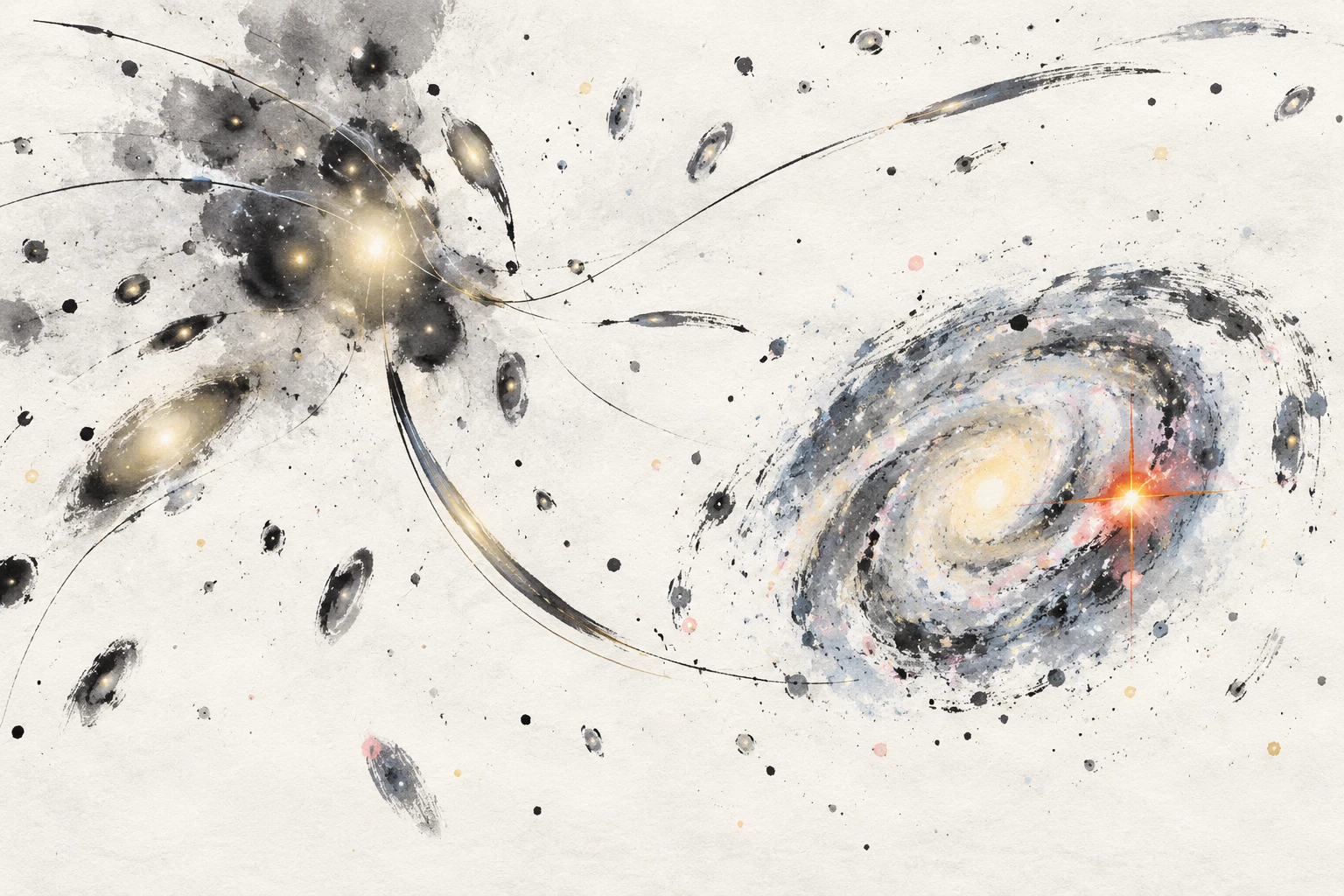
Abell 2744, nicknamed the Pandora Cluster, is a natural magnifying glass. Its mass bends and brightens light from galaxies behind it, letting JWST see fainter objects than it could alone. The field has been observed repeatedly by multiple JWST programs since 2022, giving astronomers a rare multi-epoch view. The new work is the first result from the Pandora Lensing, AGN, and Transient Exploration project, or PLATE, which searches those images for anything that changes.
Finding a transient in such data is a subtractive exercise. The researchers aligned JWST NIRCam images, NIRCam being the telescope's near-infrared camera, across epochs and filters. They then used a difference-imaging technique to subtract a template image of the same patch from later observations. What remains is the changing light. The paper reports PLATE-23a in 12 NIRCam filters across five epochs, with both rising and declining phases visible. The team also used a public gravitational-lensing model of Abell 2744 to correct the object's brightness and its distance from the galaxy center. At its redshift, the magnification is about 1.32.
What exploded, and where?
Classifying a supernova from light curves alone is a probabilistic business. The researchers fed the multi-band photometry into a Bayesian classification tool called STARDUST2, which compares the observed colors and brightness evolution with templates of known supernova types. Type IIP, a class marked by a plateau in its light curve, emerged as the best match. The favored template is the light curve of SN 2006iw, a Type IIP event. The fit strongly disfavors Type Ia and Type Ib/c alternatives, although the object remains a candidate until spectroscopy confirms it.
Where the explosion happened is as interesting as what it was. Its host is a barred spiral galaxy with a spectroscopic redshift of 0.688. Spatially resolved modeling of the galaxy's light suggests a total stellar mass of about 10^10.4 solar masses and a star formation rate of about 5.1 solar masses per year, placing it on the star-forming main sequence, the rough band where normal star-forming galaxies live. The supernova lies about 13 kiloparsecs from the galaxy center, after correcting for lensing. That is well outside the galaxy's effective radius and in a region of relatively low star formation.
That location raises a question: Did the progenitor star form locally, or was it born in a bright star-forming clump about 7 kiloparsecs away and then flung outward? The team estimates that such migration would require a projected speed of at least 700 kilometers per second. Hyper-runaway stars with that speed are extremely rare. Using an optimistic ejection probability, the authors calculate that the migration scenario is less than about one chance in a thousand relative to local formation. They conclude the star most likely formed near where it exploded, even though the neighborhood is not a hotbed of star formation.
The supernova's physical evolution also resembles local Type II events. Fitting blackbody, or thermal, models to the first two epochs gives a temperature falling from about 8,010 kelvin at roughly 5 days after explosion to about 6,100 kelvin at roughly 65 days. Its bolometric luminosity drops from about 1.35 x 10^42 to 8.39 x 10^41 ergs per second over the same span. By the third epoch, the spectrum's shape no longer matches a simple blackbody, consistent with the ejecta entering the radioactive-decay phase. The late-time data, about one rest-frame year after explosion, line up with a scaled spectrum of the nearby Type IIP SN 2017eaw. The plateau-to-tail drop is estimated at about 0.3 to 1.0 magnitude depending on the filter.
What the candidate can and cannot tell us
Those numbers come with caveats. The classification rests on template matching, not a spectrum of the supernova itself. Slitless grism spectroscopy from another JWST program did not detect the event, but the paper notes that the expected signal was below or near the sensitivity limit and could be diluted by host-galaxy light. The inferred explosion date depends on the template, so the rest-frame times carry systematic uncertainty. The first epoch's blackbody temperature may be underestimated because of missing filter coverage and hydrogen emission in one band. The extinction toward the supernova also differs between light-curve fitting and host-galaxy modeling. And the lensing magnification itself shifts by about 0.13 magnitudes between two published models, which propagates into luminosity estimates.
None of those caveats erase the central result: JWST's repeated deep images of a lensed field can catch a distant supernova in both its rise and fall, then follow its color and temperature as it cools. PLATE-23a is a first taste. The PLATE team plans to report other variables, including lensed stars and active galactic nuclei, and future spectroscopy could help confirm the classification and constrain the explosion. As telescopes such as Euclid and the Roman Space Telescope begin surveying wide swaths of sky, the combination of broad discovery and JWST's sharp infrared eye may turn these rare, faint explosions into a population rather than a curiosity.