
Can a Vehicle’s Own Magnetic Field Open a Radio Window Through Hypersonic Blackout?
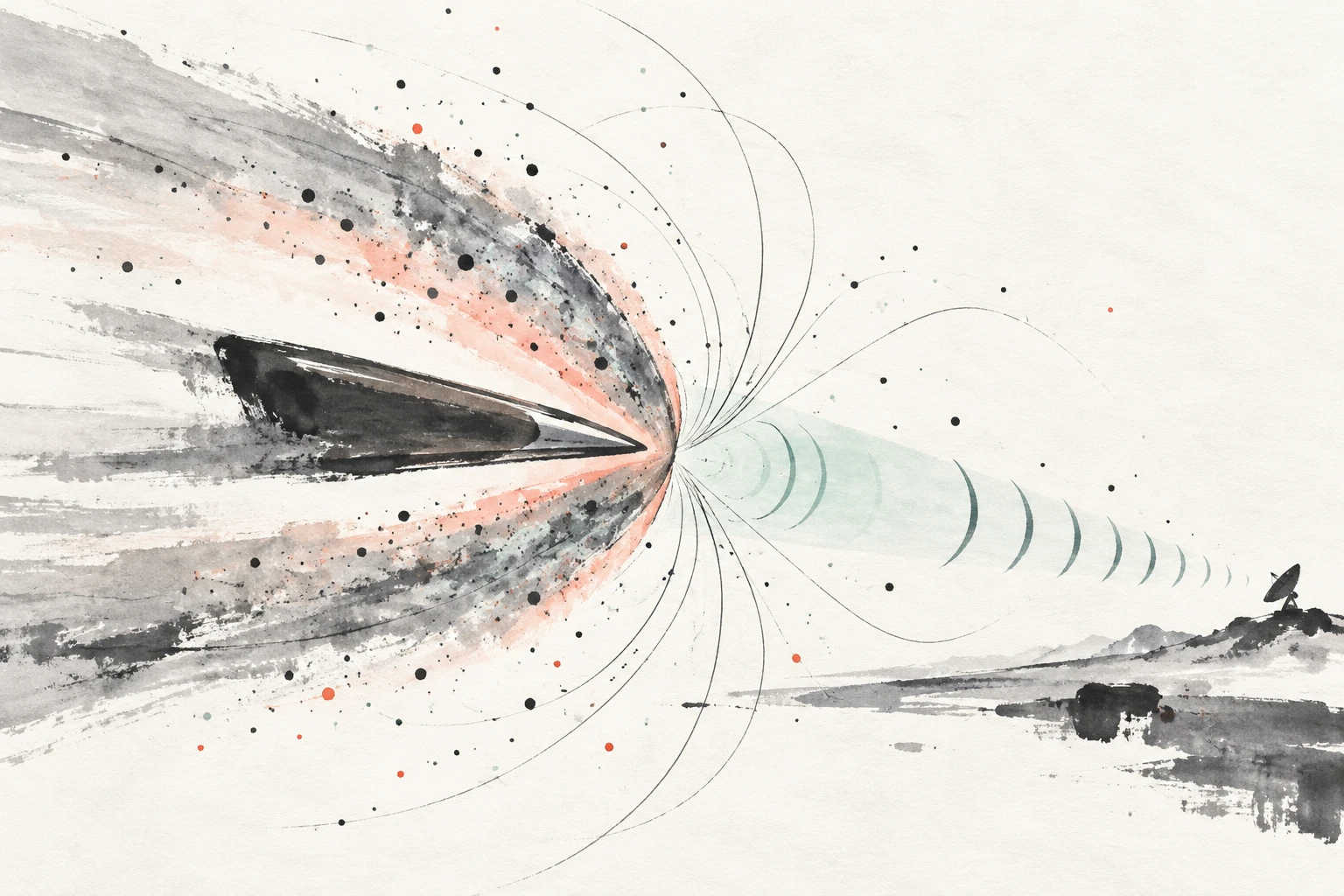
A reduced-order preprint models whether an onboard axial dipole can create a magnetic window through an ionized hypersonic sheath, finding a candidate cone whose size shrinks sharply with sheath thickness and collisional loss and is narrow near threshold.
Aug 8, 2026
At hypersonic speeds, the air ahead of a vehicle cannot get out of the way fast enough. It compresses, heats, dissociates, and ionizes, wrapping the craft in a plasma sheath. Radio signals used for telemetry, tracking, sensing, or command links can then be reflected, absorbed, or converted into evanescent fields before they ever reach the outside world.
A new arXiv preprint by Richard Lieu of the University of Alabama in Huntsville asks a narrower engineering question: if the magnetic source is carried onboard and approximated as an axial dipole, how large an angular radio-frequency opening can it actually create? The paper is a reduced-order scaling model, not a report of flight data or a laboratory measurement. Its value is in exposing the leading physics before more expensive simulations are attempted.
The radio silence around a hypersonic vehicle
In the simplest picture, an unmagnetized plasma blocks radio waves when the electron plasma frequency exceeds the radio frequency. The plasma frequency rises with electron density. A denser, more ionized sheath is therefore more opaque. Higher-frequency links can avoid this elementary cutoff because their radio frequency is higher, but they are not automatically immune; collisions can still absorb energy even when cutoff is not the main problem.
A magnetic field changes the rules. It makes the plasma anisotropic: electrons respond differently along and across the field lines. In a magnetized plasma, certain right-hand or whistler-like modes can propagate in preferred directions even when the corresponding unmagnetized plasma would be opaque. This is the magnetic-window idea. The paper does not claim to invent it. Instead, it asks how an onboard dipole field constrains the window’s angular size.
A magnetic key for an opaque plasma
The local condition is simple. For propagation aligned with the magnetic field, the electron cyclotron frequency—how rapidly electrons gyrate around field lines—must exceed the radio frequency. When the field is tilted relative to the wave direction, only the projected component matters. Stronger field and better alignment help.
But an onboard dipole is not a uniform field. Its strength falls as the cube of distance. The model therefore requires the cyclotron condition to hold at the outer edge of the plasma sheath, not merely at the vehicle surface. That single geometric fact drives the paper’s central result.
The collisionless opening half-angle is estimated as theta_open = arccos[(m_e 2 pi f / (e B_p))(1 + t_s/a)^3]. Here B_p is the axial surface dipole field, f is the radio frequency, a is the vehicle radius or nose scale, and t_s is the sheath thickness. The factor (1 + t_s/a)^3 is the finite-sheath penalty. A thin sheath around a large vehicle is favorable. A small projectile inside a relatively thick sheath pays a severe price.
The corresponding minimum surface field is B_p,min = (m_e 2 pi f / e)(1 + t_s/a)^3. Below that threshold, the reduced model predicts no collisionless radial magnetic window. Just above it, the cone is narrow. A broad opening requires a field comfortably above the threshold, not merely equal to it.
When collisions close the cone
A propagating branch is not the same as a candidate transmission path. Electron-neutral collisions can convert wave energy into thermal motion. The paper adds a reduced optical-depth screen to estimate when collisional loss narrows the candidate aperture.
The result is a loss-limited cone. If collisions are significant, the wave needs extra magnetic detuning—essentially a stronger magnetic effect—to stay away from the most absorptive part of the dispersion relation. Dense, neutral-rich, and thick sheaths are more lossy. A stronger field can help, but the required field may be much larger than the collisionless threshold.
The model also highlights a frequency tradeoff. Higher frequencies raise the electron density needed for unmagnetized cutoff, which can make a sheath less opaque in that basic sense. But higher frequencies also require stronger magnetic fields to satisfy the cyclotron-based condition. Lower frequencies are easier to support magnetically but more vulnerable to ordinary plasma cutoff and collisional absorption.
Where the reduced model stops
To explore trends, the paper uses a simplified closure for neutral density, projectile speed, and ionization. It is a Saha-type equilibrium estimate, not a validated nonequilibrium aerothermochemical simulation. The resulting maps suggest that increasing ambient density generally raises both electron density and collision frequency, while increasing speed raises the post-shock temperature and can sharply increase ionization.
The maps classify regimes: no unmagnetized blackout, blackout with no candidate loss-limited window, and blackout with a candidate loss-limited dipole window. Those boundaries are screening guides, not sharp flight predictions. The author states clearly that the work is not a demonstrated engineering solution to plasma blackout.
Several limitations are explicit. The plasma is treated with cold-plasma dispersion and perturbative collisions. The magnetic field is a vacuum dipole, ignoring distortion by plasma currents and feedback on the flow. Rays are assumed to escape radially. Antenna coupling, reflection, mode conversion, link budget, and nonequilibrium chemistry are not included. No external experimental datasets are used.
What would test the dipole scaling
The paper’s main contribution is a transparent scaling relation. It tells researchers when an onboard dipole field is unlikely to be favorable under the reduced assumptions, when it might open a collisionless window but lose too much signal to collisions, and when a case may deserve full-wave electromagnetic simulation, detailed plasma-flow modeling, antenna analysis, or laboratory validation.
The validation target is not one exact opening angle. It is the scaling behavior: the cubic penalty from sheath thickness, the linear rise in required field with frequency, the widening cone with stronger surface field, and the narrowing caused by collisional optical depth.
In the paper’s reduced picture, a magnetic window would not make the plasma globally transparent. It would require identifying candidate regimes where the dipole field remains strong enough at the sheath’s edge—and where collisions leave enough signal to hear.