Small Asteroids Start Matching Meteorite Falls—But H and LL Precursors Stay Hidden
Near-infrared spectra of 80 S-complex near-Earth objects reveal a size-dependent composition shift: L chondrite-like bodies match meteorite falls around 31–49 meters, while H and LL parent bodies likely lie below about 18 meters.
Aug 5, 2026
Ordinary chondrites are the most common type of meteorite. They make up about 81 percent of all meteorite falls, and they come in three subtypes—H, L and LL—based on their iron content and oxidation state.
For years, telescopic surveys of near-Earth objects, or NEOs, found that silicate-rich S-complex asteroids were dominated by objects with LL chondrite-like compositions. LL chondrites are the rarest of the three ordinary chondrite subtypes, only about 10 percent of falls. L chondrites, the most common at 47 percent, were a minority among those same asteroids. Something did not add up.
A mismatch that looked like a size problem
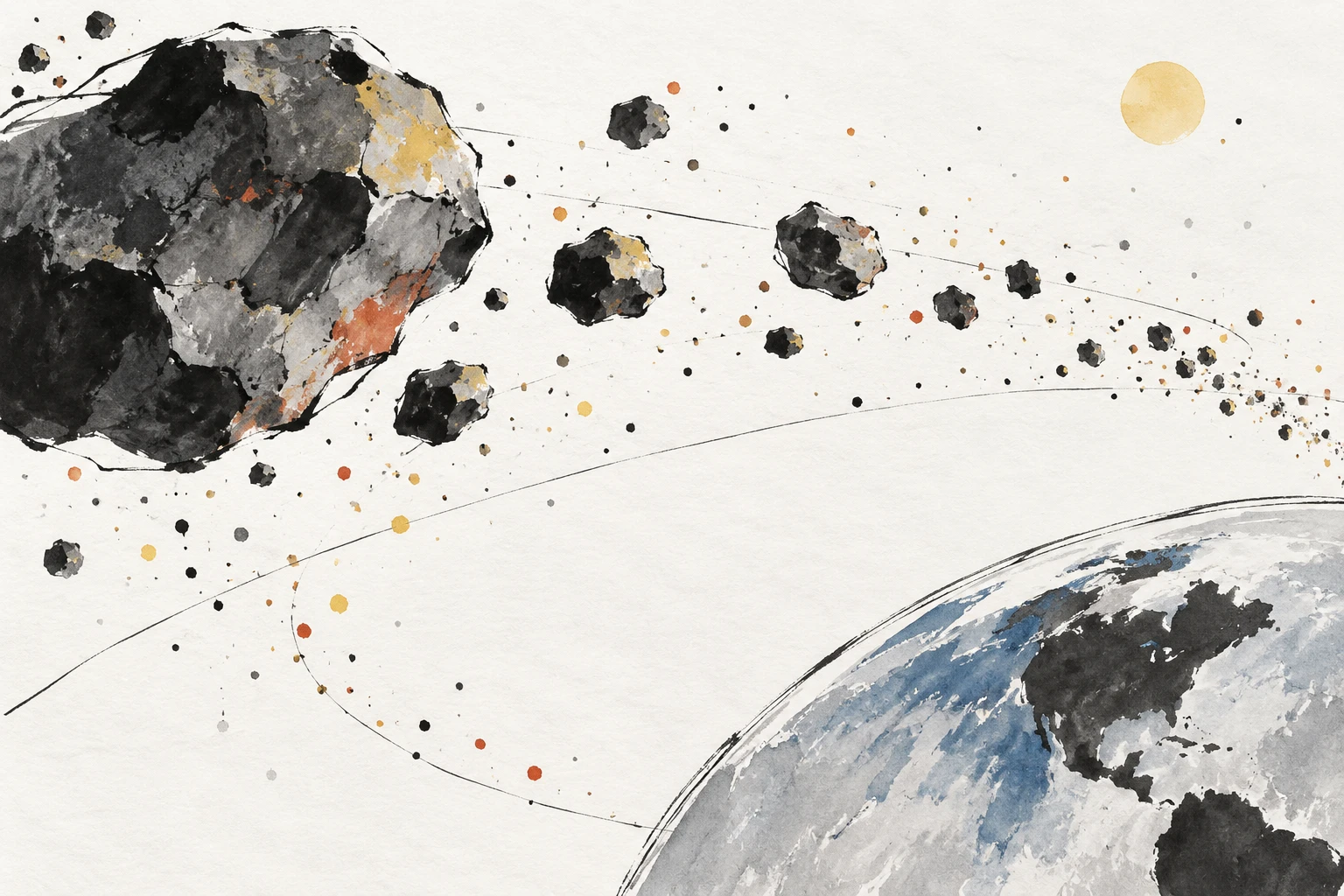
Researchers suspected the discrepancy came from size. The surveyed NEOs were mostly about 100 meters across or larger. The objects that actually enter Earth's atmosphere and drop meteorites are the immediate pre-atmospheric precursors, likely much smaller. But getting good near-infrared spectra of tiny, faint NEOs is hard.
A team led by Juan A. Sanchez of the Planetary Science Institute set out to test whether asteroid composition changes with size. The researchers used SpeX on NASA's Infrared Telescope Facility in Hawaii between May 2021 and July 2025. They obtained near-infrared spectra, from 0.7 to 2.5 micrometers, of 25 NEOs. Combining those with 55 earlier spectra gave a sample of 80 S-complex NEOs.
The objects spanned absolute magnitudes H from 20.0 to 29.2. Absolute magnitude is a measure of intrinsic brightness; smaller H means a larger asteroid. Using estimated reflectivity, or geometric albedo, the team translated that range into sizes from about 4 to 343 meters. The near-infrared light reveals absorption bands near 1 and 2 micrometers produced by olivine and pyroxene, minerals common in ordinary chondrites. The team measured the band centers and areas and used a statistical classifier—trained on a synthetic dataset built from measured ordinary chondrite ranges—to estimate whether each asteroid was more like an H, L, or LL chondrite.
Small asteroids flip the L chondrite ratio
The largest objects still showed the old mismatch. In the subgroup with a median diameter of 153 meters, ranging from 80 to 343 meters, LL chondrite-like asteroids made up 66 ± 7 percent of the sample. L chondrite-like objects were 27 ± 7 percent, and H chondrite-like objects only 7 ± 4 percent.
In the smaller subgroup, with a median diameter of 39 meters and a range from 4 to 70 meters, the balance shifted. L chondrite-like objects rose to 48 ± 9 percent, LL chondrite-like objects fell to 41 ± 9 percent, and H chondrite-like objects remained low at 10 ± 6 percent. When the team split the sample into three size bins, the smallest bin—median diameter 18 meters, range 4 to 31 meters—had L chondrite-like objects at 62 ± 12 percent and LL chondrite-like objects at 25 ± 11 percent.
A linear interpolation placed the crossover where the L chondrite-like fraction matches the 47 percent of L chondrite falls at about 40 meters, with a one-sigma range of 31 to 49 meters. That is the first observational evidence for a size dependence in the composition of S-complex NEOs, the paper says.
H and LL parent bodies still hide below the survey limit
H chondrite-like asteroids remained rare at every size the team observed. Even in the smallest bin, they reached only about 13 ± 9 percent, far below the 43 percent of H chondrite falls. The authors infer that the majority of H chondrite pre-atmospheric parent bodies—the objects before they hit the atmosphere—are smaller than about 18 meters.
LL chondrite-like objects also stayed too common. At 25 ± 11 percent in the smallest bin, they were still above the 10 percent of LL chondrite falls. The size at which LL chondrite-like NEOs match their meteoritic proportion must therefore also lie below about 18 meters. The authors note that an object like the pre-atmospheric Chelyabinsk meteoroid, estimated at about 20 meters across, is probably rare among LL chondrite precursors.
Where sub-100-meter NEOs come from
The team also used a model called NEOMOD to ask where sub-100-meter S-complex NEOs come from. The model estimates how likely an asteroid was to escape the main belt through different gravitational gateways. For this sample, about 64 percent of the source probability came from the ν6 secular resonance, a gravitational alignment with Saturn; about 25 percent from the 3:1 resonance with Jupiter; and about 7 percent from the inner asteroid belt. The paper reports only modest differences among source regions for the different chondrite subtypes, and it cautions that the apparent concentration of the smallest L chondrite-like NEOs at semimajor axes below the ν6 resonance should be treated cautiously because of the limited sample.
What the numbers do not settle
The study rests on 80 NEOs, and the dominant uncertainty is statistical. The ± values above are one-sigma uncertainties. The sizes depend on assumed reflectivity values, and the spectra can be affected by space weathering and grain size. The term parent body here means the size range where the population's composition matches meteorite fall statistics, not a hard cutoff. Real meteorite precursors will come from a size distribution that extends somewhat beyond that range. The L chondrite crossover also assumes a monotonic change between size bins, which the trend supports but does not prove.
Still, the result largely resolves a long-standing puzzle. The overabundance of LL chondrite-like asteroids in earlier surveys was not a contradiction in the meteorite fall statistics. It was a sign that those surveys were looking at the wrong end of the size distribution. The meteorites that land on Earth come from a population of small, faint objects that most telescopes have trouble seeing.
That idea changes what the next surveys need to do. To find the immediate sources of H and LL chondrites, astronomers will have to observe NEOs smaller than about 18 meters. These are faint and small, and they are precisely the objects that current spectroscopic surveys often miss. The meteorites in our collections are samples of the small precursors that surveys struggle to see, while a larger population remains almost entirely unsampled.