Thousands of Volunteers Found 6,739 Jellyfish Galaxy Candidates. Can Their Eyes Be Trusted?
A Zooniverse citizen-science project classified nearly 50,000 galaxies and produced 6,739 ram-pressure-stripping candidates, with environmental trends that match earlier smaller-sample results.
Jul 30, 2026
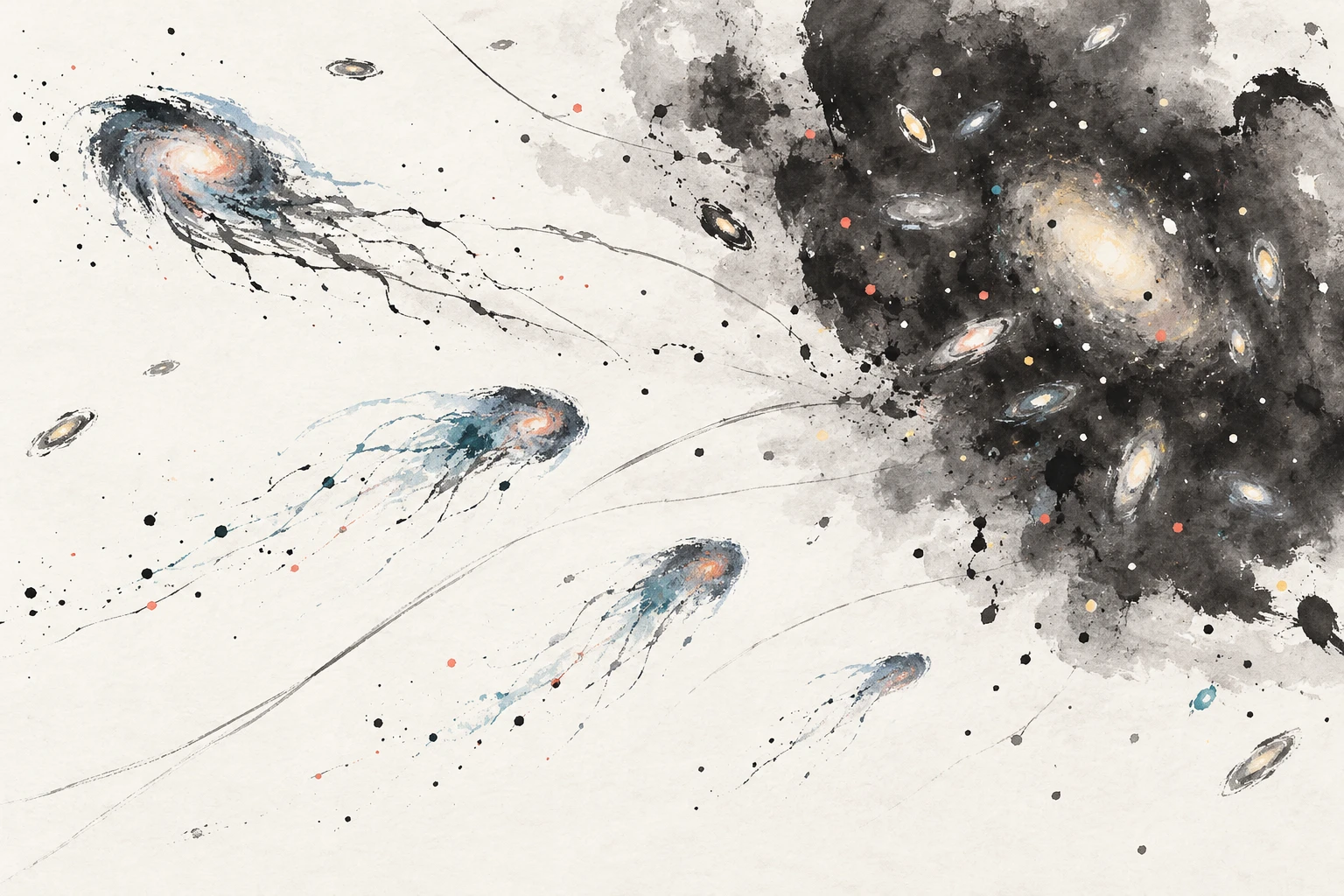
The first thing to notice about a jellyfish galaxy is not the galaxy. It is the tail. A long stream of gas trails behind a disk as it plunges through a cluster, and in places that stripped gas forms new stars. In the citizen-science project Fishing for Jellyfish Galaxies, thousands of volunteers looked at color images from the Dark Energy Camera Legacy Survey and tried to pick out those tails by eye. Their combined work has now produced 6,739 jellyfish candidates, including 6,621 that were not in earlier catalogues.
A headwind that leaves a tail
Galaxy clusters are not empty. They are filled with hot, tenuous gas called the intracluster medium. When a galaxy falls in, that gas can act like a headwind. The process, ram-pressure stripping, removes the galaxy's own star-forming gas while leaving the denser stars largely in place. The stripped gas can trail behind as a tail, sometimes forming new stars in the stream. Eventually, with its fuel gone, the galaxy may stop forming stars altogether.
These jellyfish galaxies are useful laboratories for galaxy evolution. They show environmental transformation in progress: gas is being removed, star formation may briefly rise, and the galaxy's appearance can change. But finding enough of them to study statistically has been hard. Their signatures are varied, subtle, and difficult to automate, and earlier catalogues built by expert inspection were relatively small.
Can a crowd outclass a catalog?
Volunteers on the Zooniverse platform inspected 49,703 galaxies in and around clusters and groups. The targets were late-type galaxies, brighter than 19th magnitude in the g and r bands and at least 2 arcseconds in half-light radius (the radius containing half the galaxy's light), so they would be large enough and bright enough to classify. Each galaxy appeared as a red-green-blue cutout, with a wider view to show extended tails and possible companions. The workflow asked whether a galaxy was disturbed or undisturbed, whether it looked like a merger, and whether it had a tail. If a tail was present, volunteers drew its path.
Each image was retired after ten classifications. In total, 5,286 users or logged-out sessions contributed 517,152 classifications. The team downweighted votes from users who had classified fewer than ten galaxies by 50%. To turn votes into a catalogue, they calibrated thresholds against expert classifications of 403 galaxies in the cluster Abell 1644. A galaxy enters the stripping-candidate sample if the disturbed vote fraction is at least 0.39 and either the merger fraction is at most 0.23 or the tail fraction is at least 0.37. Against the expert set, this selection has purity 0.63 and completeness 0.57. In plain terms, about 63 percent of the citizen-selected candidates match expert picks, and the method recovers about 57 percent of the experts' picks.
The catalogue: 6,739 candidates, 3,910 with prominent tails
The final catalogue contains 6,739 stripping candidates, of which 3,910 show prominent tail-like features. It also includes 5,430 merger candidates and 29,729 undisturbed galaxies. The first public release covers 37,599 visually classified galaxies. The paper describes the full classified sample of nearly 50,000 galaxies as the largest homogeneous sample of its kind to date.
More massive clusters, more jellyfish
The fraction of stripping candidates rises with environment. In galaxy groups it is about 10 percent; in massive clusters it reaches about 20 to 30 percent. That trend confirms earlier results from smaller samples. The increase becomes especially sharp above cluster masses of roughly 3 × 10^14 solar masses. In a subset of star-forming galaxies with spectroscopy (measurements that reveal galaxy velocities and cluster membership), the candidate fraction peaks near 30 percent in clusters such as A2151a and A2052. A2052 is unusually disturbed, and the authors suggest that sloshing gas may boost stripping there.
Blue, star-forming, and moving fast
For candidates with spectroscopic data, the median cluster-centric velocity is 53 percent higher than that of the general cluster population. They also sit slightly farther from cluster centers than undisturbed galaxies, on average. That combination is consistent with galaxies in the early stages of falling into a cluster, where high speed and dense gas make stripping efficient.
The candidates are typically blue, late-type galaxies with elevated star-formation rates compared with undisturbed galaxies. The excess is more pronounced at lower stellar masses. This fits the picture in which stripping compresses gas and can temporarily enhance star formation before the galaxy is quenched.
Purity, completeness, and the trouble with tails
The calibration is not perfect. Purity 0.63 means some citizen candidates are not expert-confirmed jellyfish; completeness 0.57 means some expert candidates are missed. Optical images alone cannot always separate ram-pressure stripping from galaxy mergers and other gravitational disturbances, and volunteers had particular difficulty distinguishing merging from non-merging disturbances. Still, a comparison with known jellyfish galaxies from the literature shows that those systems receive higher disturbed-vote fractions, suggesting the crowd is picking up real stripping signatures rather than random oddities.
Because the selection relies on optical tails and star-forming debris, it sees only strong cases. The measured fractions are therefore lower limits on how common ram-pressure stripping is. The cluster sample also undersamples the lowest-redshift clusters, although the authors report that a subsample above z = 0.025 leaves the trends unchanged. The paper is a preprint, and the catalogue is an initial release; follow-up spectroscopy and deeper imaging will test the candidates further.
A training set for the next survey
The team plans to use this catalogue to train automated methods for finding stripping candidates in much larger surveys. A forthcoming extension of the project will use deeper optical data from HSC and a more detailed classification workflow. Additional samples from groups and the Shapley supercluster will be released later.
For now, the result is a reminder that a well-designed visual task can still do what algorithms find hard. The volunteers were not asked to measure gas masses or velocities. They simply looked for disturbed shapes, tails, and the unmistakable drag of a galaxy falling through a cluster. That is enough to build a map of transformation in progress.