
How PUEO's Single-Digit-Watt Trigger Sifts 28,000 Alarms a Second per Module
A new preprint describes PUEO's fully digital trigger, which uses 48 radio beams and 5–9 W of trigger logic to pick neutrino-like signals from Antarctic noise—though flight thermal limits forced its interference filters off.
Jul 6, 2026
A whisper in the Antarctic ice
High above Antarctica, a balloon-borne instrument listens for radio pulses produced when an ultrahigh-energy neutrino interacts in the ice or creates an upward-going air shower. PUEO—the Payload for Ultrahigh Energy Observations—is designed for neutrinos above 10^17.5 eV via the Askaryan effect, a radio burst from a particle cascade in ice, or geomagnetic emission from an upward-going air shower. Because the instrument cannot save everything, it must decide in real time which blips to save. A new preprint describes the trigger system that makes that decision.
A fully digital referee: 192 channels, 48 beams
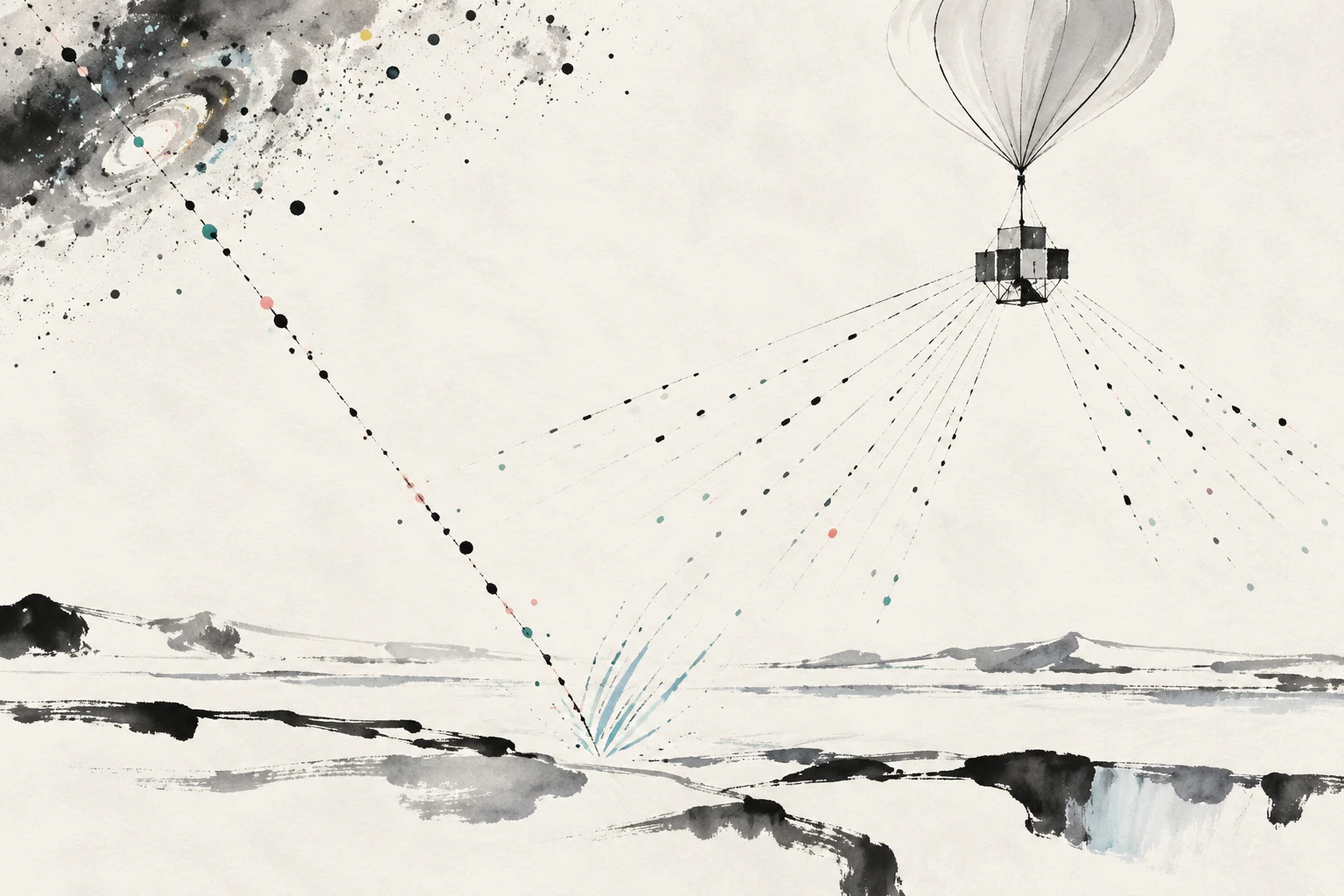
PUEO hangs beneath a NASA scientific balloon over Antarctica. Its antennas watch for two kinds of radio emission: the Askaryan effect and geomagnetic emission from an upward-going air shower. The instrument has 192 radio channels, split between horizontal and vertical polarizations. Each channel is digitized at 3 billion samples per second (3 GSa/s) by 24 Sampling Unit for RF (SURFv6) modules, each built around a Xilinx Radio Frequency System-on-a-Chip (RFSoC). Saving everything is impossible; the trigger recognizes the shape of a possible neutrino signal and discards the rest.
The trigger is fully digital and lives in the programmable logic of the digitizer chips. It first conditions the signal: it filters the frequency band, applies a matched filter to improve the signal-to-noise ratio (SNR), and can switch on digital notch filters to reject human-made radio-frequency interference (RFI). Then it normalizes the channels and reduces their dynamic range to 5-bit values. Only after that does it form beams.
Beamforming is the core trick: by adding signals from multiple antennas with tiny time delays, the system can point at different directions without moving. PUEO's trigger creates 48 synthetic beams—35 using eight antennas and 13 using six—covering roughly 25 degrees in zenith and 60 degrees in azimuth. Each beam is squared and summed over an 8-sample window every 4 samples to make an envelope. If that envelope crosses a threshold, the beam reports a level-one (L1) trigger.
Those triggers are combined at each module and then across modules. A global trigger saves a short window of data around the event. During the 2025–2026 flight, individual beams triggered at about 650 Hz. That produced about 28,000 L1 triggers per second per SURF module, but only about 4–5 level-two triggers per second in each 30-degree section, and a total experiment rate near 100 Hz. The trigger is not just finding signals. It is throwing away almost everything.
Preflight proof: half the time at SNR 1.5
The paper's central performance result comes from a ground test at McMurdo Station's Long Duration Balloon launch facility, before flight. The collaboration built a calibration instrument called the RF box, which feeds simulated Askaryan-like radio pulses into PUEO's electronics with controlled timing and amplitude. Because of space constraints in the hangar, only 12 lower-ring antenna paths were connected. The top-ring amplifiers were terminated to mimic the noise environment without adding signal.
By varying the signal strength in 11 approximately two-minute flight-like runs, the team measured how often the trigger fired when a simulated pulse arrived. The result: 50% trigger efficiency at a scaled single-antenna SNR of about 1.5. The scaling accounts for the fact that only 6 antennas were instrumented per SURF but all 8 had equivalent noise, so the measured 6-antenna SNR was multiplied by 3/4 to represent an 8-antenna beam. The system can catch a signal near the noise floor half the time.
It does so while using only about 5 W in the trigger logic excluding the optional biquad filters. Each biquad filter adds about 1 W in bypass and about 1 W more when active, so the trigger portion can reach about 9 W with two active filters. With two digital notch filters enabled, the trigger uses roughly 12% of the configurable logic blocks and 26% of the digital signal processing (DSP) resources on the chip.
The filter that worked, then flew disabled
Radio-frequency interference is a serious problem in Antarctica. Satellites in the Mobile User Objective System transmit near 360–380 MHz, and South Pole radio transmitters operate near 450 MHz. Earlier ANITA flights used analog notches. PUEO instead implements up to two programmable digital biquad filters, which carve out narrow bands with modest power and resource cost: each biquad uses about 1.5% of slices and 4.7% of DSPs, and adds about 1 W in bypass plus about 1 W more when active.
In preflight tests, injecting a 370 MHz sine wave into six channels at about 1.75 times the thermal noise RMS caused the automatic gain control and bit-reduction (AGC-BR) scale to fall by about 1.8× to compensate. Turning on the digital notch restored the scale to its no-interference value. The filter worked as designed.
But during the 2025–2026 flight, thermal constraints meant the system flew with RFI rejection disabled. The paper is clear about the consequence: only about 17% of the phi sectors—azimuthal slices—had interference significant relative to thermal noise. An atypical flight path generally kept multiple MUOS satellites out of view, and South Pole policy changes reduced the power of the 450 MHz transmitter when operationally viable. The paper attributes the omission to thermal constraints, not to the filter's preflight performance.
What the hangar test can—and cannot—tell us
The efficiency measurement is a preflight result, not a flight result. It used simulated signals injected by the RF box, not neutrinos from the ice. Only one direction was exhaustively measured, though it was chosen to represent likely arrival directions. The paper states that full trigger performance during the 2025–2026 flight will be covered elsewhere. The work is also posted as a preprint, so it has not completed formal peer review. Those caveats define its scope. The paper shows a low-power, fully digital trigger can run at 3 GSa/s, form 48 beams, and reach 50% efficiency at a scaled single-antenna SNR of about 1.5. It does not yet show how many neutrinos PUEO will see.
A balloon trigger built on ANITA and ARA
PUEO expands on the ANITA and ARA experiments with a fully digital trigger at 3 GSa/s, low-power FPGA matched filtering and beamforming, and resource-efficient RFI mitigation. The trigger runs in the programmable logic of the SURF modules, with the processing system powered down during operation for power and thermal reasons. It must make its decision on the payload in real time.
The preflight result is 50% efficiency at a scaled single-antenna SNR of about 1.5, using about 5 W without the optional biquads and up to about 9 W with two active. The paper says full flight trigger performance will be covered elsewhere; it does not yet report neutrino sensitivity. That is the next measurement.