
Can a Star Both Shield and Strip Its Planet’s Atmosphere?
A review of star-planet interactions maps how radiation, tides, and magnetic fields jointly shape exoplanet atmospheres, interiors, and orbits—and why the Solar System is a valuable but imperfect guide.
Jul 4, 2026
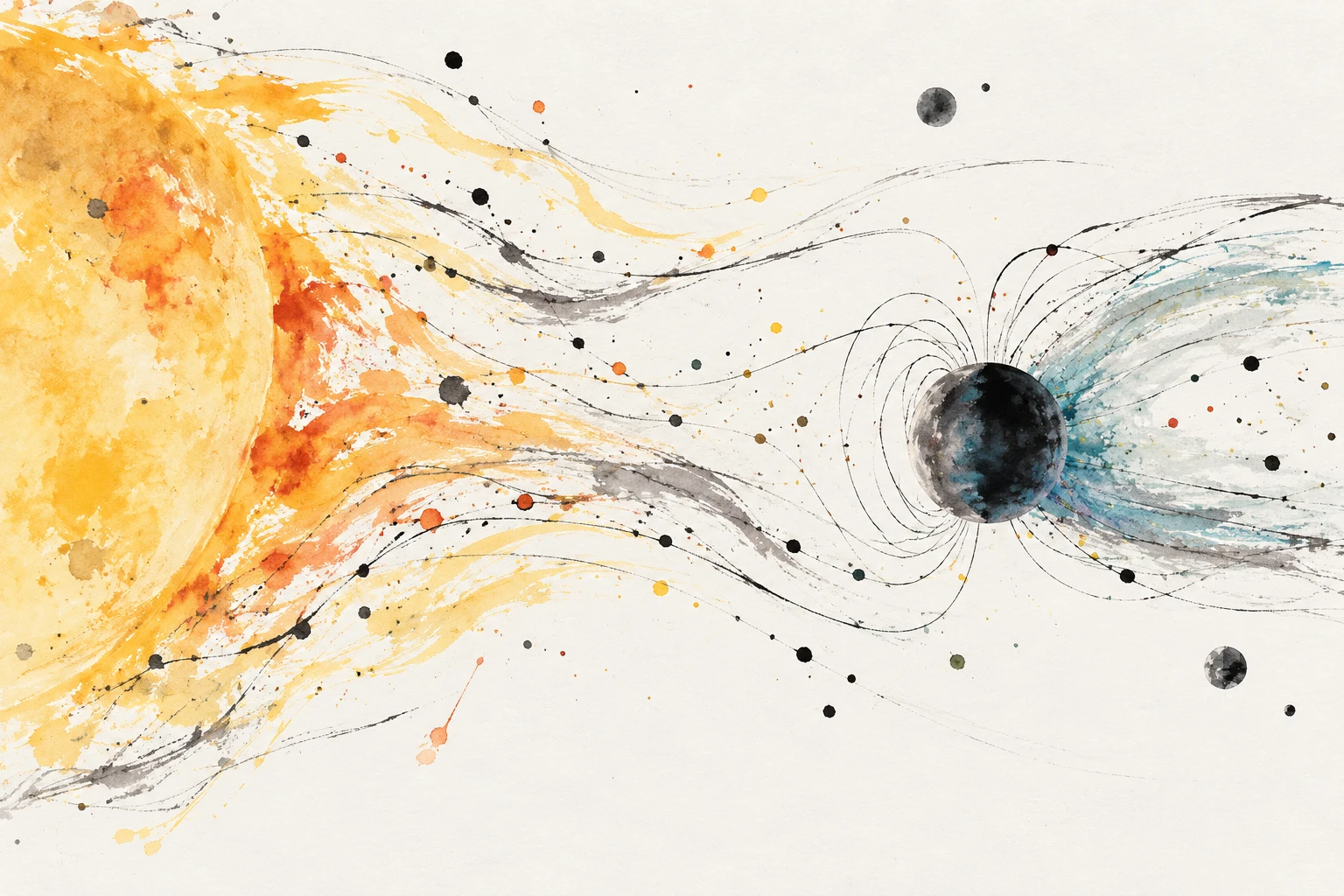
Imagine a planet closer to its star than Mercury is to the Sun. It is not just bathed in light. The star’s gravity stretches it, its wind pushes against its upper atmosphere, and its magnetic field may link directly to the planet’s own magnetism. These are star-planet interactions: the continuous exchange of energy, momentum, and mass between an exoplanet and its host star.
A review chapter now on arXiv (2607.03874v1) synthesizes what astronomers know about these interactions. It is not a single discovery. It is a map of a field built around the recognition that planets and stars evolve together, not separately.
The review organizes the physics into three pillars: radiation, tides, and magnetism. Together, they can shape a planet’s atmosphere, interior, and orbit. They help determine whether a world keeps its air, loses it, heats up, or spirals inward.
Radiation sets the escape budget—but the popular shortcut fails
High-energy stellar radiation, from X-rays through the far- and extreme-ultraviolet (together often called XUV), is a primary driver. It heats and ionizes the upper atmosphere, breaks molecules apart, and can give atmospheric particles enough energy to escape. Stellar winds and magnetic fields complicate the picture. They can shield a planet from some erosion, but they can also compress its magnetosphere and accelerate loss.
One caution from the review is that a popular shortcut for estimating atmospheric loss, called energy-limited escape, is often unreliable. Comparisons with detailed hydrodynamic simulations show it can overestimate or underestimate mass-loss rates by orders of magnitude, depending on the planet and the irradiation. The review stresses that the formula was developed as an upper-limit estimate for hydrogen-dominated primordial atmospheres; it is not appropriate for secondary atmospheres, and even for primordial cases it can fail badly when its assumptions are violated.
Tides can drag a hot Jupiter inward—or push another world out
Tides are not just about oceans. In a close star-planet system, gravitational tides redistribute energy and angular momentum. They can synchronize a planet’s rotation, circularize its orbit, heat its interior, and drive volcanic activity. They can also change the orbit: inward or outward migration depends on which way angular momentum is transferred between the planet’s orbit and the star’s spin.
For many hot Jupiters—giant planets on very short orbits—the review notes that a stable synchronous state is often impossible. Their systems are “Darwin unstable,” so tidal dissipation should cause continuous orbital decay. Yet clear observational proof is rare. The WASP-12b system remains the only widely accepted case of measurable orbital decay.
Magnetic wings, stellar hotspots, and a broken Jovian template
Magnetic interactions offer another channel. When a planet orbits inside the sub-Alfvénic region—where the relative flow is slower than magnetic waves—it can create Alfvén wings. These are current-carrying structures that connect the planet to the star and act like transmission lines for field-aligned currents.
Such coupling can heat the stellar chromosphere, producing localized “hotspots” in emission lines. It can also accelerate particles toward the star and, in principle, generate radio emission. Observations, however, are intermittent. Signals sometimes appear at the planet’s orbital period and sometimes vanish, leading researchers to describe star-planet interactions as having an “on-off” nature.
One striking recent example is the young, active HIP 67522 system. Analysis of TESS and CHEOPS data by Ilin et al. found that stellar flares cluster at a particular planetary orbital phase, a significant correlation that supports the idea that a close-in planet can help trigger flares on its host star. But no exoplanet radio emission has yet been confirmed, though several systems are promising candidates.
Magnetic fields can also act on a planet’s interior. If the stellar magnetic field changes as the planet orbits—because the star’s field is tilted, the orbit is inclined, or the planet’s distance varies—eddy currents can be induced in a conducting mantle or ionosphere. This is induction heating. Modeling in the review suggests this process could be profound for the TRAPPIST-1 planets. The three innermost worlds, TRAPPIST-1b, c, and d, may receive enough induction heating to create global magma oceans. In some models, volcanic outgassing could then supply transient secondary atmospheres even after primordial ones are lost.
Astronomers often use Io and Jupiter as a template. Io orbits inside Jupiter’s magnetosphere, drives powerful currents, feeds a plasma torus, and helps generate Jupiter’s radio emission. It is a natural laboratory for magnetic star-planet-like interactions. But the review warns against treating the Jovian system as a perfect analogue. Along Jovian field lines, the Alfvén speed diverges dramatically from the close star-planet profile, with differences reaching nearly three orders of magnitude. In close star-planet systems, the profile is comparatively smooth, varying by only a factor of about 4–5 between the planet and the star. That difference matters: in exoplanetary systems, Alfvén wings may act as extended obstacles, with energy tapped along a large stretch of the star-planet connection rather than only near the planet.
The review is a synthesis, not a final verdict. Efficiency factors in magnetic interaction models are poorly constrained. Atmospheric escape depends on planetary mass, composition, magnetic field, and the star’s full evolutionary history. Observations are often transient, and radio detections remain elusive.
The next step, the authors argue, is to couple models of interiors, atmospheres, and stellar winds into a single evolving system. That means moving beyond static pictures of a planet sitting in a stellar breeze. It means treating the star and planet as a connected, changing system. The broader message is simple: a planet’s habitability is not just about its distance from a star. It is also about the star’s radiation, tides, and magnetism—forces that can protect a world, reshape it, or strip it bare over billions of years.