
Can Astronomers See Planets Through the Magnetic Activity of Their Stars?
A new review shows how magnetic activity in cool stars obscures exoplanet signals while also governing the space environments where planets evolve.
Jun 30, 2026
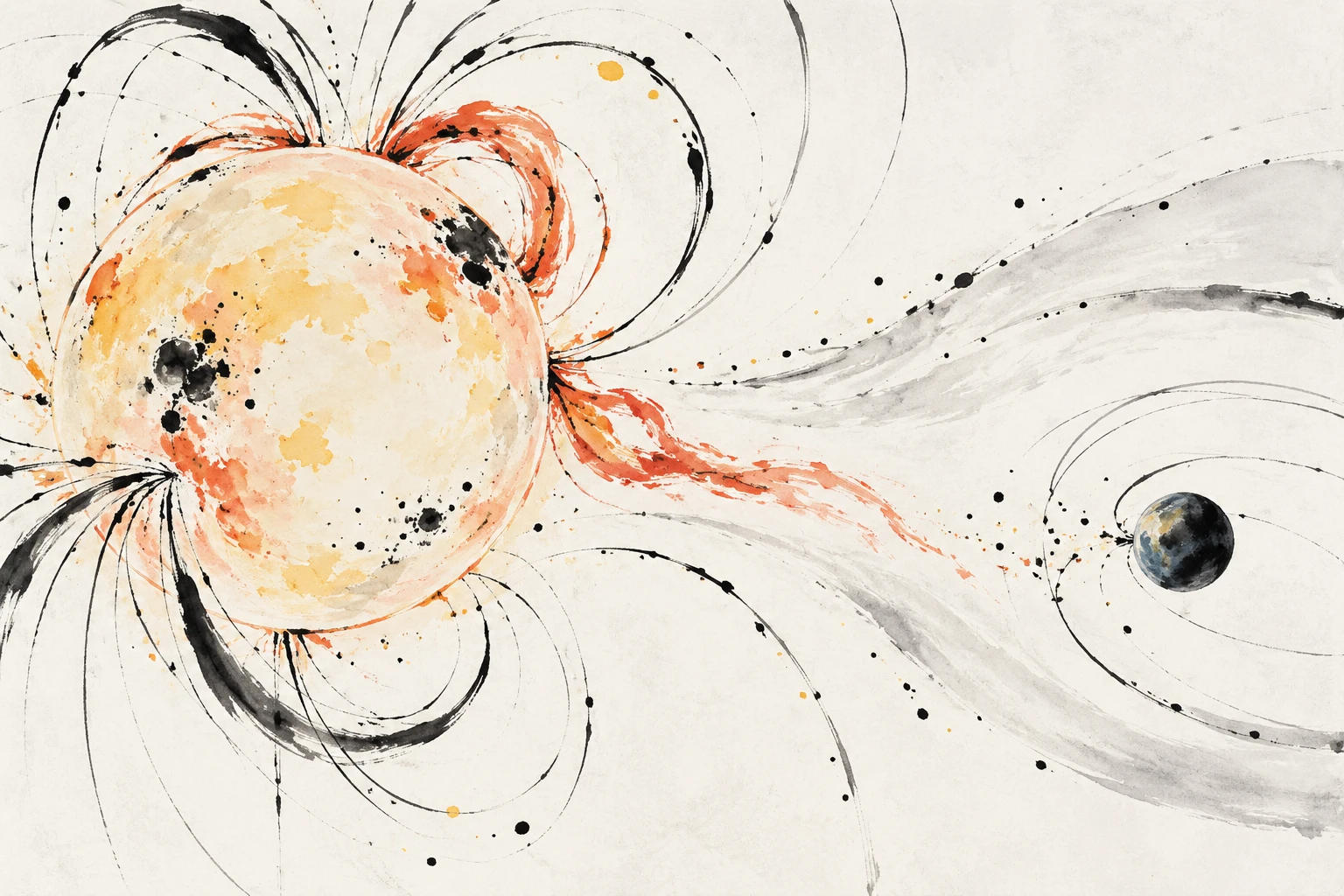
Imagine trying to hear a whisper next to a thunderstorm. That is roughly the challenge astronomers face when they search for planets around cool stars. The star itself is magnetic. Dark spots rotate across its face, bright plages and flares erupt, and the resulting flickers can look uncannily like a planet passing by or tugging its host star. A new review, posted to arXiv in June 2026, synthesizes how this stellar magnetism works—and why it matters for the exoplanets astronomers are trying to find and understand.
The review, led by Emre Işık and colleagues, focuses on cool stars: those with outer convection zones, including the Sun. In these stars, a magnetohydrodynamic dynamo generates magnetic fields deep inside. Those fields emerge at the surface as bipolar magnetic regions, the larger ones often involving sunspots. They heat the chromosphere and corona, modulate the star's radiation and wind, and power flares and coronal mass ejections. The phenomena span minutes to decades, from individual magnetic flux tubes to global coronal structures.
The Sun as a time machine
To understand distant stars, the review leans on the Sun—and on Sun-like stars at different ages as evolutionary snapshots of a solar-mass star. The “Sun in Time” framework uses such stars as stand-ins for different epochs. Observations show that the young Sun was dramatically more active. Its coronal X-ray and extreme-ultraviolet emission was roughly 100 to 1,000 times stronger than today's, while transition-region and chromospheric ultraviolet emissions were 20 to 60 and 10 to 20 times stronger. As the Sun spun down with age, its magnetic activity weakened. This matters for planets: high-energy radiation and particles can heat, ionize, and erode planetary atmospheres.
The noise that looks like a world
For planet hunters, the same activity is a nuisance. Starspots and faculae create quasi-periodic signals in brightness and in radial-velocity measurements, which track the tiny back-and-forth motion of a star caused by an orbiting planet. Those signals can mimic or mask planets. The review points to τ Ceti as a cautionary case. Earlier studies suggested planets near its habitable zone, but a 2025 analysis attributed those signals to stellar activity. After correcting for the star's activity cycle and rotation, the star showed a long-term radial-velocity precision of about 40 centimeters per second—the lowest value obtained to date on any star.
Activity also contaminates transmission spectroscopy, where astronomers measure a planet's atmosphere as it crosses in front of its star. Unocculted spots and faculae change the color of the stellar disk, creating spectral features that can be mistaken for atmospheric haze or Rayleigh scattering. Simplified contamination models can introduce biases comparable to real atmospheric signatures, especially for active stars.
A dynamo that can switch off
The review also examines how magnetic activity scales with rotation. Stars with similar internal structure but faster rotation generally show stronger activity. This relationship is often expressed through the Rossby number, which combines rotation period and convective turnover time. At low Rossby numbers—meaning fast rotation—activity saturates; below a threshold near Ro ≈ 0.1, faster rotation no longer increases X-ray emission.
The relationship appears steeper than once thought. For solar-type stars, the mean unsigned magnetic field—measured through Zeeman broadening, a technique that uses spectral-line broadening to gauge total field strength—grows strongly as rotation increases. Modeling suggests the rate at which magnetic flux emerges must scale nearly quadratically with rotation, with an exponent around 1.9, not linearly. In fast rotators, active regions dominate the surface field; in the Sun, small-scale dynamo fields dominate.
Then there is a possible midlife transition. Recent spectropolarimetric measurements show that the large-scale dipole field of solar-like stars declines sharply near the solar Rossby number. That drop coincides with weakened magnetic braking, the process by which magnetized winds carry away angular momentum and slow a star's rotation. The review discusses a subcritical dynamo framework: near solar age, the global dynamo may become less efficient, allowing stars to flip between active and quiet states. This could explain why the Sun is less active than many similar stars, why gyrochronology—aging stars by their rotation—breaks down for middle-aged and older stars, and why grand minima like the Maunder Minimum occur.
The review is candid about uncertainty. Stellar coronal mass ejections—plasma eruptions that can strip atmospheres—are difficult to observe; only a few confirmed detections exist. Flares are better characterized, but how their energy is distributed across optical, ultraviolet, and X-ray wavelengths is not fully mapped. Extreme-ultraviolet light, which drives much atmospheric escape, is absorbed by interstellar gas and cannot be observed directly for most stars. Astronomers must reconstruct it from other wavelengths or models.
Surface mapping techniques each have blind spots. Zeeman-Doppler imaging recovers the large-scale magnetic field but misses small-scale, mixed-polarity flux. Doppler imaging can produce artifacts from incomplete phase coverage. Transit spot mapping gives tight latitudes along the planet's path but suffers from degeneracies between spot size and temperature. The review stresses that samples must be homogeneous in mass, temperature, and metallicity; otherwise, trends attributed to rotation may be confused by other stellar properties.
The way forward, the authors argue, is coordinated observation and forward modeling. Combining photometry from Kepler and TESS with high-resolution spectra from instruments like HARPS and HARPSpol, X-ray monitoring, and radio observations can capture activity across atmospheric layers. Physics-based models can translate surface magnetic maps into synthetic signals, allowing astronomers to test whether a bump in a light curve is a planet or a starspot. For astrometry—the measurement of a star's tiny position shifts on the sky—the news is relatively good: for the Sun viewed from 10 parsecs, the activity-induced astrometric signal is about 0.2 microarcseconds or less (rms ≈ 0.07), below the roughly 0.3 microarcsecond wobble expected from an Earth-mass planet in the habitable zone. But for young, fast-rotating, or very nearby stars, stellar noise can dominate.
None of this makes exoplanet science hopeless. It makes it inseparable from stellar physics. The same magnetic fields that blur a planet's signal also sculpt the space environment where that planet lives. Understanding the star is not a distraction from the search for other worlds. It is part of the search. The next generation of surveys will need to treat stellar magnetism not just as noise to subtract, but as a physical system to map—a weather report for worlds we are only beginning to see.