
NuSTAR Separates a Galactic Center Pair, Sharpening the Case for One Ultracompact Binary
A new NuSTAR analysis resolves SLX 1744-299 and SLX 1744-300 above 10 keV for the first time, showing one fading, one bursting, and tightening indirect limits on whether either is an ultracompact X-ray binary.
Jun 9, 2026
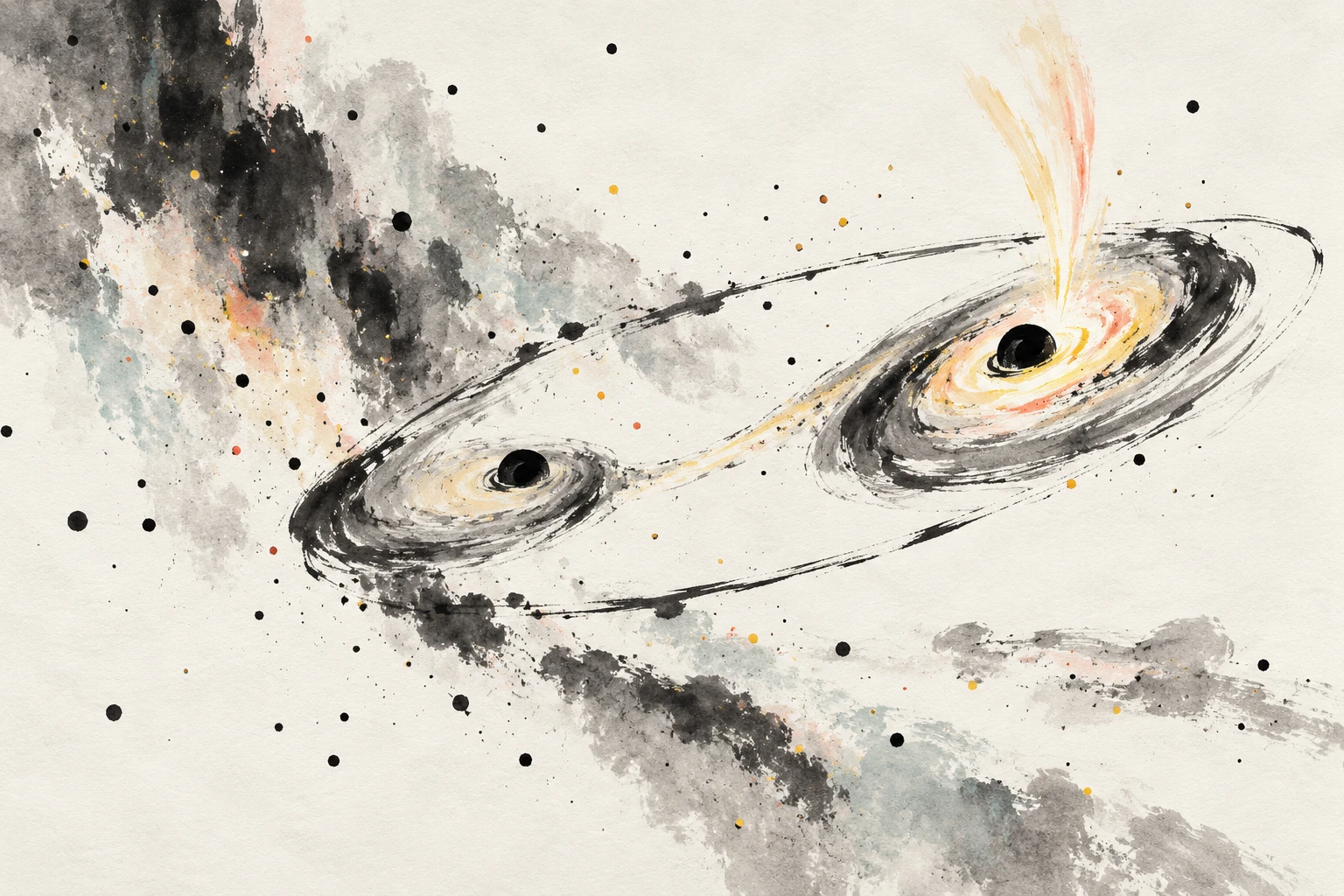
In 1987, an X-ray telescope aboard Spacelab 2 saw a single bright source near the Galactic Center. Improved image reconstruction later revealed two separate low-mass X-ray binaries, SLX 1744-299 and SLX 1744-300, separated by only about 2.7 arcminutes. For decades, their hard X-ray light above 10 keV remained blended. A new analysis of archival NuSTAR data has finally split them.
Both are low-mass X-ray binaries: systems in which a neutron star or black hole pulls gas from a companion less massive than the Sun. In these two, Type-I X-ray bursts have confirmed that the compact object is a neutron star. Astronomers are especially interested in the ultracompact members of this family. An ultracompact X-ray binary has an orbital period shorter than about 80 minutes, so its companion is a degenerate or semi-degenerate star that no longer burns hydrogen in its core. The donor is hydrogen-poor, the accretion disc is tiny, and such systems are expected to be strong sources of low-frequency gravitational waves for the future LISA mission. Yet only 20 are confirmed and 25 are candidates, while population estimates suggest many more exist. Finding them is hard because orbital periods are rarely measurable.
SLX 1744-299 has been considered an ultracompact candidate because it is faint, persistent, and has shown intermediate-duration bursts. SLX 1744-300 has remained largely unconstrained. To judge either, astronomers first had to separate their X-ray emission.
Splitting the pair above 10 keV
Enzo A. Saavedra and colleagues at the Instituto de Astrofísica de Canarias analyzed a NuSTAR observation from July 29, 2018. NuSTAR, the Nuclear Spectroscopic Telescope Array, focuses hard X-rays from 3 to 78 keV. Its sharp imaging is what allowed the two sources to be resolved individually above 10 keV for the first time. The on-source exposure was 44.2 kiloseconds over 79 kiloseconds of elapsed time. The researchers extracted spectra and timing data, and simulations showed that cross-contamination between the two sources was about 1 percent or less, negligible for their analysis.
Earlier XMM-Newton observations in the 0.5-10 keV band found SLX 1744-299 about 1.9 times brighter than SLX 1744-300. NuSTAR saw the opposite. In the 3-78 keV band, SLX 1744-300 was slightly brighter, with a flux ratio of about 1.15. Extrapolated to 0.5-10 keV, the ratio becomes about 1.3. The pair's relative brightness is not fixed; it changes on both long and short timescales.
One fades, the other bursts
Both sources were in the hard state, an accretion regime marked by strong aperiodic X-ray variability and a hard spectrum. Their fractional rms variability was about 23 percent, and their spectra were well described by thermal Comptonisation: low-energy seed photons scattered to higher energies by hot electrons. But their behavior diverged.
SLX 1744-299 faded gradually, dropping 28 percent over the observation. As it faded, its spectrum hardened. The photon index fell from about 2.4 to 2.2, the seed-photon temperature cooled from about 0.6 to 0.2 keV, and the electron temperature rose from about 20 to above 40 keV. The authors interpret this as a declining mass-accretion rate: fewer seed photons made Compton cooling less efficient, allowing the corona to heat up.
SLX 1744-300 stayed steady but produced two Type-I X-ray bursts, thermonuclear flashes on the neutron star surface. Each lasted about 30 seconds and showed the characteristic cooling of the neutron star photosphere. Their short recurrence, about 5 hours or less, points to mixed hydrogen and helium burning rather than pure helium.
Faintness as a clue to a short orbit
Using previously reported upper limits on distance, the team derived upper limits on persistent X-ray luminosity: less than about 1.1 x 10^36 erg per second for SLX 1744-299 and less than about 2.6 x 10^36 erg per second for SLX 1744-300 in the 3-78 keV band. Converting these to mass-accretion rates and comparing them with the disc instability model, which predicts when an accretion disc stays ionized and stable, they found that a persistently stable disc at the low rate of SLX 1744-299 requires an orbital period below about 90 minutes. For SLX 1744-300, the upper limit on the orbital period is about 105-155 minutes.
Both limits allow an ultracompact nature, but the case for SLX 1744-299 is much tighter and more compelling, especially given its earlier intermediate-duration bursts. SLX 1744-300 remains a weaker candidate.
This work does not measure either orbital period. The periods are inferred from luminosity limits and a model. The distances are upper limits, not measurements, because no burst showed photospheric radius expansion. The disc instability comparison assumes that accretion is radiatively efficient and that mass transfer matches accretion. NuSTAR's low-energy cutoff at 3 keV also limits sensitivity to soft thermal emission below that threshold. The burst recurrence limit could be affected by gaps from Earth occultations. The paper is posted as an arXiv preprint (v1).
Still, the observation shows what hard X-rays can do in crowded regions. By splitting a pair that had blurred together for decades, NuSTAR has turned a long-standing ambiguity into a sharper question: is SLX 1744-299 an ultracompact X-ray binary? If so, it would be one more laboratory for accretion without hydrogen, and a potential source of low-frequency gravitational waves for LISA.