Faint Galaxies May Be Spun Out, Not Shut Down
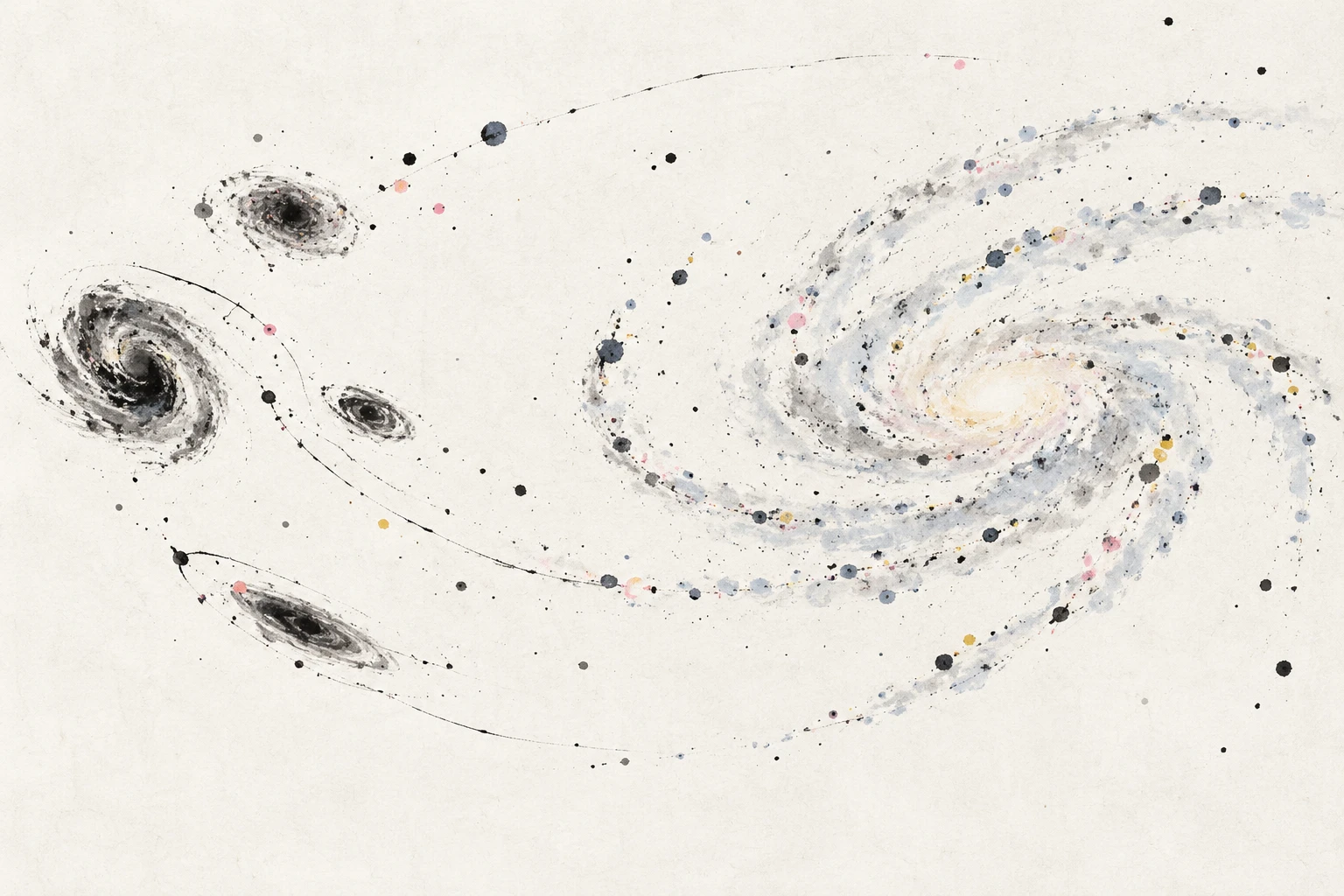
In IllustrisTNG simulations, low surface brightness galaxies have star-formation histories broadly similar to brighter galaxies, but higher halo spin and stellar angular momentum push material outward and dim their centers.
Jun 8, 2026
Imagine a galaxy so faint that its disk barely rises above the dark sky. Astronomers call such objects low surface brightness galaxies, or LSBGs: diffuse, extended systems with only a thin scattering of stars per patch of sky. They are not rare. Earlier surveys suggest they may make up roughly 30 to 50 percent of the galaxy population, and more sensitive surveys keep finding more. Yet their origin has remained surprisingly unsettled.
A new study using the IllustrisTNG suite of cosmological simulations traces thousands of them back through cosmic time. The work, led by Luis Enrique Pérez-Montaño and colleagues and posted as a preprint on arXiv, suggests that the faint look of these galaxies is not mainly a story of stalled star formation. It is a story of spin.
The spin before the faintness
LSBGs are defined by their central surface brightness—how much light comes from a given patch of sky. The classic threshold is about 21.65 magnitudes per square arcsecond in blue light; this study uses 22.0 in the r band. Larger magnitude numbers mean fainter light. Bright disk galaxies have central surface brightness brighter than the threshold (lower magnitude values), while LSBGs are fainter (higher magnitude values). The question is whether they were born faint or became faint, and what physical process did the dimming.
The new analysis focuses on central galaxies—the most massive galaxy in a dark matter halo—drawn from TNG100, a roughly 100-Mpc-per-side simulation that follows gravity, gas, star formation, black-hole feedback, and related physics. The team selected 12,220 central galaxies with stellar masses between 10^9 and 10^12 Suns. Of those, 3,231 were classified as LSBGs and 8,989 as high surface brightness galaxies, or HSBGs. Then they used merger trees, which link a galaxy to its ancestors across cosmic time, to compare how the two groups grew.
Redshift is a cosmic clock: higher values mean earlier times. The simulations show that LSBG and HSBG progenitors were not dramatically different at very early epochs. Then, around redshift 2, the host halos of future LSBGs—especially at intermediate and high masses—began to stand out. Their spin parameter, a measure of the angular momentum of the halo and its contents, rose by roughly a factor of two compared with HSBG halos. The specific angular momentum of the stars, or angular momentum per unit mass, diverged later, around redshift 1.5 to 0.5. The paper argues that this angular-momentum divergence comes before the emergence of the low-density nature, making high angular momentum a plausible cause rather than a coincidence.
In the simulation, the extra angular momentum keeps gas and stars from settling into a compact central mass. Instead, material is redistributed outward, lowering the central surface brightness. Once the low-density nature is established, the simulations show little further change in central stellar surface density.
Stars form, but farther out
Here is the counterintuitive part. LSBGs are often described as feeble star formers. But the new simulation finds that their star formation histories are broadly similar to those of HSBGs of the same stellar mass, with differences mainly in the spatial distribution. The difference is not when stars form, but where. In low surface brightness galaxies, ongoing star formation is shifted toward the outskirts. At recent epochs, especially below redshift 0.5, LSBGs often show higher outer star formation rates than their brighter counterparts. They are not dead. They are spread out.
This spatial shift also helps explain why LSBGs can look so diffuse without being especially old or passive. New stars are appearing in an extended disk rather than concentrating in the center. For massive LSBGs, the inner regions do eventually quench, but the outer disk keeps forming stars longer than in massive HSBGs. The paper links these trends to an inside-out picture, in which central star formation shuts down first while outer regions can remain active.
Mergers help the giants
Mergers and interactions add another piece, but mainly for the giants. For low-mass LSBGs, the fraction of stellar mass formed outside the galaxy and later accreted—called the ex-situ fraction—has a median generally below about 15 percent, though it can reach around 30 percent. For intermediate-mass systems, mergers are still not the main driver, although accreted mass matters more for dispersion-dominated LSBGs. But for massive LSBGs, accreted stars can contribute 40 to 60 percent of the total stellar mass by the present day. Mergers can bring in high-angular-momentum material and help redistribute stars and gas to larger radii, reinforcing the diffuse look. The authors note that mergers seem most relevant for building LSBGs in massive galaxies.
Morphology matters less than one might expect. In the simulation, LSBGs are mostly rotation-dominated systems, galaxies supported by ordered rotation rather than random motions. Their disks become more rotationally supported over time. But once the low surface brightness nature is established, later changes in morphology do not appear to erase it. The faintness is stubborn.
What the simulation cannot yet tell us
Several caveats temper the result. This is a simulation, not a telescope observation. It depends on the physics recipes built into IllustrisTNG, including how stars form and evolve, how black holes feed back, and how chemical enrichment proceeds. The study examines central galaxies only, so it deliberately excludes satellites, where environmental processes such as ram-pressure stripping, tidal interactions, and galaxy harassment can dominate. Some subsamples are small, especially intermediate-mass dispersion-dominated LSBGs, which number only 12 and produce noisy trends. The classification also relies on a fixed surface brightness threshold and on face-on measurements without dust extinction in the synthetic images.
Even with those limits, the picture is coherent: faint galaxies may not be failed galaxies. They may be galaxies whose host halos spun them out, pushing their stars and gas into wide, dim disks. Their light is still there, just written in broader strokes. The next step is to see whether real LSBGs in the sky carry the same fingerprint of spin, mergers, and outer-disk star formation that the simulated ones do.