Can a Boosted Hubble See the Light That Reionized the Universe?
A new white paper argues that a boosted Hubble could map the shape of ionizing radiation escaping star-forming galaxies, filling a gap between measurements near the Lyman edge and the full ionizing spectrum that models aim to describe.
Jun 4, 2026
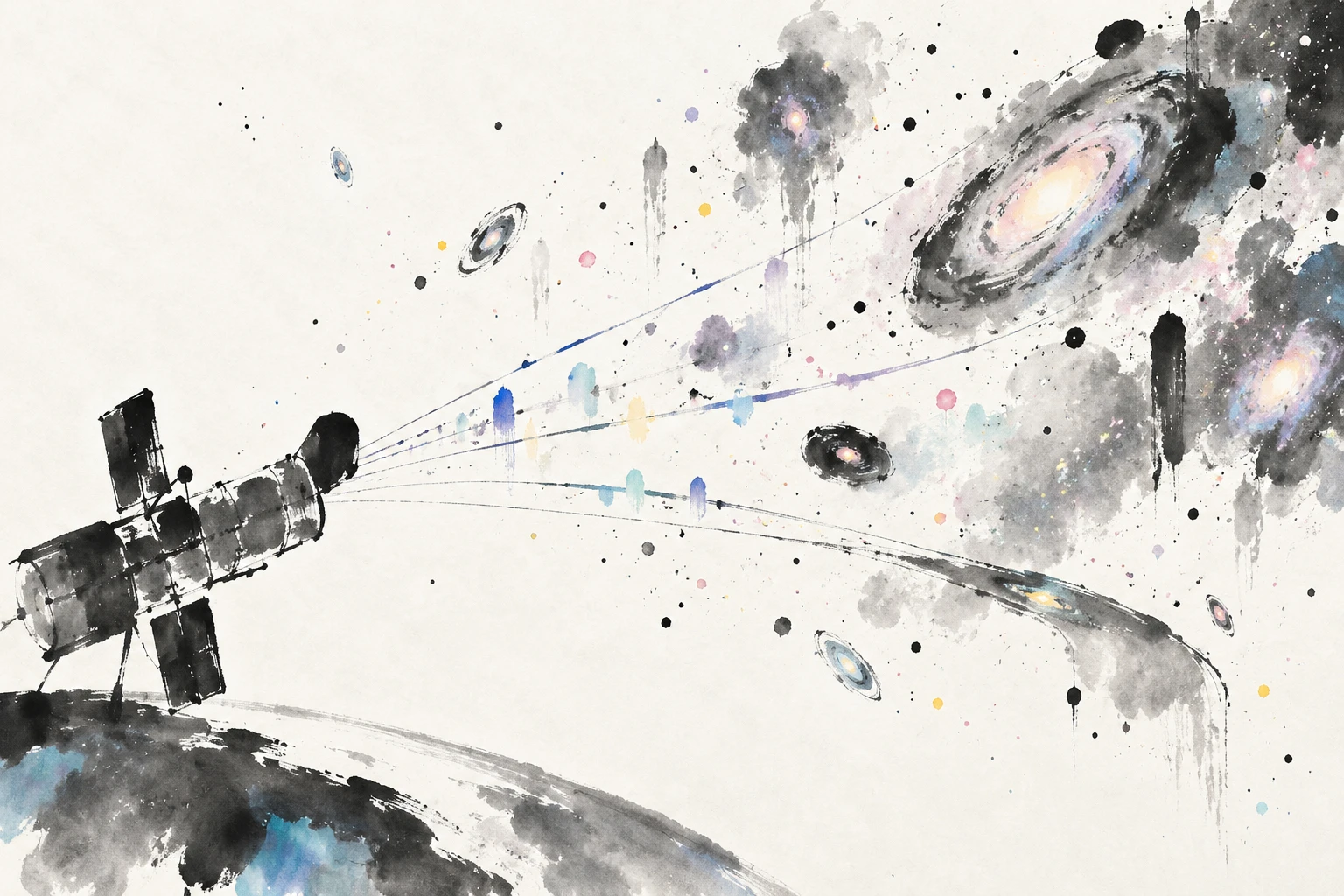
The universe is mostly ionized, and star-forming galaxies are thought to have contributed to creating and sustaining that state by letting ionizing photons escape. A new white paper led by Stephan R. McCandliss of Johns Hopkins University, submitted to the Space Telescope Science Institute's request for Building a Roadmap for Hubble science into the 2030s, argues that a boosted Hubble Space Telescope could carry out deep panchromatic spectroscopy of star-forming galaxies. The work could help reveal the shape of the escaping ionizing radiation and serve as precursor science for the future Habitable Worlds Observatory.
The Lyman edge is not the whole escape story
The most direct way to study escape is to look for the Lyman continuum: ultraviolet light just shortward of 911.8 angstroms. At high redshift, intergalactic hydrogen clouds absorb almost all of this light before it reaches us; direct detections rely on rare, lucky sightlines. At low redshift, the paper notes, the intervening opacity is negligible—at redshift around 0.3, where much of the LzLCS+ data were acquired. The Low-z Lyman Continuum Survey plus, or LzLCS+, is an 89-object database spanning redshifts 0.22 to 0.45, built largely from Hubble's Cosmic Origins Spectrograph (COS) low-resolution G140L mode. The paper calls these data the gold standard for inferring the physics of LyC escape at high redshift by JWST.
Calculations in the paper show that the shape of a galaxy's ionizing spectrum matters: measuring just below the Lyman edge can miss much of the total ionizing output. The paper uses an edge escape fraction at 900 angstroms, just below the Lyman edge. The paper points out that this value can be very low—less than 1 percent—while the integrated escape fraction across the whole Lyman continuum can be about 10 percent. The two numbers are not linearly related.
Part of the reason is nebular emission. When free electrons recombine directly to the n=1 level of hydrogen, they can produce a broad excess of light up to about 100 angstroms shortward of the edge, called the Lyman bump. Its strength depends on the clumpiness and column density of the interstellar medium. Dust may also alter the spectrum beyond the Lyman edge, but that behavior is essentially unexplored. As a result, the 850–911.8 angstrom window is not a reliable proxy for the total ionizing output.
Hubble's current LzLCS+ spectra miss diagnostic lines
The LzLCS+ spectra were taken with COS G140L CENWAVE=800. At the sample's median redshift of about 0.3, that wavelength range does not reach most rest-frame features longward of the Si IV doublet. Missing are lines such as N IV, C IV, He II, O III, and N III—diagnostics that constrain the age, chemical enrichment, and presence of evolved Wolf-Rayet populations.
Without those lines, models of star formation history are less secure. The paper shows a FICUS fit for one galaxy, J115855+312559. The fit favors light-weighted ages under 3 million years, but the model set only extended to 10 million years. The code is now being updated to include much older stellar populations. That matters because to judge whether low-redshift leakers are true analogs of high-redshift galaxies, models need to reach several billion years; signs of ancient star formation much older than about 1 billion years would argue against an analogy.
A 450-orbit start, with a 500–1,000 orbit push to medium redshift
The authors propose deep panchromatic spectroscopy—covering a broad range of wavelengths—with Hubble's Cosmic Origins Spectrograph and Space Telescope Imaging Spectrograph (STIS). One goal is to complete near-ultraviolet coverage of the 89 LzLCS+ objects with STIS, reaching a signal-to-noise ratio of about 10 at 2310 angstroms. They estimate roughly 5 orbits per object, or about 450 orbits total.
A second goal is to expand to a medium-redshift sample near redshift 0.5. That would require about 20 orbits per object for 20 to 40 galaxies, a 500 to 1,000 orbit program. By targeting galaxies that drop out at 900 angstroms, the observations might reveal some that drop back in toward 600 angstroms, if dust attenuation levels off as some models suggest. That would probe the ionizing spectrum over a rest-frame band from 500 to 900 angstroms; the paper calls the advance in understanding the LyC shape out to 700 angstroms unprecedented.
Data from such a program would become a resource for designing the Habitable Worlds Observatory (HWO). The paper argues that the data and analysis techniques could help optimize spectrograph design parameters and allow efficient detection of interstellar-medium outflow signatures. A dedicated Treasury-style program, with data freely accessible to the wider ionizing-photon (iPhoton) community, would let many researchers contribute models and analyses. The authors frame this as a lower operating cost way to catalyze crowd-sourced answers.
This is a white paper, not a new detection. Its orbit estimates and science returns are forecasts based on current instrument background limits and model assumptions. The Lyman bump's strength depends on the interstellar medium in each galaxy. Dust behavior beyond the Lyman edge is theoretical. The FICUS example has caveats, including possible aperture corrections and incomplete old-population models. And at higher redshifts, intergalactic absorption still makes direct Lyman continuum detection difficult; the proposed medium-redshift sample would require long exposures and targets selected for the expected drop-out behavior.
Still, the question is fundamental. The universe is mostly ionized, and star-forming galaxies are thought to have contributed by letting ionizing photons escape. Hubble's ultraviolet eyes have already caught the edge of that process. A boosted Hubble, the authors argue, could finally reveal its shape—and help the next great observatory know where to look.