
How Cold Is Dark Matter? JWST-Led 28-Lens Study Tightens the Answer
A new analysis of 28 quadruple-image gravitational lenses—26 observed with JWST's MIRI and two with Keck/Hubble narrow-line measurements—finds no evidence for warm dark matter deviations on dwarf-galaxy scales, setting upper limits on the dark matter free-streaming length and strengthening key predictions of cold dark matter.
Jun 3, 2026
A Quasar Split Four Ways
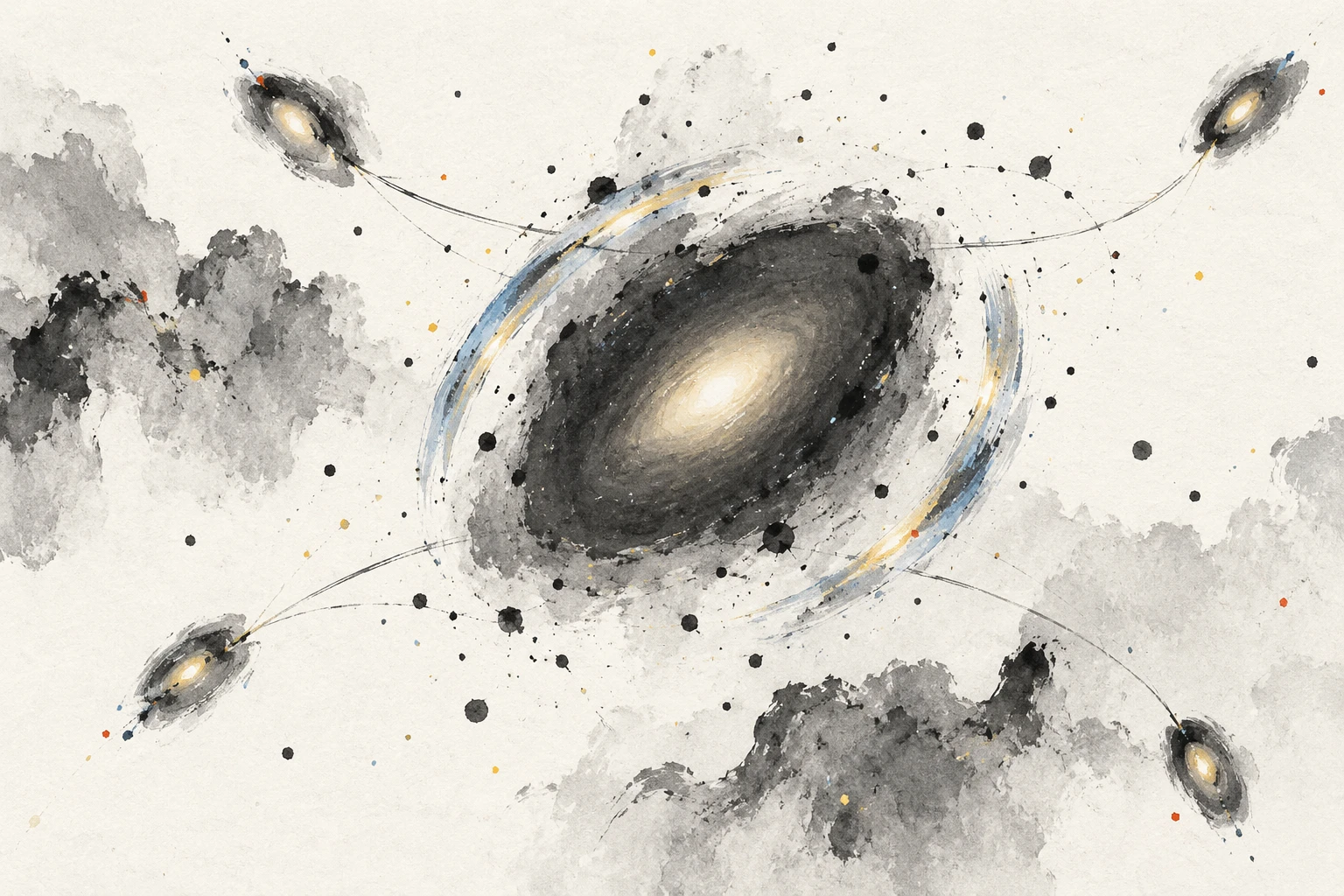
When a massive elliptical galaxy sits almost exactly between Earth and a distant quasar, its gravity can bend the quasar light into four bright images. The copies are not perfect. They are slightly misplaced and unevenly bright, because unseen clumps of matter—dark matter halos and subhalos in the lens plane and along the line of sight—nudge the light along its journey. That tiny distortion is the signal behind a new study of 28 such lenses.
Why Tiny Warps Matter
Dark matter emits no light, and its particle nature remains unknown. One key property is the free-streaming length: the distance dark matter particles traveled in the early universe before density fluctuations could grow appreciably. Slow, cold particles have a short free-streaming length and can form halos down to very small masses. Fast, warm particles stream farther and erase the smallest clumps. Counting those small halos is therefore a way to infer what dark matter is made of.
The team observed 26 quadruply imaged quasars with JWST's Mid-Infrared Instrument, or MIRI. Two more systems came from narrow-line measurements with Keck and Hubble. MIRI detects mid-infrared emission from warm dust around the background quasar, a region 1 to 10 parsecs across—about 3 to 33 light-years. That size is critical: it is large enough to avoid strong contamination from stellar microlensing in the foreground galaxy, but small enough to feel perturbations from dark halos as light as about a million solar masses.
The researchers also modeled extended lensed arcs, the stretched images of the quasar host galaxy, together with the image positions and brightness ratios. The arcs help pin down the mass profile of the main foreground galaxy, breaking some degeneracies that can let ordinary lensing effects mimic dark matter clumps. They detected arcs in 24 of 28 systems.
The Dark Matter Speed Limit
The new analysis places upper limits on the free-streaming length. Under subhalo abundances predicted by cosmological N-body simulations—computer models that follow gravity on cosmic scales—the data rule out deviations from cold dark matter above about 10^7.2 solar masses. For predictions from the semi-analytic galacticus model, the scale is about 10^7.4 solar masses. Those bounds correspond to a free-streaming length shorter than 6.0 kiloparsecs and 7.0 kiloparsecs, respectively. A kiloparsec is about 3,260 light-years.
Using the paper's 10:1 Bayes-factor criterion, the limits translate to a spin-1/2 thermal relic mass greater than 7.4 keV or 6.5 keV, depending on which simulation prediction is used. Spin-3/2 particles give slightly weaker bounds. These are not direct detections of dark matter particles. They are constraints on a class of warm dark matter models, based on how such particles would change the population of small halos.
A Census of Invisible Clumps
Assuming cold dark matter's negligible free-streaming length, the team also measured the projected mass in dark subhalos around elliptical galaxies: 1.7 with uncertainties of plus 2.6 and minus 1.2 times 10^7 solar masses per square kiloparsec, at 95 percent confidence. In terms of mass fraction near the lensed images, that is about 3.2 percent, with a range from 0.9 to 8.3 percent. This is a census of clumps that are mostly invisible, inferred through gravity alone.
The measurement is consistent at the 2-sigma level with predictions from both galacticus and the Symphony N-body simulations. The paper notes a tentative 1.8-sigma tension with Symphony, but that is not decisive. More data could show whether simulations slightly under-predict subhalo abundance around strong lenses, or whether lenses contain extra sources of small-scale perturbation.
What the Result Does Not Say
This is a preprint, and the conclusions depend on modeling choices. The strongest limits use priors on subhalo abundance from simulations and semi-analytic models. Under a less informative prior, the paper reports a weaker 95 percent exclusion limit on a spin-1/2 thermal relic mass of about 4.7 keV; the corresponding 10:1 Bayes-factor limit is about 3.0 keV. The analysis also faces a known covariance: warmer models with more massive subhalos can mimic colder models with fewer massive subhalos. More lenses and independent probes can help break that degeneracy.
The result does not prove cold dark matter. It does, however, confirm some of its key predictions on scales above roughly 10^7.2–10^7.4 solar masses. It also narrows the room for warm dark matter particles that would have erased small structures in the early universe.
A Map Written in Light
The most striking part of this work is its method. Astronomers cannot see dark matter halos directly, but they can watch how those halos warp the light of distant quasars. A slight mismatch in the brightness of four images becomes a probe of invisible architecture across cosmic time.
Future surveys are expected to discover hundreds of new quadruply imaged quasars. If dark matter is cold, those lenses should sharpen the constraints further. If it is warm, the same technique might eventually detect a turnover in the halo mass function—the missing small clumps that warm particles would have prevented. For now, the light from 28 distant quasars says that dark matter on dwarf-galaxy scales is consistent with cold dark matter.