
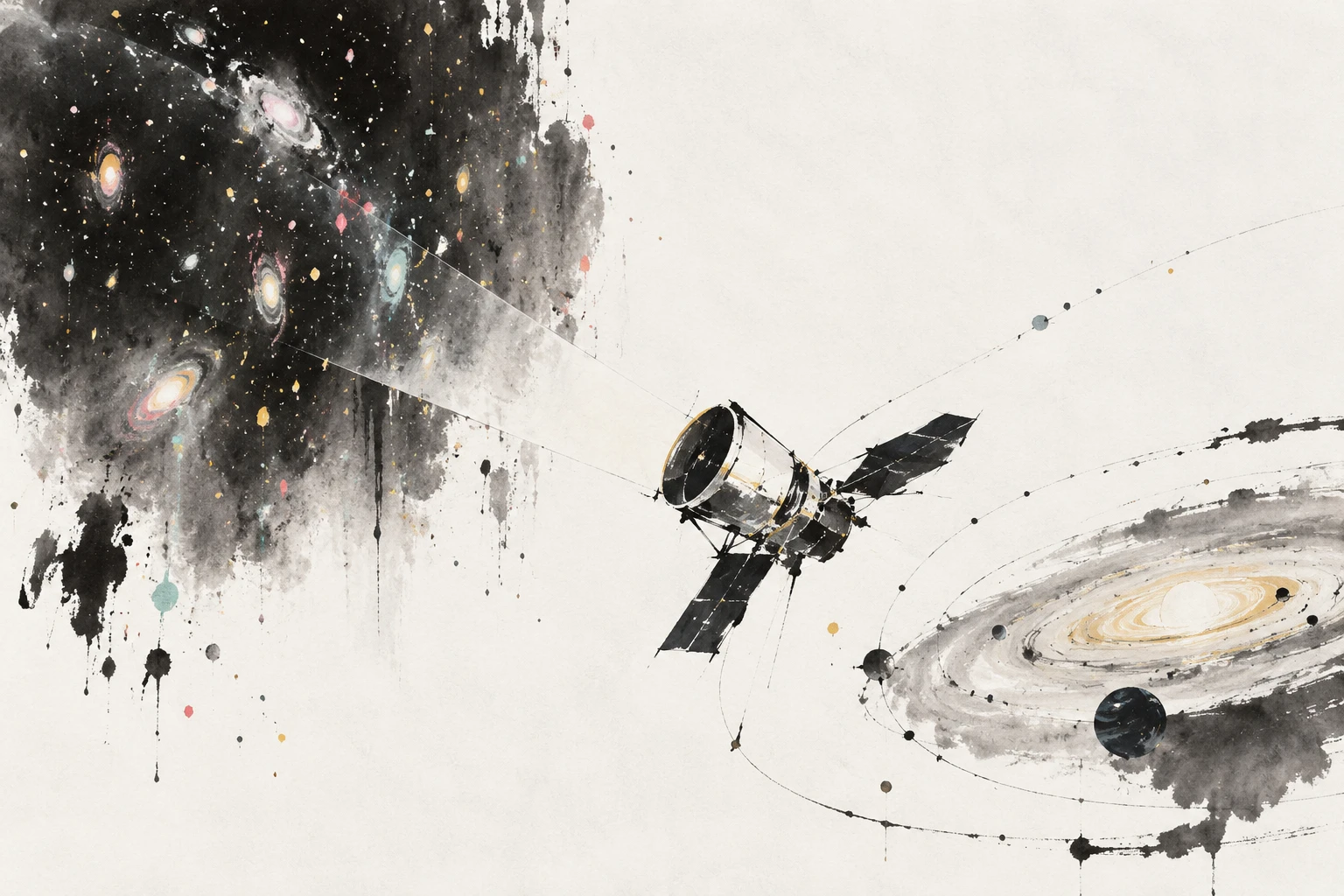
Can a 1-Meter Space Telescope See the First Galaxies and Water's Snowline?
A new science book outlines how the proposed JAXA mission GREX-PLUS would use a cooled infrared telescope to hunt galaxies beyond redshift 15 and locate water's snowline in planet-forming disks.
Jun 3, 2026
Some of the most important light in the Universe never reaches the ground. Water vapor, carbon dioxide, and other molecules in Earth's atmosphere swallow mid-infrared wavelengths. The oldest galaxies, their light stretched by cosmic expansion, also slide into the infrared. A proposed Japanese space mission called GREX-PLUS—short for Galaxy Reionization EXplorer and PLanetary Universe Spectrometer—is designed to go above that atmosphere and catch both kinds of signal. Its science team has now released the second version of a science book outlining what such a mission could do. It is a preprint, not a launch announcement, and not an observational discovery.
A 1-Meter Telescope, Chilled to 50 K
The GREX-PLUS concept calls for a telescope with a 1-meter primary mirror cooled to 50 K—about minus 223 degrees Celsius. It would operate in a Sun-Earth L2 halo orbit, and is envisioned as a JAXA strategic L-class mission launching in the 2030s on an H3 rocket. The baseline lifetime is five years.
Two instruments sit at the heart of the plan. A wide-field camera would image a broad swath of sky in five bands from 2 to 8 micrometers, in the near- and mid-infrared. A high-resolution spectrometer would observe from 10 to 18 micrometers with a resolving power of about 30,000. That is roughly ten times finer in wavelength than JWST's spectrographs over the same range. But the spectrometer is listed as optional because two key technologies—its detector and an immersion grating—remain challenging to procure and build.
The Camera: Hunting Galaxies at Redshift 15
One primary goal is to detect the first generation of galaxies at redshift greater than 15. Redshift measures how much cosmic expansion has stretched a galaxy's light; z greater than 15 corresponds to a cosmic age of less than a few hundred million years after the Big Bang. At those distances, hydrogen in intergalactic space absorbs ultraviolet light shortward of the Lyman-alpha line. That break is pushed beyond 2 micrometers, into a range that the Roman and Euclid space telescopes do not cover across the full 2-8 micrometer span. GREX-PLUS would.
The planned survey tiers are deliberately broad. A deep survey would cover 10 square degrees to about 26.5 AB magnitude in the shorter-wavelength 2–4 micrometer bands; a medium survey 100 square degrees to 25.5 AB magnitude; and a wide survey 1,000 square degrees to 24 AB magnitude. The longer-wavelength bands are shallower: for example, the deep survey reaches about 24.5 AB magnitude at 5.2 micrometers and 23.5 AB magnitude at 6.8 micrometers, according to the baseline plan. The science book says the planned surveys would be 10 to 100 times deeper than Spitzer surveys over similar areas, or 100 to 1,000 times wider at similar depth, in the 3–4 and 5–8 micrometer bands. Depending on how the bright end of the galaxy luminosity function behaves, the team forecasts tens to hundreds of galaxies beyond redshift 15 in the deep and medium surveys. Those numbers are extrapolations, not detections.
The Spectrometer: Finding Water's Snowline
The second primary goal is to locate the water snowline in protoplanetary disks—the boundary where water vapor condenses into ice. That boundary matters because it helps divide where rocky planets and gas giant planets form, and it shapes how water reaches rocky worlds like Earth. Previous observations have mostly traced the hot surface layers of disks, not the colder midplane where the snowline sits.
GREX-PLUS would target a water emission line at 17.75 micrometers. Even if the disk is too small to resolve spatially, the disk's Keplerian rotation shifts the line's wavelength by different amounts on either side of the star. With a resolving power of 30,000, the spectrometer could use that Doppler shift to locate the emitting region—and thus where the snowline lies—without resolving the disk spatially. The science book describes a survey of about 100 disks in nearby star-forming regions, totaling roughly 300 hours. The same instrument would also probe organic molecules, exoplanet atmospheres, Solar System planets, and interstellar chemistry.
The GREX-PLUS Science Book v2 is a collection of scientific themes drawn from workshops, not a report of new data. Its forecasts depend on models, simulations, and extrapolated luminosity functions. The timing and sources of cosmic reionization remain debated, and JWST has already found more bright galaxies at very high redshift than many pre-JWST models predicted. GREX-PLUS would test those tensions with wider infrared surveys, but it has not been launched, and its spectrometer is not yet guaranteed.
Many of the book's science cases rely on finding rare objects. Wide surveys are also meant to provide targets for follow-up observations with JWST, ALMA, and the Extremely Large Telescopes, while overlapping with Roman and Euclid imaging. Roman and Euclid would provide deep imaging up to about 2 micrometers for Euclid and 2.3 micrometers for Roman; GREX-PLUS would extend that coverage into longer infrared wavelengths. Together, they could connect the first galaxies, the growth of supermassive black holes, the dusty history of galaxy assembly, and the chemistry of planet-forming disks.
The appeal of GREX-PLUS is not its mirror size. A 1-meter mirror is smaller than JWST's 6.5-meter mirror and Roman's 2.4-meter mirror, but its advantage would be a cold, quiet infrared view and the ability to survey wide fields from above the atmosphere. If it flies, it could look back to the first galaxies and inward to the snowlines where water ice condenses—a key step in the story of how rocky worlds get their water.