
A New Map Places Repeating Fast Radio Bursts in Their Own Statistical Family
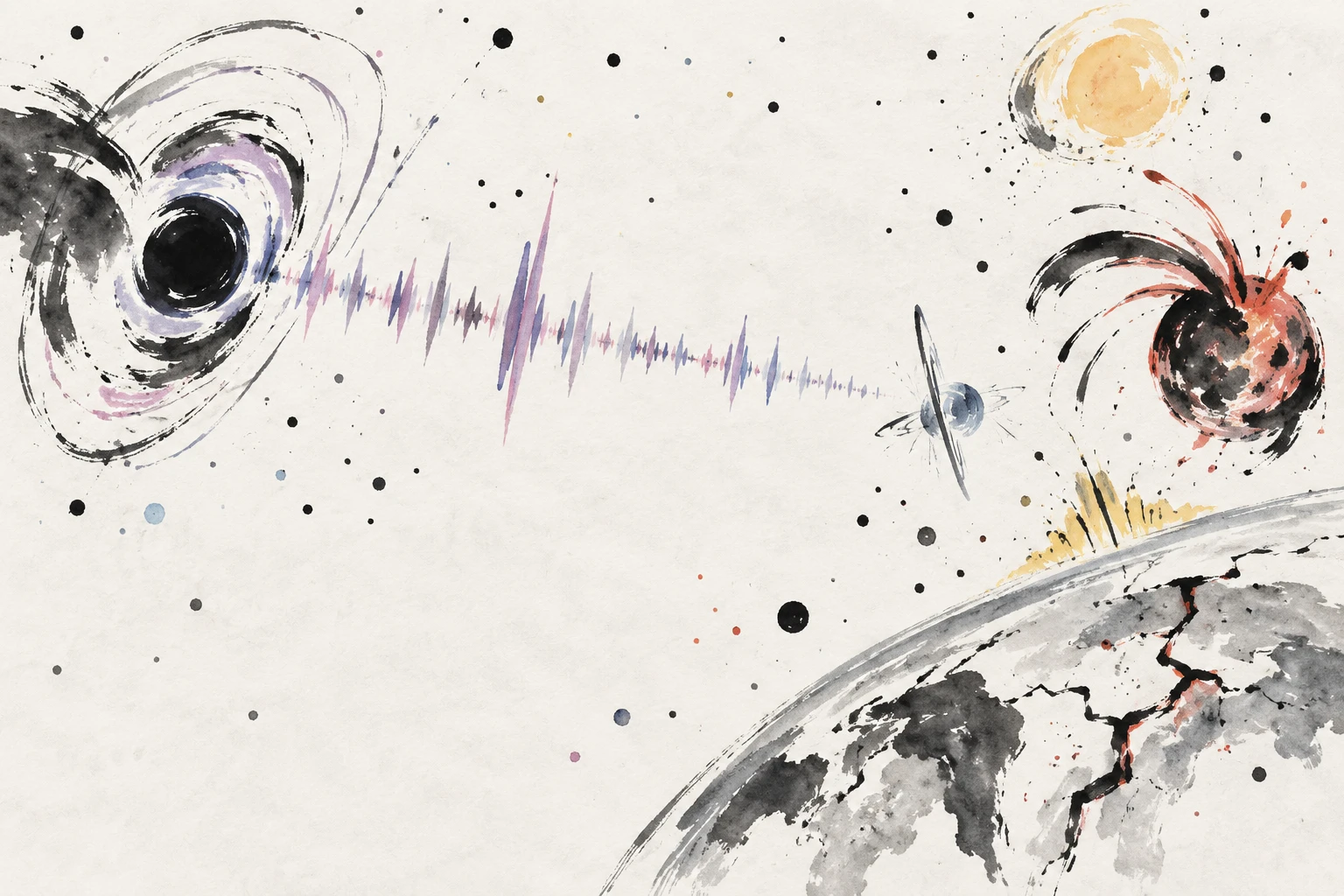
By comparing thousands of bursts from repeating fast radio bursts with earthquakes, solar flares, magnetar X-ray flares and pulsar glitches, a preprint reports that repeaters occupy a distinct region of stochasticity-chaos space.
Jun 1, 2026
Fast radio bursts, or FRBs, are extremely luminous millisecond-duration radio transients that originate at cosmological distances. Despite extensive follow-up and theoretical work, the physical mechanism that triggers them is still debated.
One leading suspect is a magnetar: a neutron star with an extreme magnetic field. In 2020, the Galactic magnetar SGR J1935+2154 produced FRB 20200428 in association with a bright X-ray flare, showing that at least some FRBs can be produced by magnetars. But that clue leaves a deeper question. Does the magnetar's crust crack like an earthquake, or does its magnetosphere erupt like a solar flare?
A magnetar clue, and a deeper puzzle
A new preprint by Si-Lu Xu and colleagues tries to sort out the family tree by measuring not what FRBs are, but how unpredictable they are. It introduces a diagnostic called the Pincus-Lyapunov diagram, or PLD. The PLD places each type of transient in a two-dimensional space: one axis for stochasticity, or randomness without memory, and one for chaos, or extreme sensitivity to initial conditions.
The idea is simple. Earthquakes, solar flares, magnetar X-ray flares, pulsar glitches and FRBs all produce sequences of events in time, each with an energy. If two phenomena share a trigger, their sequences might share a statistical fingerprint.
The Pincus Index and the Lyapunov Exponent
To build the fingerprints, the team compiled five samples of repeating FRBs observed with the Five-hundred-meter Aperture Spherical radio Telescope, or FAST, in China. The sample includes FRB 20121102A, FRB 20190520B, FRB 20201124A, FRB 20220912A and FRB 20240114A. They compared those bursts with X-ray flares from five magnetars, glitches from four pulsars, more than 17,000 solar flares and more than 800,000 earthquakes.
Two numbers do the work. The Pincus Index measures how much a sequence resembles its own shuffled version; a value near 1 means the pattern is already close to random. The Lyapunov exponent measures how quickly nearby trajectories in a dynamical system diverge; higher values indicate stronger chaos. Placing both numbers on a map creates the PLD.
Where repeating bursts land
The map is not a random scatter. Earthquakes occupy a region of high chaos and relatively low stochasticity. Pulsar glitches sit at the opposite end, highly stochastic but weakly chaotic. Magnetar flares and solar flares fall in between and largely overlap, consistent with both being powered by magnetic reconnection in magnetized plasma.
Repeating FRBs land in their own compact neighborhood. Their sequences are highly stochastic but weakly chaotic, with the FRB reference point near a Pincus Index of 0.90 and a Lyapunov exponent of 0.09. That location is clearly offset from the main magnetar-flare group and from glitches.
The split is statistically meaningful, though not enormous. Using an energy-distance statistic and 10,000 permutations, the researchers found p-values of about 0.03 for magnetar flares and 0.02 for pulsar glitches when compared with the FRB population. Those values fall below the conventional 0.05 threshold, but only modestly. A comparison of FRB 20240114A with the rest of the FRB sample found no significant difference, with a p-value of 0.63. A separate self-consistency check splitting the FRB sample into two subsamples gave p=0.984.
One magnetar remains especially instructive. SGR J1935+2154 produced the famous 2020 event. Its X-ray bursts from that episode and its radio bursts sit close to the FRB cluster in the PLD. But its 2022 X-ray bursts, without a reported FRB counterpart, fall away from the FRB region and closer to ordinary magnetar flares. The same source appears capable of different dynamical modes.
The most active repeater refuses to drift
Could a repeater's position simply shift when it becomes more active? The team tested that with FRB 20240114A, the most prolific repeater known. FAST detected more than 10,000 bursts from it between January and August 2024, with peak rates reaching 729 bursts per hour. Yet across nearly eight months, the Pincus Index and Lyapunov exponent stayed stable. Statistical tests indicated the series were stationary, with no long-term drift. Changes in burst rate seemed to change how many bursts arrived, not their underlying statistical character.
A noisy engine, not a single drumbeat
The authors conclude that repeating FRBs are not simple radio twins of ordinary magnetar X-ray flares, pulsar glitches or solar flares. Their high randomness and low chaos suggest a noisy, high-entropy engine: turbulent plasma, multiple quasi-independent magnetospheric emission sites, or random external triggers, all around a compact object that is still plausibly a magnetar.
That conclusion comes with important limits. The PLD is a statistical diagnostic, not a direct picture of the trigger. The p-values are only modestly below the conventional significance threshold, and the comparison samples vary in size and detection conditions. The study does not rule out earthquake-like starquakes. Viewing geometry could reshape the observed energies even if the intrinsic dynamics were quake-like, and spin periodicity could be hidden below detectability.
What the map still cannot settle
So the family feud is not over. The new map suggests that repeating FRBs have a distinct rhythm, more random than a quake and less chaotic than a flare, but it does not identify the drummer. The authors' conclusion is narrower than a solved trigger: repeating FRBs are not simple radio analogues of ordinary magnetar flares, pulsar glitches, solar flares or earthquakes, and their engine appears messier and more stochastic than any single analogy.