
JWST Finds 253 Young Stellar Object Candidates Along the Pillars of Creation’s Edges—Did Massive Stars Trigger Them?
A new JWST study identifies 253 reliable young stellar object candidates in the Pillars of Creation, finding them clustered along feedback-sculpted edges and hinting that some may have been triggered by massive stars—while cautioning that age and spatial evidence alone cannot prove it.
May 28, 2026
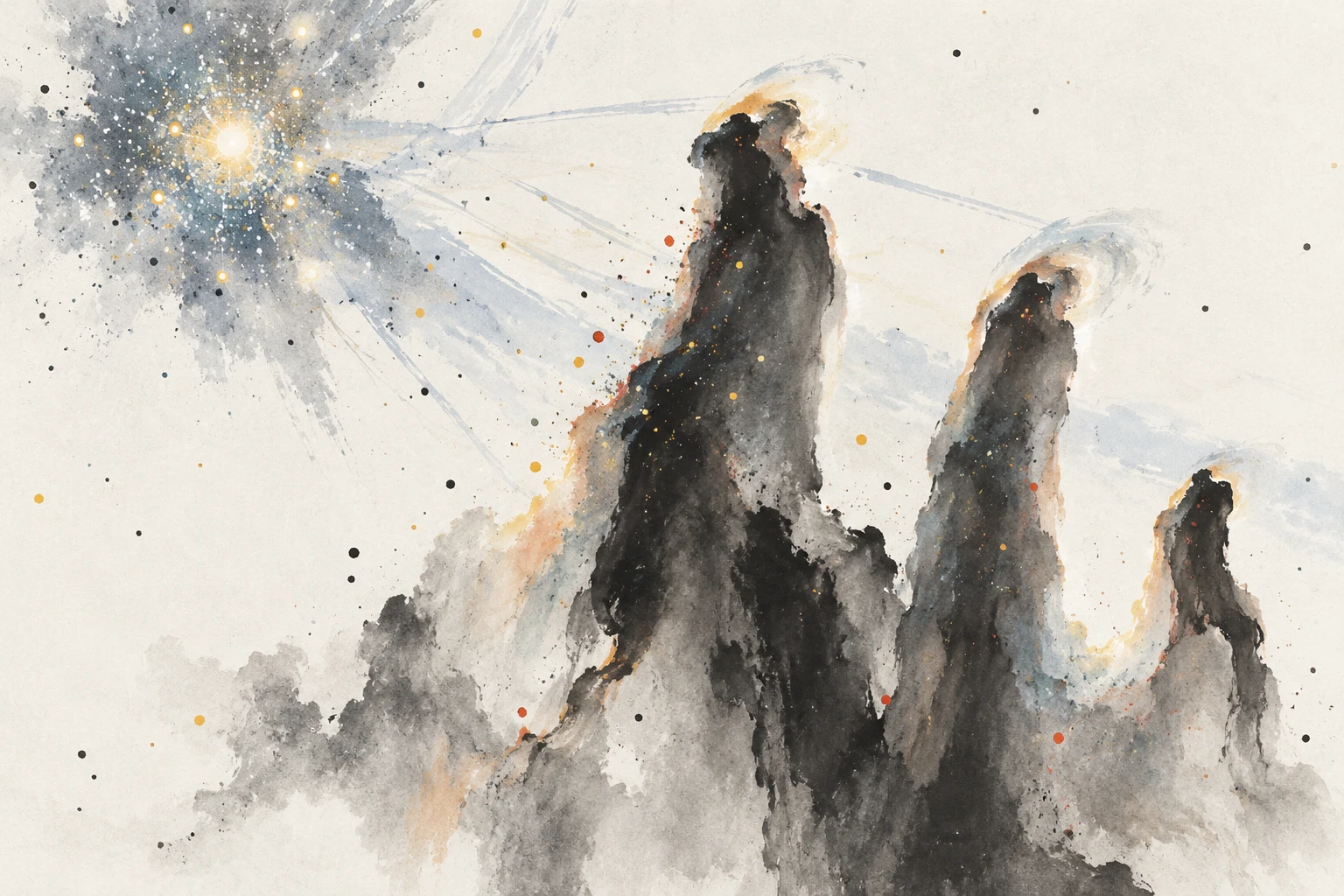
The Pillars of Creation are towering gas-and-dust structures in the Eagle Nebula (M16), sculpted by ionizing radiation and stellar winds from massive stars in the NGC 6611 cluster. Their dense material has survived long enough to be carved into iconic towers, even as that feedback erodes and disperses their outer layers. The long-standing question is whether the same stellar feedback also squeezes nearby gas hard enough to ignite new stars, or whether it mostly disperses the material before stars can form.
A new preprint posted to arXiv reports evidence that, at least locally, star formation has been more active than previously inferred and that some young objects could have been triggered. Using the James Webb Space Telescope’s Near-Infrared Camera (NIRCam) and Mid-Infrared Instrument (MIRI), astronomers identified 253 reliable young stellar object (YSO) candidates in the Pillars of Creation, plus 11 preliminary candidates. These are not confirmed stars. They are sources whose infrared light suggests they are young stellar objects—forming stars and more evolved pre-main-sequence stars, some still wrapped in dusty disks or envelopes.
Infrared observations matter here because visible light cannot easily escape the dense, dusty pillars. JWST’s infrared detectors can peer through that dust and resolve crowded regions that earlier telescopes blurred together. The team drew on publicly available JWST observations of the Eagle Nebula, then combined color measurements, spectral energy distribution (SED) fitting—comparing each source’s brightness across wavelengths with models of young stars—and stellar isochrones, which are theoretical age markers on a temperature-luminosity diagram.
Young Stars Crowd the Edges
The first result is a population boom. Earlier Hubble, Spitzer, and other surveys identified only a small number of young-star candidates near the pillars, and some studies concluded that star formation there was relatively quiet. JWST’s sharper view reveals many more. The 253 reliable candidates are not scattered uniformly. They cluster along the boundaries of the pillars, with the highest concentration near the bright rim at the base of Pillar I.
That pattern is what simulations of triggered star formation predict. When radiation and winds from massive stars push into a molecular cloud, they can create dense rims and pillar-like structures where gas collapses into new stars. The spatial match alone is suggestive, but not decisive. Stars can also form spontaneously, and feedback can redistribute stars that would have formed regardless, so clusters near feedback-driven structures may mix triggered and spontaneously formed stars.
A Tentative Age Gradient
To test the triggering idea further, the researchers estimated ages for the candidates. Among the reliable candidates that also passed an isochrone-quality check, they found 64 sources 1 million years or younger using one fitting method and 58 using another. That is a substantial very young population.
The team also looked at how those ages change with distance from W205, the primary massive star ionizing the region. They report a weak trend: stars farther from the ionizing source appear slightly younger. If feedback triggered star formation, such a gradient could arise as the ionization front sweeps outward, compressing gas and igniting stars in sequence. The timescale is plausible. Simple calculations suggest the ionization front could reach the tips of the pillars in about 0.1 million years and the base of the pillars in roughly 0.5 to 0.6 million years.
There is also a hint that star formation has been busier than expected in the recent past. Using 64 candidates 1 million years or younger from one method, the authors estimate a star formation rate of about 2.4 × 10⁻⁴ solar masses per year across an area of roughly 3.5 square parsecs. That is higher than the rate expected from the mass of dense gas in the pillars, based on a standard relationship between dense gas and star formation. The authors caution that their sample is incomplete, so the rate is likely a lower limit, and that the observed patch may be an unusually active subregion rather than representative of the whole nebula.
P1 and T1: Close-Ups of Complexity
JWST’s resolution also offers intimate portraits of two well-studied young objects at the pillar tips. P1, long studied as a single YSO candidate, appears to be a composite of multiple sources. Its surroundings include a spiral-like structure in a circumstellar disk, though the image could also show an accretion stream or outflow. T1 is a highly inclined young star, seen nearly edge-on, with two fan-shaped lobes of reflected light separated by a dark lane—a classic signature of a disk viewed at a steep angle. The brightness pattern flips between infrared bands, which might indicate a warped or misaligned inner disk, but that remains an open question.
These structures are scientifically valuable because they show how complex individual forming systems can be. They do not by themselves prove that the stars were triggered.
What Would Count as Proof?
The new study is careful about its central claim. Triggered star formation is notoriously difficult to confirm. A spatial association with pillar edges, or even a weak age gradient, can be produced by other processes. Stellar ages in dusty star-forming regions carry large uncertainties from variability, extinction, model assumptions, and the limited number of photometric bands available. Many candidate classifications remain ambiguous. The distances used to measure the age gradient are projected on the sky, not true three-dimensional separations. And the paper is a preprint, meaning it has not yet completed peer review.
What the observations do establish is that the Pillars of Creation contain a much richer population of young star candidates than earlier telescopes could see. They also place that population in a suggestive pattern: along the sculpted edges where massive stars are pushing gas around.
The larger picture is one of feedback’s dual nature. Massive stars can erode and disperse molecular clouds, shutting down star formation. But in the right circumstances, their radiation and winds can also compress gas and light new stellar fires. The Pillars of Creation may be a place where both processes are happening at once, with the bulk of the young stars forming alongside the central cluster and a subset possibly triggered later.
For now, the verdict is not settled. The evidence points toward triggered star formation as a real possibility, not a proven fact. But JWST has turned one of astronomy’s most famous landmarks into a laboratory where the next step—additional observations, wider maps, and better age measurements—can test whether the pillars are merely being destroyed or are also building the next generation of stars.