
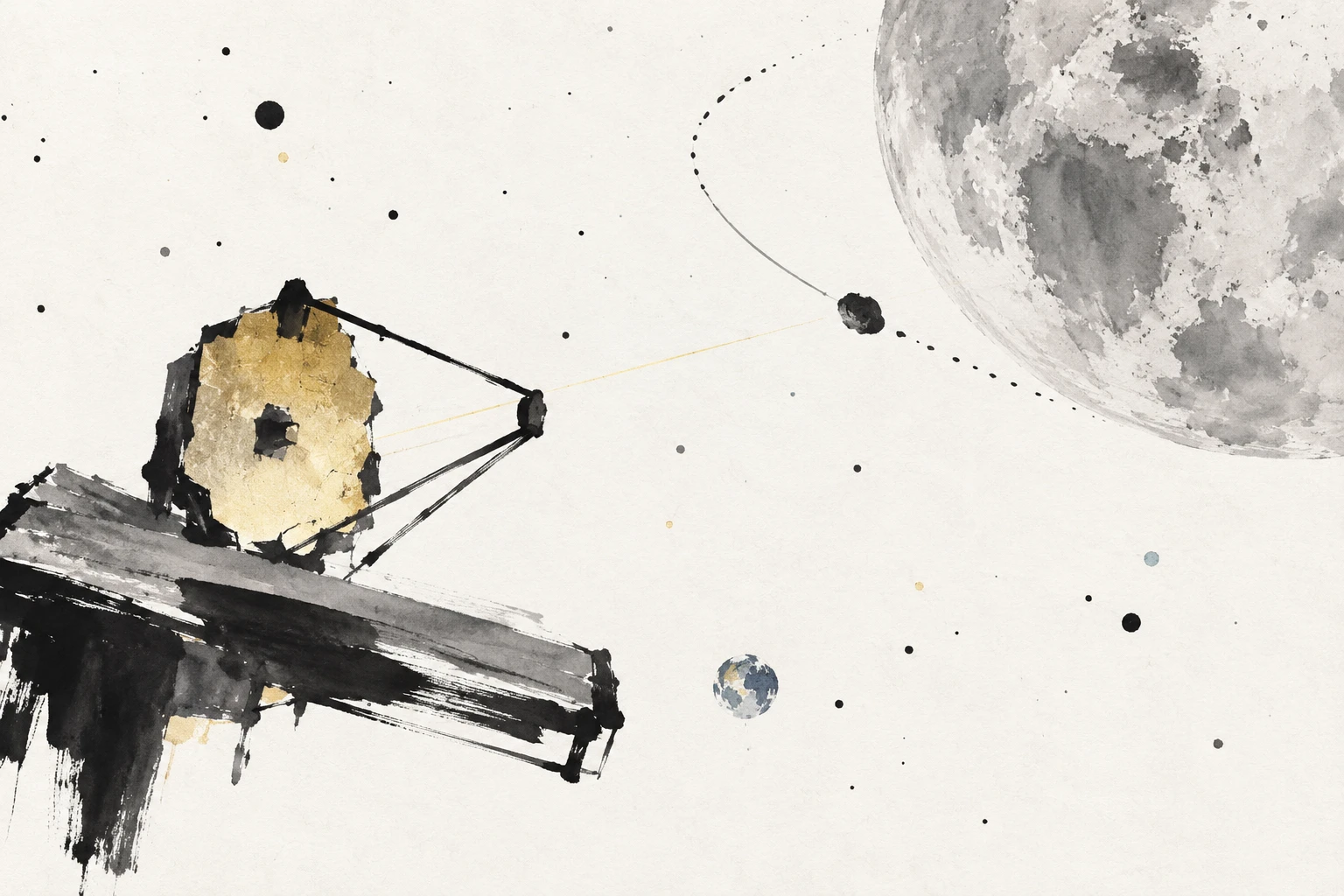
JWST Rules Out a 2032 Lunar Impact—and Highlights a Follow-Up-Limited Era for Planetary Defense
New JWST observations of asteroid 2024 YR4 show it will miss the Moon in 2032, while demonstrating that small asteroids can fade beyond ground-based reach before their hazard is resolved.
May 19, 2026
On 2026 February 18 and 26, the James Webb Space Telescope pointed its Near Infrared Camera at a 60-meter asteroid named 2024 YR4. The object was exceedingly faint: its infrared flux measured about 4 nanojanskys—a unit of brightness for very dim infrared sources—equivalent to a visual magnitude of 30.5. That makes it the faintest near-Earth object detected to date, beyond the roughly magnitude-27 limit of ground-based telescopes.
JWST did not simply spot a dot. It measured the dot's position well enough to rewrite the asteroid's future.
A 60-meter asteroid with a lunar question mark
2024 YR4 was discovered during its discovery apparition, which ended with ground-based observations in March 2025. Its orbit initially allowed a chance of an Earth impact during its 2032 December 22 close approach. By the time the object became too faint for ground-based tracking, the Earth impact had been ruled out, but a lunar impact remained possible. A lunar impact of this scale could have consequences for Earth-orbiting infrastructure, as well as for human exploration on and around the Moon. By then, the asteroid posed no threat to Earth.
After March 2025, 2024 YR4 became too faint to track from the ground until 2028. The question was whether the remaining lunar-impact probability could be retired early—or would linger for two more years.
Turning trailing stars into a position on the sky
JWST observed with NIRCam, its near-infrared camera. Because the telescope tracked the asteroid, stars in the background appeared as streaks. The team used those streaks, tied to stars from the Gaia catalog, to calibrate the asteroid's exact position.
The task was difficult. Only a few usable reference stars were available in some exposures, and bright stars were saturated. Trailing and detector effects further complicated the measurements. Three groups analyzed the data independently. Their astrometric positions agreed to about 50 milliarcseconds—thousandths of an arcsecond.
The asteroid was found only 0.5 sigma from the prediction from the previous orbit, confirming that solution was stable. The new positions extended the observational arc by eight months.
The 2032 Moon encounter is a miss
Using eight new positions, the team computed an updated orbit. The result: on 2032 December 22, 2024 YR4 will pass 22,900 ± 800 kilometers from the center of the Moon. That is well outside the Moon, and it rules out a lunar impact.
The improvement was dramatic. The uncertainty in the encounter was reduced by more than a factor of 30. The new solution is incompatible with the range of trajectories that would have hit the Moon. The same orbit solution also removes a previously possible low-probability Earth impact in 2047, and the team finds no Earth impact over the next 100 years.
Small nongravitational forces were considered. The Yarkovsky effect—a tiny thermal push that can slowly change a small asteroid's path—showed no detectable signal. Even allowing for a plausible range, it would increase the predicted uncertainty by only about 5 percent. Solar radiation pressure matters less. For now, gravity alone is enough.
A new kind of planetary defense bottleneck
2024 YR4 is not just a resolved case. It is a preview. Next-generation surveys such as the Vera C. Rubin Observatory, NASA's NEO Surveyor, ESA's proposed NEOMIR, and the Roman Space Telescope are expected to find many more small asteroids—objects tens of meters across. These are far more numerous than kilometer-scale hazards, and they fade below ground-based detection quickly.
As a result, the limiting factor in assessing their risk may not be whether an impact is likely, but whether enough follow-up observations can be obtained. The paper calls this a follow-up-limited regime.
As a demonstration, the authors created a synthetic 10-meter asteroid on the same orbit as 2024 YR4. It would have been discoverable in December 2024, but by early February 2025 it would have become too faint for ground-based telescopes—while its Earth-impact probability was still above 1 percent. JWST could have followed it into March and resolved the risk. That is a simulation, not an observed object, but it shows how space-based observations can fill a gap.
What the forecast does—and does not—settle
The 22,900-kilometer miss distance is a prediction from the updated orbit, not a direct observation of the 2032 encounter. The astrometry itself faced difficult conditions, and the final uncertainty is dominated by calibration rather than the asteroid's centroid.
The object was not detected in the longer-wavelength F322W2 filter, so the team could only set an upper limit on its brightness there. The paper is an arXiv preprint (v1). The lunar-impact probability was small—about 4 percent after May 2025 JWST astrometry—but it still needed to be eliminated.
What the data do show is that JWST can detect, track, and help characterize a near-Earth object at a brightness far beyond the reach of ground-based telescopes. For 2024 YR4, the answer is now clear: the Moon will not be hit in 2032. The broader lesson is that planetary defense is entering an era in which the smallest, most common asteroids may be found faster than they can be followed. As the sky surveys grow more powerful, the ability to send a large space telescope after a fading speck may become as important as finding it in the first place.