
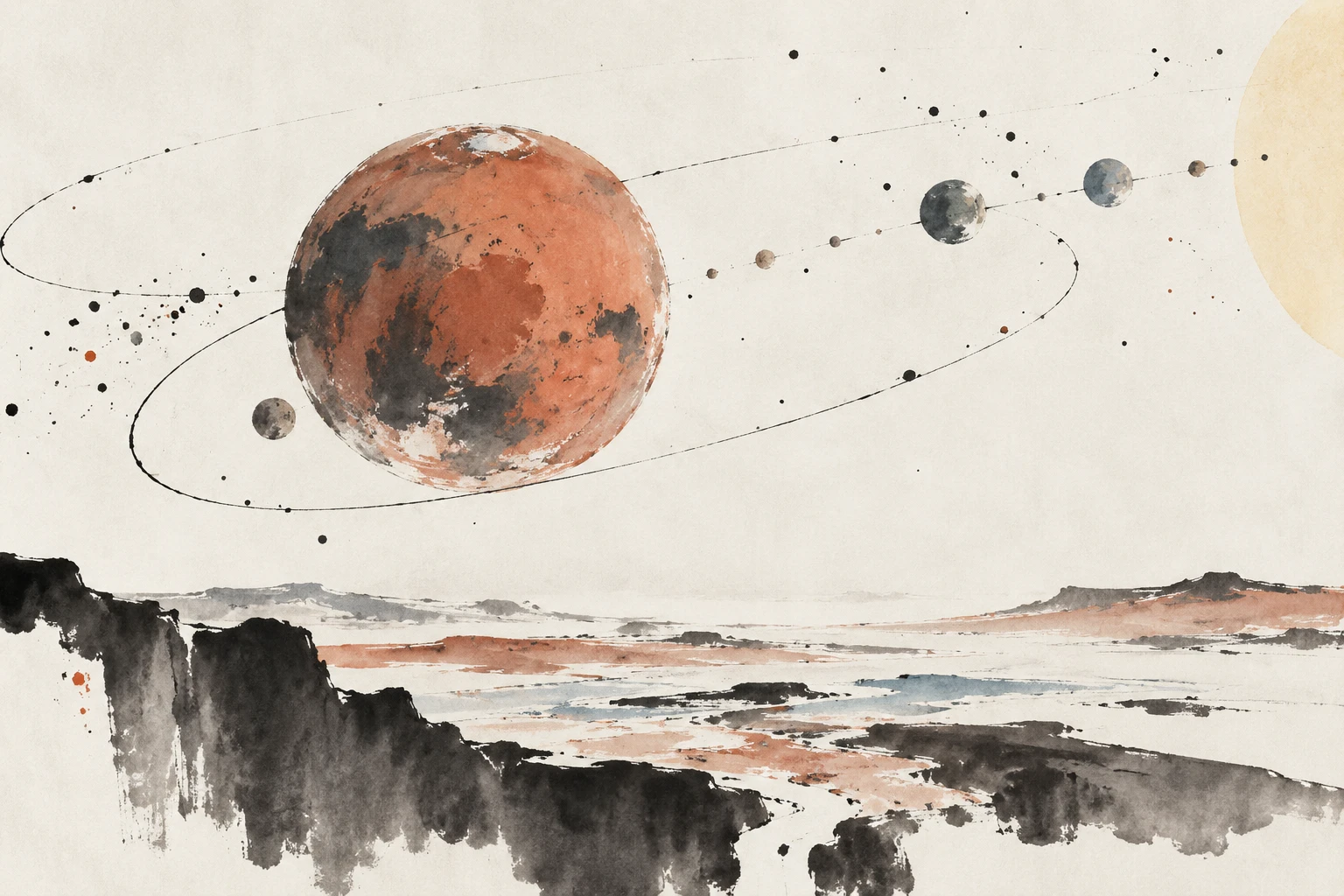
If Mars Orbited Another Star, Could We Even Tell It Was There?
A new synthesis argues that Mars is a uniquely data-rich analog for sub-Earth exoplanets—and that confirming a true Mars twin beyond the Solar System will remain at or beyond the limits of current telescopes.
May 18, 2026
Imagine Mars not as the familiar red disk in our telescopes, but as a faint dot passing in front of a distant star. Could astronomers tell that it once had lakes, rivers, and a thicker atmosphere? Or would it look like just another small, airless rock?
That question is at the heart of a new synthesis by Stephen R. Kane and colleagues, posted as an arXiv preprint. The paper draws on decades of Mars exploration and modern exoplanet science to ask what the Red Planet can teach us about Mars-size worlds beyond the Solar System—planets that sit at the edge of habitability.
A small planet with a detailed climate history
Mars is about 11% of Earth’s mass and 53% of Earth’s radius. It receives 44% of Earth’s sunlight and has a surface pressure only 0.63% of Earth’s. Today its CO2-dominated atmosphere is thin and cold. But its surface preserves clay minerals, sulfates, valley networks, and lake sediments that record a wetter, potentially habitable early era.
NASA’s Curiosity rover found a long-lived lake system at Gale crater with neutral pH, low salinity, and essential nutrients. Perseverance confirmed a delta-lake system in Jezero crater. Orbital spectroscopy and missions such as MAVEN have helped map hydrated minerals and quantify how the atmosphere escapes today. Isotopic ratios of argon, hydrogen, and nitrogen show that Mars lost a substantial fraction of its original atmosphere.
This makes Mars a rare thing: a small planet whose climate history we can study in detail. For exoplanets, that history is exactly what we cannot yet see.
Why Mars analogs are so hard to see
The paper quantifies just how hard these planets are to detect. In the NASA Exoplanet Archive as of December 31, 2025, 120 confirmed exoplanets had reported mass and radius entries at or below 10 Earth masses and 2 Earth radii, with no precision cut; only 11 fell in the sub-Earth regime, meaning both mass and radius below Earth’s. That scarcity is largely a selection effect: transit surveys—which look for the slight dimming when a planet crosses in front of its star—favor larger planets and short orbits, and radial-velocity surveys—which look for a star’s tiny wobble caused by an orbiting planet—struggle with the tiny wobble a Mars-mass planet induces.
The numbers are sobering. In the best case, a Mars-size planet transiting a late M-dwarf could produce a transit depth of about 1,600 parts per million (ppm)—the amount of starlight blocked—readily detectable. But around a K-dwarf or Sun-like star, the depth drops to roughly 49 and 24 ppm, respectively, challenging even from space. The radial-velocity signal of Mars on the Sun is only about 7.8 millimeters per second, far below current precision. A Mars-mass planet at Mars-like irradiation around an M-dwarf might produce about 4.1 centimeters per second; around a K-dwarf, about 1.3 centimeters per second. Direct imaging is even more daunting: the reflected-light contrast of a Mars analog around a Sun-like star is about 1.1×10^-11, roughly an order of magnitude fainter than an Earth analog.
The authors used the Planetary Spectrum Generator to simulate how a present-day Mars analog would appear in transmission and reflected light. A transmission spectrum is the light filtered through a planet’s atmosphere during a transit. The model atmosphere is 96.934% CO2, with nitrogen, oxygen, and trace gases, plus dust and water-ice aerosols. Strong CO2 bands appear at 2.7 and 4.3 micrometers. But the transit depth variation is less than 10^-6 for a Mars-size planet around a Sun-like star, making detection challenging even for JWST.
Reflected-light spectra show CO2 and surface mineral features that change with phase angle, but they are faint. These simulations are not observations. They use present-day Mars as a template, and different pressure, dust, or composition would alter the signals. Still, they show why future observatories like the Habitable Worlds Observatory and the proposed LIFE mid-infrared interferometer are central to characterizing true Mars analogs.
Where a Mars twin might be found—and why habitability has a clock
The best near-term prospects, the paper suggests, are not direct images of lonely Mars twins. They are transit and transit-timing variations (TTVs)—small changes in when transits occur—in compact systems around late M-dwarfs, and the Nancy Grace Roman Space Telescope’s microlensing survey. Microlensing uses a foreground star’s gravity to briefly magnify a background star; a planet can add a short blip to that signal. Roman is expected to detect planets above about Mars mass in statistically useful numbers, with sensitivity down to about 0.02 Earth masses under favorable circumstances. PLATO’s long-duration photometry could also find longer-period terrestrial planets. But confirming a true Mars analog—its mass, atmosphere, and habitability—will remain observationally demanding.
The broader lesson is that small rocky planets can be habitable for a while and then lose their chance. Mars had early surface water and geochemical environments that could have supported life. But its small size meant rapid interior cooling, declining volcanism, a brief dynamo (the global magnetic field generated by a planet’s churning core), and sustained atmospheric escape. Its climate was further destabilized by large obliquity swings—changes in axial tilt—and CO2 condensation, or carbon dioxide freezing out.
That pathway may be common for Mars-mass exoplanets. The paper concludes that such worlds are most likely to have clement conditions early, when outgassing peaks, and later only if internal heat, tidal dissipation, or episodic volatile delivery keeps them alive. Quiet K and G stars at moderate irradiation may offer the best long-term prospects. Close-in planets around active M-dwarfs face a harsher gauntlet of flares, winds, and pre-main-sequence luminosity.
Mars, in other words, is not just a neighboring planet. It is a benchmark for the smallest rocky worlds we are only beginning to see—and a reminder that habitability is a story with a beginning, a middle, and sometimes an end.