The Moon Rings Like a Bell. Calibrated Gravitational Waves Could Help Map Its Interior.
A new preprint forecasts that calibrated gravitational waves could improve estimates of the Moon's density and elastic parameters by roughly an order of magnitude, turning its seismic response into a new kind of tomography.
May 13, 2026
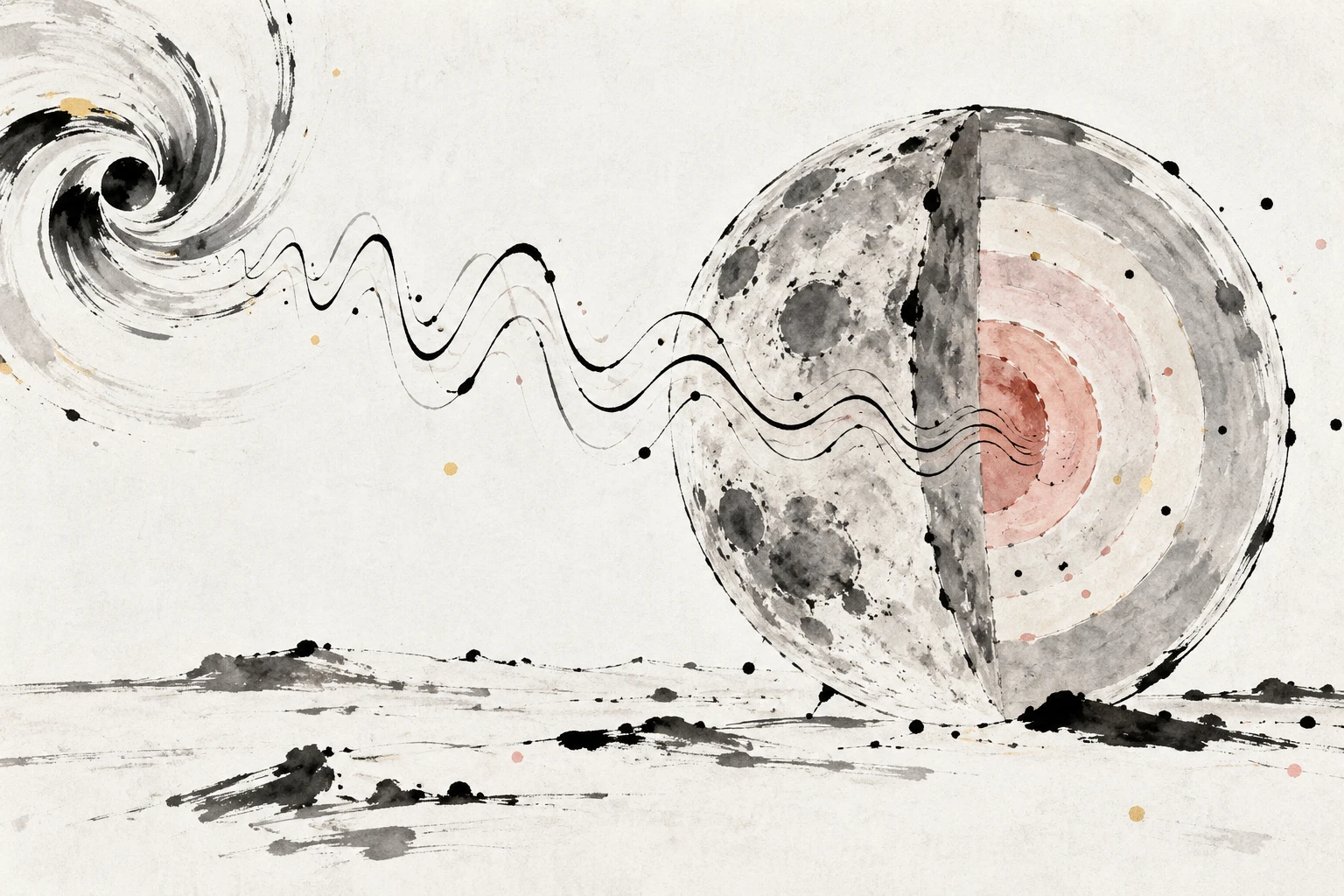
Imagine the Moon as a bell floating in the solar system. Every so often, a passing gravitational wave—a ripple in spacetime—could make it ring.
That is not an observation yet. It is the premise behind a new preprint by Han Yan and Jan Harms, posted to arXiv, that asks whether the Moon's own vibrations could be used to map its deep interior. Their answer is a forecast: if the incoming gravitational waves are calibrated by a network of other gravitational-wave detectors, the Moon's seismic response could sharpen estimates of its density and elastic parameters by roughly an order of magnitude.
A Bell Made of Rock and Metal
The Moon is not a uniform sphere. For their model, the authors use a five-layer Moon: a dense inner core, an outer core, a mantle, a crust, and a surface layer, each with different densities and stiffnesses. These properties control how the Moon vibrates. Seismologists call the whole-body standing vibrations normal modes: discrete tones, like the overtones of a struck bell.
Renewed lunar geophysical instrumentation and proposed lunar observatories such as the Lunar Gravitational-Wave Antenna, or LGWA, and the Laser Interferometer Lunar Antenna, or LILA, aim to exploit the Moon's exceptionally quiet seismic environment to probe the millihertz-to-hertz gravitational-wave band. A gravitational wave in that band could excite the lunar modes, especially spheroidal modes with angular degree l=2, which distort the sphere in a quadrupolar pattern.
The Moon's stiffness matters. Its bulk modulus resists compression, its shear modulus resists shear deformation, and its density determines how mass is distributed. Together, those properties set the frequencies at which the Moon naturally rings and the strength of each tone.
The Trick: Knowing the Wave Before You Read the Echo
Normally, a vibrating object tells you only part of its story. You can measure its tone, but if you do not know how hard it was struck, you cannot easily translate the loudness into internal structure. For the Moon, the gravitational-wave source has traditionally been the unknown hammer.
That is changing. Future detector networks—combining instruments such as the Einstein Telescope, LISA, and LGWA—could measure the incoming gravitational-wave strain independently. In that case, the strength of the hammer is known. The lunar response becomes a probe of the Moon itself.
This is the inverse, tomographic question the new paper tackles. Instead of asking how a given lunar structure responds to a gravitational wave, the authors ask: what can the response tell us about the structure? Tomography here means inferring the interior from how vibrations resonate within it.
From Normal Modes to Sensitivity Kernels
The authors build a first-principles, perturbative framework. They start with a spherically symmetric Moon, divided into layers with radial profiles of density, bulk modulus, and shear modulus, plus boundaries between internal layers. They solve for the Moon's normal modes, the discrete standing-wave patterns and frequencies of the body.
Then they ask what happens when those properties change slightly. First-order perturbation theory tells them how small shifts in density, stiffness, or layer boundaries alter mode frequencies and mode amplitudes. They derive sensitivity kernels—mathematical maps showing how strongly each observable responds to a change at each depth. Those kernels feed into a Fisher matrix, a standard statistical tool for forecasting how well parameters can be estimated under given noise and prior assumptions.
To check the machinery, the team compared its analytical predictions with MINEOS, a standard normal-mode solver used in geophysics. They tested representative 0.2 percent perturbations to inner-core shear-wave speed, outer-core compression-wave speed, and the inner-core/outer-core boundary. The comparisons used modes within a 25 percent linearity tolerance; the authors report that most modes—about 70–75% in the tests—met that criterion, and for those the analytical predictions matched MINEOS well.
An Order-of-Magnitude Gain, in Forecast
The main result is a statistical forecast, not a detection. The authors considered modes up to mode number n=150, corresponding to about 104 millihertz. They compared three observational scenarios: using eigenfrequencies alone, using frequencies plus horizontal amplitude measurements, and using frequencies plus both radial and horizontal amplitudes.
Even when the amplitude measurements were assumed to be 100 times less precise than the frequency measurements, adding the amplitudes reduced the estimated uncertainties in density, bulk modulus, and shear modulus by nearly an order of magnitude, with weak dependence on radius. The reason is that frequencies and amplitudes respond differently to structure. Amplitudes depend on the shape of the eigenfunctions and on the coupling between the gravitational wave and the Moon, so they carry information that frequencies alone miss.
That complementarity is the paper's central promise. Calibrated gravitational waves turn modal amplitudes into independent structural observables—data about the lunar interior that can be combined with frequency measurements to break degeneracies and tighten constraints.
Where the Picture Is Still Blurry
This is a proof-of-principle study. It models the Moon as spherically symmetric and one-dimensional, ignoring lateral heterogeneity, topography, and self-gravity. The perturbations are linearized, so they are valid only for small changes in structure. Near-degenerate modes can violate simple first-order perturbation theory, though the authors note that a generalized version can handle them.
The forecast also assumes high signal-to-noise observations, around 100, and treats the modes' quality factors as independently known. In a real mission, fewer modes may be measurable, and the actual signal-to-noise may fall short of the ideal case. The Fisher matrix can mislead when signals are weak or parameters are strongly correlated, although the authors argue that their setup is heavily over-constrained because hundreds of observables are used to infer tens of parameters.
Future work would need three-dimensional sensitivity kernels, nonlinear Bayesian inference, and joint inversions that combine gravitational-wave-driven lunar data with traditional seismic catalogs, tidal Love numbers, and geodetic constraints.
A New Way to Read the Moon's Deep History
The paper argues that tighter constraints on density and elastic parameters with depth would enhance understanding of the lunar interior and might lead to breakthroughs in understanding the formation history of the Earth-Moon system. The new paper does not claim that gravitational-wave tomography has been achieved. It maps a possible route: use gravitational waves as a known hammer, listen to the lunar bell, and turn the echo into a picture of what lies beneath.
If future lunar seismometers and gravitational-wave detectors work together, the Moon's quiet ringing could become more than a curiosity. It could become a new way to image a planetary interior—using the Moon itself as the instrument.