
A Brown Dwarf’s Eight-Year Orbit Lines Up With Two Alien Planets
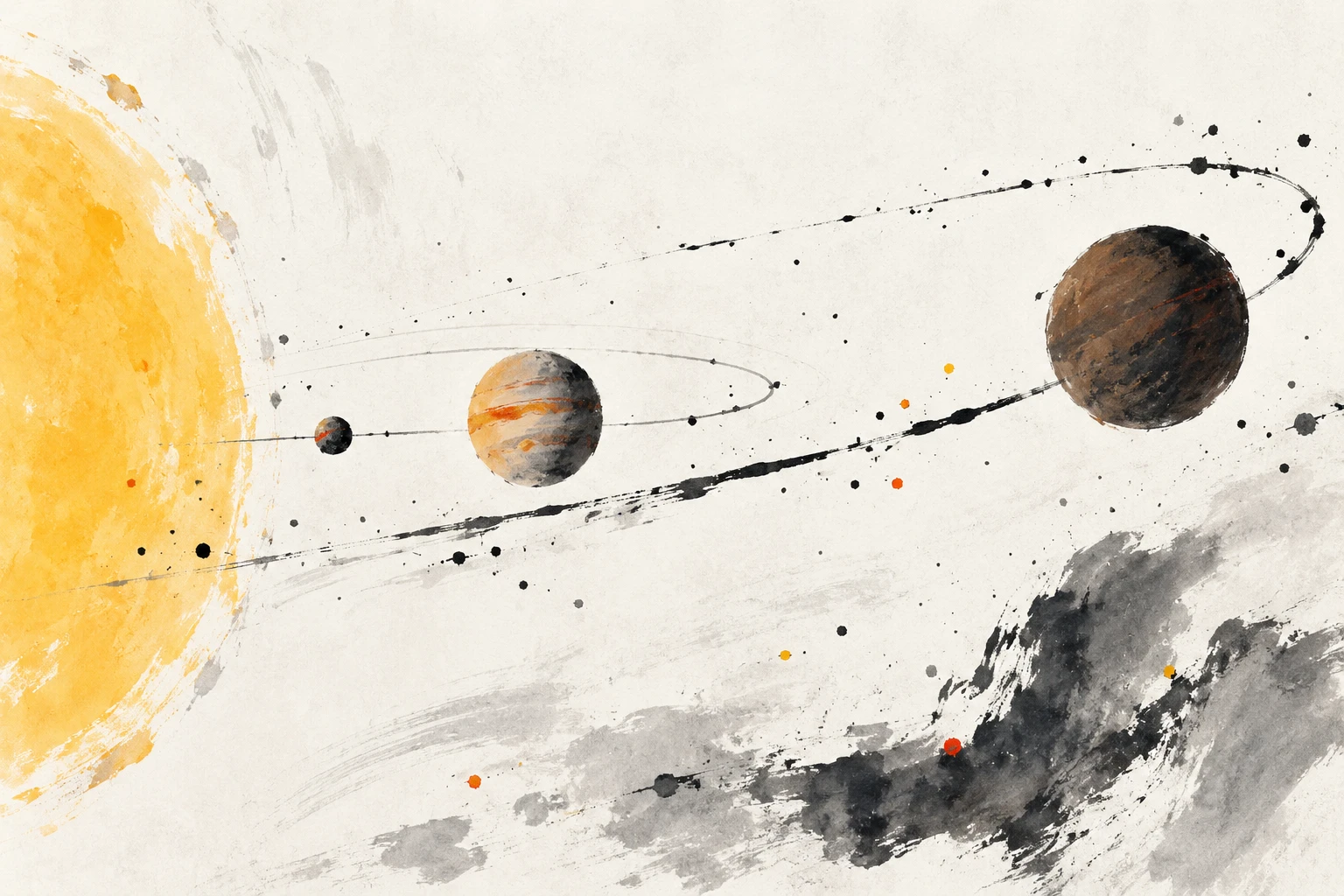
Long-term TESS and radial-velocity monitoring of TOI-201 reveal a hot super-Earth, a warm Jupiter, and an eccentric brown dwarf sharing one orbital plane—an arrangement that hints at a gentler formation history than violent scattering.
Apr 27, 2026
In April 2023, NASA's TESS satellite watched a star named TOI-201 dim once, for a long time. A single dip in starlight can mean a planet crossing in front of its star. This one lasted long enough to stand out as a long-duration transit. Follow-up spectroscopy from five ground-based observatories has now tied that event to a brown dwarf—an object heavier than a planet but not massive enough to sustain hydrogen fusion—on an orbit of roughly eight years. The work, posted as a preprint on arXiv, presents TOI-201 as a rare three-body architecture: a hot super-Earth, a warm Jupiter, and an eccentric brown dwarf, all sharing nearly the same orbital plane.
A Single Dip, an Eight-Year Orbit
TOI-201 is a young F-type star about 1 billion years old and 112 parsecs away. TESS observed it across more than 30 sectors. Those observations refined the known warm Jupiter TOI-201 b, a gas giant in a 53-day orbit, and validated a new 5.8-day transit signal from an inner super-Earth, TOI-201 c. The brown dwarf, TOI-201 d, appeared only once in the TESS photometry, in Sector 64. To reconstruct its much longer path, astronomers used radial velocity measurements—the star's slight back-and-forth motion along our line of sight—gathered with FEROS, HARPS, CORALIE, CHIRON, and PLATOSPEC. High-contrast imaging with VLT/SPHERE also ruled out stellar companions within about 5 arcseconds.
Three Worlds in One Plane
The team fit the data with an N-body model, a simulation that accounts for the gravitational tug-of-war between the warm Jupiter and the brown dwarf. That was necessary because the brown dwarf perturbs the warm Jupiter, producing transit timing variations—small shifts in when the Jupiter crosses its star. The inner super-Earth was modeled separately; it is far enough from the massive outer companions that their gravitational influence is undetectable on observable timescales.
TOI-201 c circles every 5.849 days. Its radius is 1.436 Earth radii, placing it below the radius valley, the observed gap between rocky super-Earths and gas-rich sub-Neptunes. Interior models allow a rock-dominated world with little or no surface water and a mass between about 3 Earth masses for pure silicate rock and about 9 Earth masses for pure iron. The radial velocity data could not measure its mass directly, only set an upper limit below about 33 Earth masses.
TOI-201 b is a prototypical warm Jupiter: 0.59 Jupiter masses, 1.01 Jupiter radii, a 52.978-day orbit, and a mild eccentricity of about 0.28. Eccentricity measures how far an orbit departs from a perfect circle. Its interior is consistent with a rocky core of 14 to 28 Earth masses wrapped in a gaseous envelope, with the planet showing heavy-element enrichment relative to the star.
TOI-201 d is the outlier. It orbits every 2,881 days—roughly 7.9 years—with an eccentricity of 0.622. Its mass is 16.46 Jupiter masses, and its radius is 0.99 Jupiter radii. That puts it in the brown dwarf regime, slightly above the deuterium-burning limit, the mass threshold at which an object can briefly fuse deuterium. The authors report that it is the longest-period transiting object ever characterized with radial velocities, and the only known system hosting a distant brown dwarf coplanar with inner planets. All three orbits are nearly edge-on from Earth: inclinations of about 87.5, 88.9, and 89.9 degrees.
What the Coplanar Setup Does—and Doesn’t—Settle
Coplanarity is not just a geometric curiosity. Violent planet-planet scattering tends to tilt orbits, so a system with three bodies in one plane probably avoided that kind of upheaval after formation. The authors argue for a dynamically mild history in which the warm Jupiter formed in a dense inner disc and acquired its eccentricity less violently. The super-Earth may have formed alone in the innermost region of the disc. Given its size and the system's roughly 1-billion-year age, stellar photoevaporation—where radiation drives gas from a planet's atmosphere—may have removed any primordial envelope.
For the brown dwarf, the paper explores two paths. It might have formed close to its current orbit early, perhaps as a fragment in a massive disc, and the inner disc later realigned with it. Or it might have formed farther out, then migrated inward while interactions with gas pumped up its eccentricity. The second scenario has a catch: the warm Jupiter sits near an instability limit, so the brown dwarf would have had to stop migrating at just the right distance to avoid disrupting it. The authors call that explanation possible but more fortuitous.
The super-Earth's mass remains unknown. Its radial velocity signal is below the star's jitter, the noise from stellar activity, so the team could only place an upper limit. TOI-201 d's eight-year period rests on long-term radial velocity monitoring and a single transit event. The formation scenarios are hypotheses drawn from the system's architecture, not a direct observation of its birth. The work is a preprint and has not yet completed peer review. Future high-cadence spectroscopy could measure the super-Earth's mass and the warm Jupiter's spin-orbit alignment, two tests that would sharpen the picture.
TOI-201 is a rare laboratory for watching how very different worlds—a rocky inner planet, a gas giant, and a brown dwarf—can end up sharing one orbital plane. Its quiet alignment suggests that some planetary systems assemble without catastrophe, and that even objects near the boundary between planets and stars can settle into the same clockwork dance.