The Sun Seeds Switchbacks, but the Flip Happens Later
A new review preprint argues that the Sun's lower atmosphere supplies only the seeds for magnetic switchbacks, while the field reversals themselves likely form later in the expanding solar wind.
Apr 17, 2026
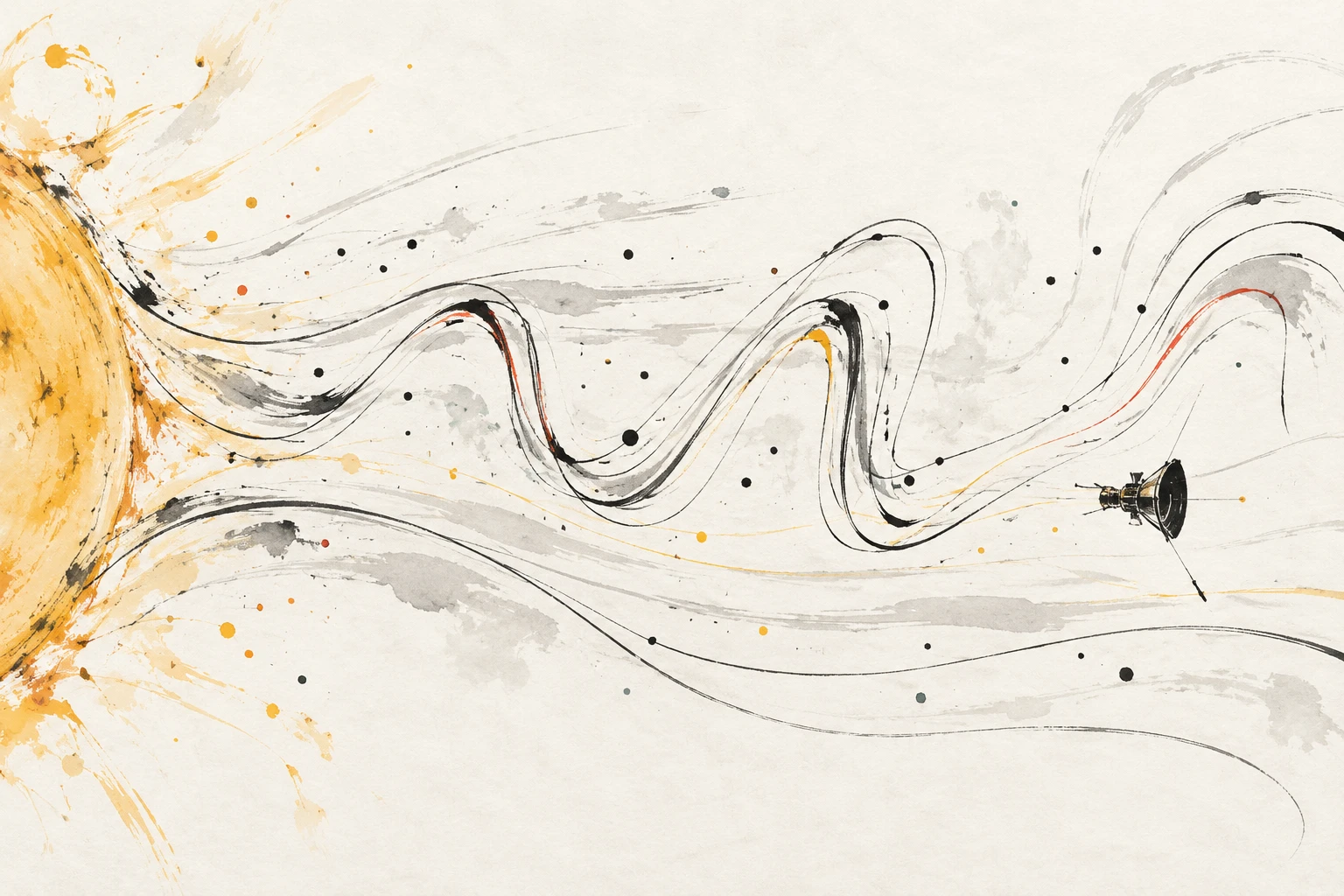
Imagine a spacecraft falling toward the Sun. The magnetic field mostly points outward. Suddenly it swings back toward the Sun, then returns. The velocity jumps. The density barely changes.
Parker Solar Probe saw this over and over. In its early orbits, the probe found that the near-Sun solar wind is full of magnetic switchbacks: sharp deflections where the magnetic field, normally pointing away from the Sun, swings back toward the Sun and then returns. The velocity spikes at the same time. The density stays nearly constant.
Switchbacks are Alfvénic, meaning their magnetic wiggles are tied to motions of the plasma, and they often keep a nearly constant magnetic field strength even as the field direction rotates. That combination, called spherical polarization, makes them distinctive. They may also matter for the energy budget and acceleration of the young solar wind.
The puzzle is simple to state: what creates them? A review preprint posted to arXiv on April 17, 2026, by Peter Wyper of Durham University and colleagues surveys the proposed mechanisms. It is a review, not a new observation, so its value lies in comparison: which ideas survive the growing pile of Parker Solar Probe data, and which do not.
Seeds in the lower atmosphere, not finished switchbacks
The paper divides candidate mechanisms into two families. One acts low in the solar atmosphere, near the photosphere and chromosphere. The other acts later, within the solar wind itself, at distances Parker Solar Probe samples.
Low-atmosphere candidates include convective motions, vortex flows, turbulence in the magnetic carpet, interchange reconnection, and jets. Interchange reconnection is the reconnection of open magnetic field lines with closed loops. It can launch hot, field-aligned outflows and twisted Alfvénic waves. Jet-like events, from large-scale jets to smaller jetlets, are impulsive and can untwist magnetic field lines and send waves upward.
These processes are common and plausible sources of the fluctuations the solar wind needs. But simulations repeatedly find a limit. Strong magnetic folds can form in the chromosphere, yet they struggle to cross the transition region into the corona. U-shaped field lines and plasmoid flux ropes produced by interchange reconnection tend to be destroyed as they are ejected, because newly reconnected field lines crash into older ones. Untwisting waves can travel far, but in the low-beta corona, where magnetic pressure dominates, the Lorentz force unbends the field before a full reversal can escape.
The review's general consensus is therefore not that the lower atmosphere is irrelevant. It is that the lower atmosphere supplies seed perturbations, flows, and particle beams. The finished reversal, with a deflection greater than 90 degrees, likely comes later.
The flip likely happens around or beyond the Alfvén radius
In situ mechanisms take those seeds and amplify or reshape them as the wind expands. One central idea is wave growth. As the solar wind moves outward, the Alfvén speed drops. The relative amplitude of Alfvénic fluctuations therefore grows, much as a wave on a stretching string can appear larger. If the fluctuations remain spherically polarized, a growing parallel magnetic perturbation can eventually cancel and reverse the background field. Simulations of expanding solar wind patches and flux tubes show this happening, although the simulated fraction of switchbacks can be lower than observed, which may mean impulsive sources are needed.
Other in situ ideas invoke compressive fast waves, velocity shear, beams, and merging flux ropes. Adjacent streams of solar wind move at different speeds. Because the magnetic field is frozen into the plasma, that shear can fold field lines back on themselves. If the speed contrast exceeds the local Alfvén speed, the Kelvin-Helmholtz instability can roll the boundary into vortices and mixing layers. Reconnection outflows can also create beams of fast particles that drive kinetic instabilities. Flux ropes, small twisted magnetic structures, may merge and elongate into switchback-like shapes.
Some of these mechanisms can produce observed traits such as sharp rotations, radial elongation, and high Alfvénicity. But many run in idealized simulations. Some are challenged to make the nearly constant magnetic field strength that real switchbacks often show. None has been confirmed as the dominant path.
A key new observational constraint comes from Parker Solar Probe's dives into the sub-Alfvénic solar wind, where the wind moves slower than the local Alfvén speed. Several studies report fewer true switchbacks there. If that pattern holds, it would argue against mechanisms that make full field reversals in the low corona. It would point instead to formation around or beyond the Alfvén radius, where the magnetic field loses its tight grip on the flow.
But the review treats this clue carefully. A switchback carries a local velocity spike comparable to the Alfvén speed. That spike can make an otherwise sub-Alfvénic region look locally super-Alfvénic, muddying the statistics. More perihelion passes are needed to separate the switchbacks' local velocity spikes from the background flow.
The paper also notes that switchback definitions vary. Some studies count deflections as small as 25 degrees. The review adopts a stricter standard: a reversal beyond 90 degrees with a correlated velocity enhancement. That choice matters for comparing mechanisms and observations.
Tests that could discriminate between mechanisms
The review lays out tests that could help discriminate between mechanisms. Researchers can map switchbacks back to their solar sources, measure how their prevalence changes with distance, compare Alfvénicity and spherical polarization near the Alfvén radius, and look for links between flow shear and the proportion of large switchbacks. Theory and simulation need to make sharper predictions for these tests.
For now, the safest conclusion is also the most interesting. Switchbacks probably carry an imprint of their coronal birthplace, but the dramatic U-turn itself may be forged in transit. The Sun provides the raw material; the expanding wind completes the flip.
That is a switchback in more than name: a story that begins at the Sun but may not finish until the solar wind has already left it behind.