
A Tiny Photonic Lantern Could Do Two Jobs at Once for Exo-Earth Imaging
A proposed hybrid photonic lantern would simultaneously feed an exoplanet spectrograph and sense wavefront errors, a dual role the authors propose could help the Habitable Worlds Observatory stare at an Earth-like world for weeks.
Apr 15, 2026
Imagine trying to photograph a firefly hovering beside a lighthouse, then keeping that exposure going for weeks. That is roughly the challenge facing the Habitable Worlds Observatory (HWO), a proposed NASA space telescope designed to directly image Earth-sized planets in the habitable zones of Sun-like stars. HWO is envisioned as a 6-meter telescope that can suppress starlight to about one part in 10 billion, a contrast of 10^-10, and spread the surviving planet light into a spectrum to search for biosignatures.
To do that, the observatory must not only block starlight. It must also hold the wavefront, the shape and timing of light waves arriving from the telescope, steady enough that faint planet light remains separable from scattered starlight. A preprint posted on arXiv by Mona El Morsy and colleagues proposes a compact photonic device that could tackle both jobs at once: a hybrid mode-selective photonic lantern, or HMSPL.
The paper is a technology-development study, not a detection. It introduces the device concept and planned laboratory and on-sky tests. Its central claim is that one small photonic component could serve as both the science fiber for exoplanet spectroscopy and the wavefront sensor that keeps starlight contamination under control.
Single-Mode Fibers Are the Quiet Workhorses of Exoplanet Spectroscopy
Ground-based instruments such as Keck/KPIC, VLT/HiRISE, and Subaru/REACH have shown the power of single-mode fibers, or SMFs, for exoplanet spectroscopy. An SMF carries light in a single spatial mode. Light exiting the fiber forms a stable, diffraction-limited spot free of modal noise, unwanted mode-dependent fluctuations. That stability allows compact spectrographs with fixed line profiles and precise measurements.
For a space mission like HWO, SMFs offer another advantage: without atmospheric turbulence, a well-aligned fiber can capture a large fraction of a planet's light. For an unobstructed aperture as envisioned for HWO, coupling efficiency can be upward of 80%. The catch is alignment and wavefront quality. If the planet image drifts or the wavefront changes, light leaks away from the fiber. Over week-long observations, that drift could compromise the calibration between planet light and residual starlight.
A conventional wavefront sensor measures the telescope's optical errors, but it often does so along a different path than the science camera. That difference creates non-common path aberrations: errors seen by the sensor but not by the spectrograph, or vice versa. The result can be uncalibrated starlight contaminating the planet signal.
HWO will need to monitor wavefront errors at the specific spatial frequencies where the planet appears, and at wavelengths close to those used for science. Doing this while also collecting a faint spectrum is a difficult balancing act. The authors argue that photonic lanterns are well suited to solve it.
A Hybrid Lantern That Splits Science Light from Sensing Light
A photonic lantern is a waveguide device that converts a multimode input into multiple single-mode outputs. It couples light over a broader angular range than an SMF alone, which helps preserve throughput, while still delivering the stable single-mode outputs that spectrographs prefer. Placed at the telescope focal plane, a lantern can also act as a compact wavefront sensor: the way light distributes among its outputs encodes the complex amplitude—the intensity and phase pattern—of the point spread function.
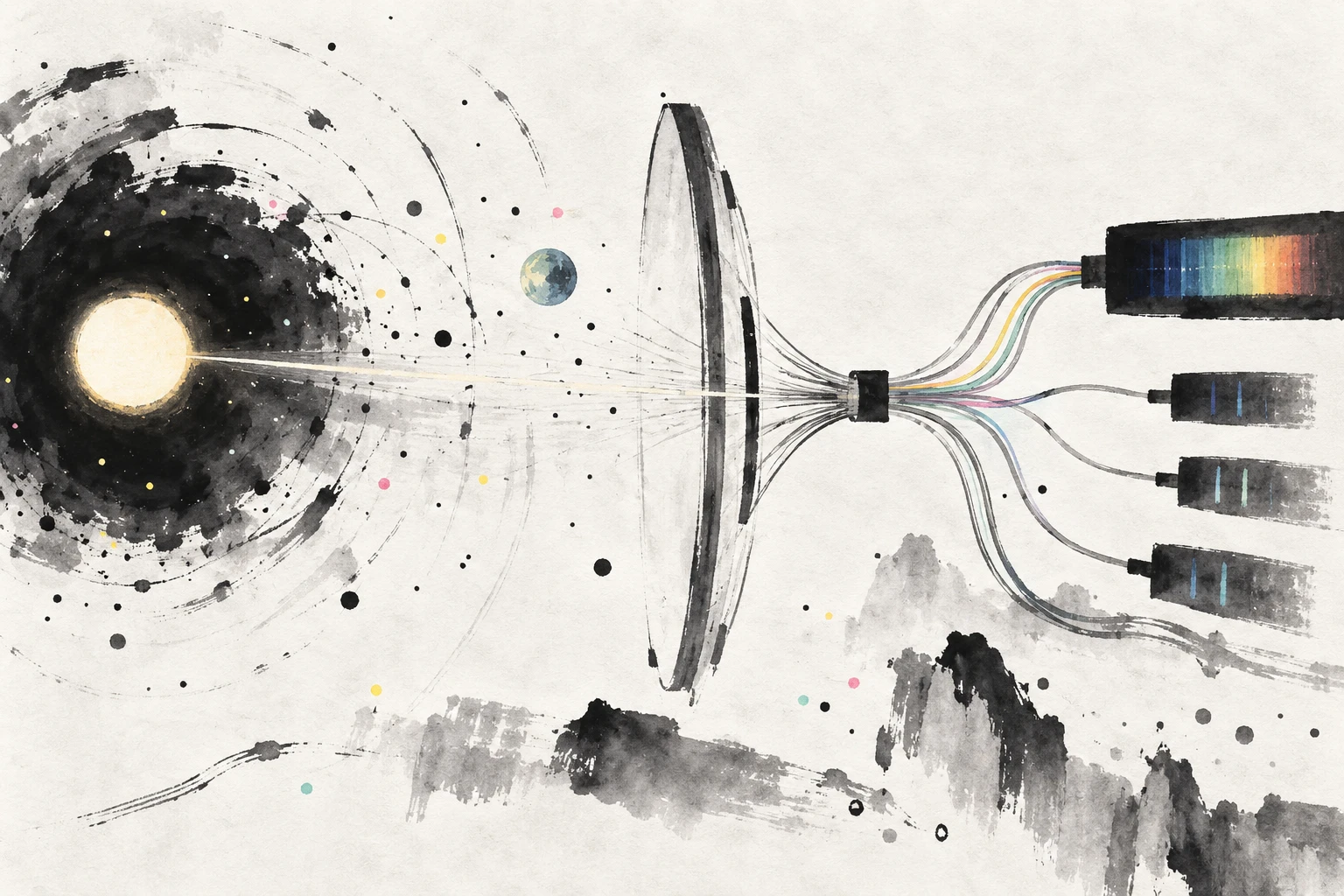
The hybrid mode-selective photonic lantern goes further. It is designed to route the fundamental LP01 mode, where planet light is concentrated, into a central single-mode fiber feeding a moderate-resolution spectrograph for exoplanet spectroscopy. Adjacent single-mode fibers collect surrounding speckle light and send it to a low-resolution spectrograph for rapid wavefront sensing. Because the same device handles both roles, the authors say, non-common path aberrations are eliminated, injection efficiency is optimized, and background suppression improves.
The paper describes a 19-port HMSPL design optimized through numerical simulations for the near-infrared H-band, a strategic wavelength window where fiber spatial filtering helps suppress starlight and where telecommunications technology provides a mature foundation.
From a UTSA Testbed to SCExAO to the Sky
The HMSPL itself has not yet been demonstrated on sky. The paper reports an important starting point from an existing visible photonic lantern at SCExAO, an instrument on the Subaru Telescope. That lantern was not designed to be mode-selective, yet about 40 percent of the point-source light was concentrated in a single output fiber across the 710 to 740 nanometer range. The team will use such a configuration to develop algorithms and measurement techniques while better mode-selective devices are built.
Planned tests range from a UTSA laboratory testbed to SCExAO validation and an end-to-end on-sky demonstration. At the University of Texas at San Antonio, the ExplorinG Research on Exoplanets and Technology testbed will study the HMSPL's long-term stability under controlled thermal conditions. The requirement is demanding: relative output intensities should vary by less than 0.1 percent over a week-long observation, with the test enclosure held to about plus or minus 0.1 kelvin. A broadband supercontinuum source and a deformable mirror will probe the lantern's response across wavelengths and input shapes.
At SCExAO, the team will validate simultaneous spectroscopy and wavefront control. Initial tests will use the existing visible lantern in a quasi-mode-selective setup, later moving to the near-infrared once the HMSPL is delivered. A final on-sky demonstration will target a bright star with a moderate-contrast companion, about one part in a million, at small angular separation. The HMSPL will be positioned on the companion, and observations will be taken both with and without stellar suppression. Active wavefront control will be attempted on a best-effort basis because rapid atmospheric variations may exceed the sensor's linear range.
A key question is whether the lantern's transfer function, the mapping from input light to output fibers, remains stable enough to trust. If it drifts, the control loop between the lantern and the telescope's deformable mirror loses its reference. The authors note that a photonic lantern is a monolithic component only tens of millimeters in size. It has fewer bulk optical parts than a traditional wavefront sensor and should experience smaller temperature gradients. If that stability holds, the device could help self-calibrate the extracted spectra.
The work aligns with the Astro2020 decadal survey's priority on the Habitable Worlds Observatory and NASA's call for mission-critical technologies to reach technology readiness level 5, or TRL 5, by 2029. A key outcome of the work could help maximize HWO's spectral resolution, which is essential for exoplanet characterization and the search for biosignatures.
Many hurdles remain. The optimized 19-port design's mode selectivity has been studied in simulations, and the paper presents planned tests rather than an on-sky HMSPL demonstration. The laboratory work is a testbed study, not a flight demonstration, and the on-sky tests will face atmospheric turbulence that HWO will not. The paper frames the work as advancing technology for space, where thermal and mechanical stability will be important.
Still, the idea is striking in its economy. If a single photonic lantern can separate planet light from starlight, feed a spectrograph, and sense the wavefront that keeps that separation intact, it would be a small monolithic component doing a job that might otherwise require more bulk optics. For a telescope trying to see an exo-Earth, such quiet efficiency could be exactly what makes the difference.