
Hayabusa2’s Next Target Is a Roughly 450-Meter Asteroid—and the Spacecraft Can Barely Turn to See It
A new arXiv preprint overview describes how Japan’s Hayabusa2 will attempt a high-speed, close flyby of near-Earth asteroid Torifune in July 2026, demonstrating capabilities relevant to fast reconnaissance for planetary defense.
Apr 10, 2026
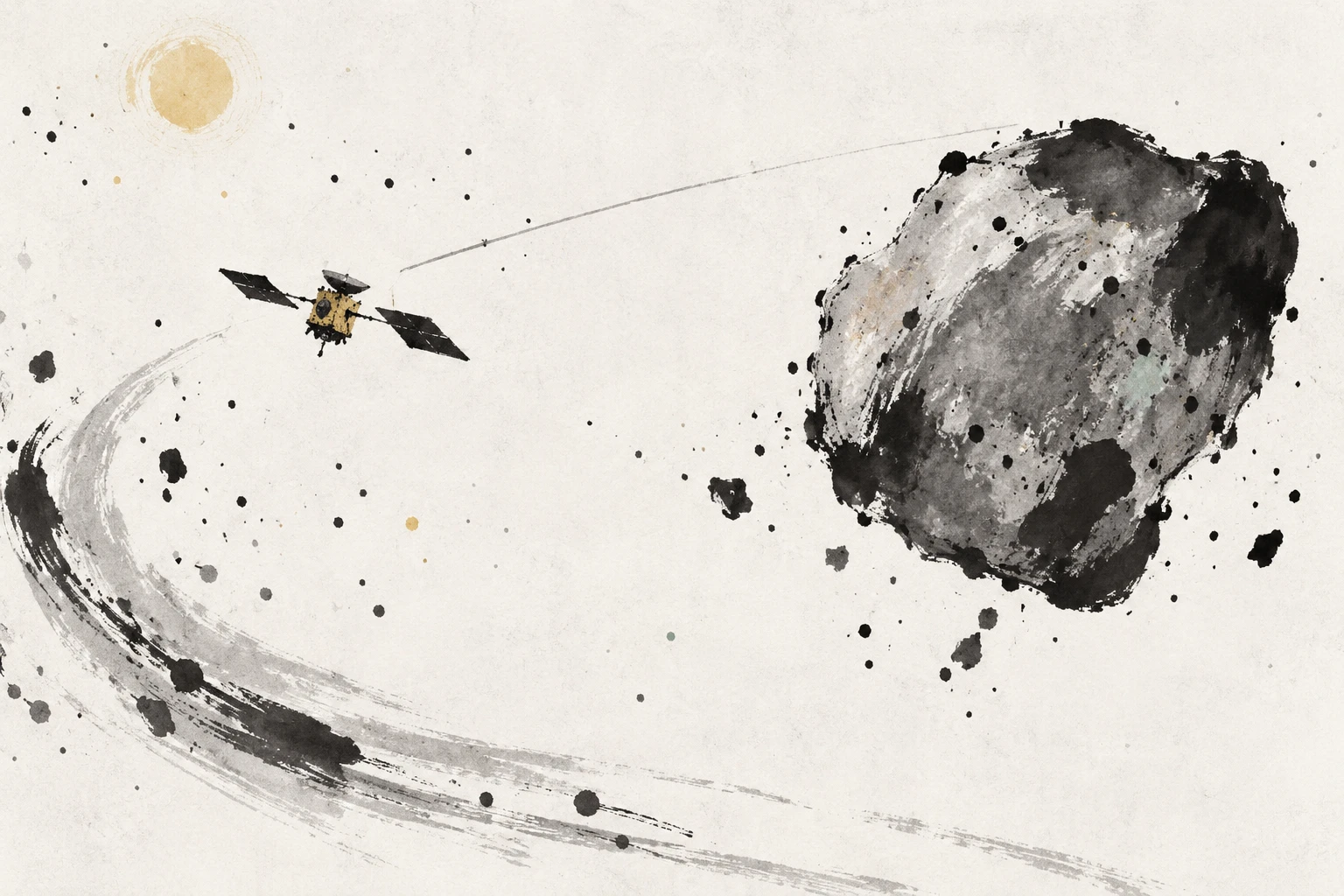
On July 5, 2026, if the plan holds, Japan’s Hayabusa2 spacecraft will cross the path of a small near-Earth asteroid named Torifune at 5.25 kilometers per second. It is currently planned to pass about 1 to 10 kilometers from the asteroid’s center—possibly closer—close enough to see detail, but far too fast for the spacecraft to turn and track its target like an orbiting observer. Most data will be collected in a narrow window before the asteroid’s shadowed side turns toward the cameras.
That is the extended mission Hayabusa2#, pronounced Hayabusa2 Sharp, for Small Hazardous Asteroid Reconnaissance Probe. After delivering samples of the carbonaceous asteroid Ryugu to Earth in December 2020, Hayabusa2 was repurposed for a decade-long journey. It is now aiming for a flyby of Torifune in July 2026 and a rendezvous with another near-Earth asteroid, 1998 KY26, in 2031. A new arXiv preprint overview by the mission’s Torifune Flyby Working Group describes how the team plans to squeeze science and engineering value from an aging spacecraft built for rendezvous, not high-speed flybys.
A roughly 450-meter asteroid with a blurred identity
Torifune, formally (98943) Torifune, is an Apollo-type near-Earth asteroid. It orbits the Sun every 383 days, with an orbit that brings it inside Earth’s path. Its name comes from Japanese mythology and was chosen with help from a children’s selection committee in Japan.
Telescopic observations have built a rough portrait. The asteroid’s equivalent diameter—the diameter of a sphere with the same volume—is about 450 meters, though published estimates vary from roughly 337 to 465 meters depending on the telescope, wavelength, and assumptions about albedo (reflectivity). Its shape appears elongated. It spins about once every 5.02 hours, and its spin axis probably points near the ecliptic north.
Its composition is less settled. Early mission analysis applied an L-type classification (a different spectral class). More recent visible and near-infrared spectra favor an S-complex asteroid (a spectral class linked to pyroxene and olivine), possibly Sq-type. That would make Torifune a relative of asteroids Itokawa and Eros, and of meteorites known as L- and LL-chondrites. The mission has not ruled out that L-type material could exist locally. Resolving this ambiguity is one reason the flyby matters.
The hard part is not reaching Torifune. It is looking at it.
Hayabusa2 was designed to linger at Ryugu, not to scream past a small asteroid. Its remote-sensing instruments point along the spacecraft’s -z axis. At 5.25 kilometers per second, the spacecraft cannot slew (turn quickly enough) to keep Torifune centered. The plan therefore fixes the spacecraft’s orientation and allows only a very small pointing change near closest approach. That tiny adjustment is crucial: without it, the NIRS3 spectrometer would lose the asteroid about 110 seconds before closest approach, and the LIDAR laser altimeter would not catch it at all.
The viewing geometry adds another constraint. Before closest approach, Torifune’s sunlit side faces the spacecraft. Afterward, the shadowed side dominates, and the solar phase angle (the Sun-asteroid-spacecraft angle) jumps to about 160 degrees. The paper states that this essentially prohibits post-encounter observations. Nearly all data must therefore be collected before or around closest approach.
The team plans to use five instruments: the telescopic and wide-angle optical navigation cameras ONC-T and ONC-W1, the thermal infrared imager TIR, the near-infrared spectrometer NIRS3, and LIDAR. A second wide-angle camera, ONC-W2, will not be used because its field of view is not favorable. The mission’s goal is modest but demanding: let every employed instrument get at least one data point.
ONC-T will monitor the asteroid’s brightness to refine its spin, search for a possible satellite, and take multi-color images to map surface variations. TIR will measure thermal properties—how quickly the surface heats and cools—which can help constrain the surface material. NIRS3 will look for a 3-micrometer absorption feature related to water and hydroxyl, and for mineral signatures that could settle its taxonomy. LIDAR will fire one laser pulse per second and hope to catch a few reflected pulses, providing a precious altitude fix. Shape modeling will combine images and other data, though the limited viewing geometry will make shape reconstruction harder.
A test run for planetary defense
The flyby is also a demonstration relevant to a different kind of mission. Planetary defense researchers want to know how to characterize a potentially hazardous asteroid quickly—before any attempt to deflect it. The DART mission’s impact on Dimorphos showed that the efficiency of a kinetic impact depends on the target’s mass, strength, orbit, and composition, properties that were not fully known in advance. The National Academies’ 2023–2032 decadal survey recommended a fast reconnaissance demonstration to address that gap.
Hayabusa2# is not that dedicated mission, and Torifune, at roughly 450 meters across, is larger than the 50-to-100-meter objects the fast reconnaissance concept targets. But the flyby will test relevant skills: precise navigation toward a small body, rapid observations under severe time pressure, and the use of a repurposed, aging spacecraft. The team argues it can demonstrate how a used spacecraft can contribute to fast reconnaissance.
The paper is an overview of an ongoing plan, not a report of completed observations. The flyby sequence, final encounter distance, and pointing strategy are still being refined. The spacecraft has experienced minor issues with its ion engines and reaction wheels, though the mission has identified resolutions and sees no risks before the flyby. After Ryugu operations, its instruments show degradation relative to initial performance—about 10 percent for LIDAR, 23 percent for NIRS3, and 10 percent for ONC sensitivity—but the team expects correction procedures to mitigate it.
The asteroid’s exact size, albedo, spin axis, and composition also carry uncertainties from telescopic data. The paper stresses that remote sensing during the flyby will not be enough for global characterization. This is a brief, one-pass encounter.
If it succeeds, Hayabusa2# will add a new portrait to the small-body gallery and show that a spacecraft built to sit beside an asteroid can still, with careful planning, catch one in its peripheral vision.