
Split Light from 28 Quasars Sets a New Ceiling on the Tiniest Dark Matter Halos
Using 28 quadruply lensed quasars, astronomers place one of the strongest upper limits yet on the minimum mass cutoff of the halo mass function in a sharp-cutoff CDM model, comparable to or stronger than constraints from Milky Way satellites.
Apr 6, 2026
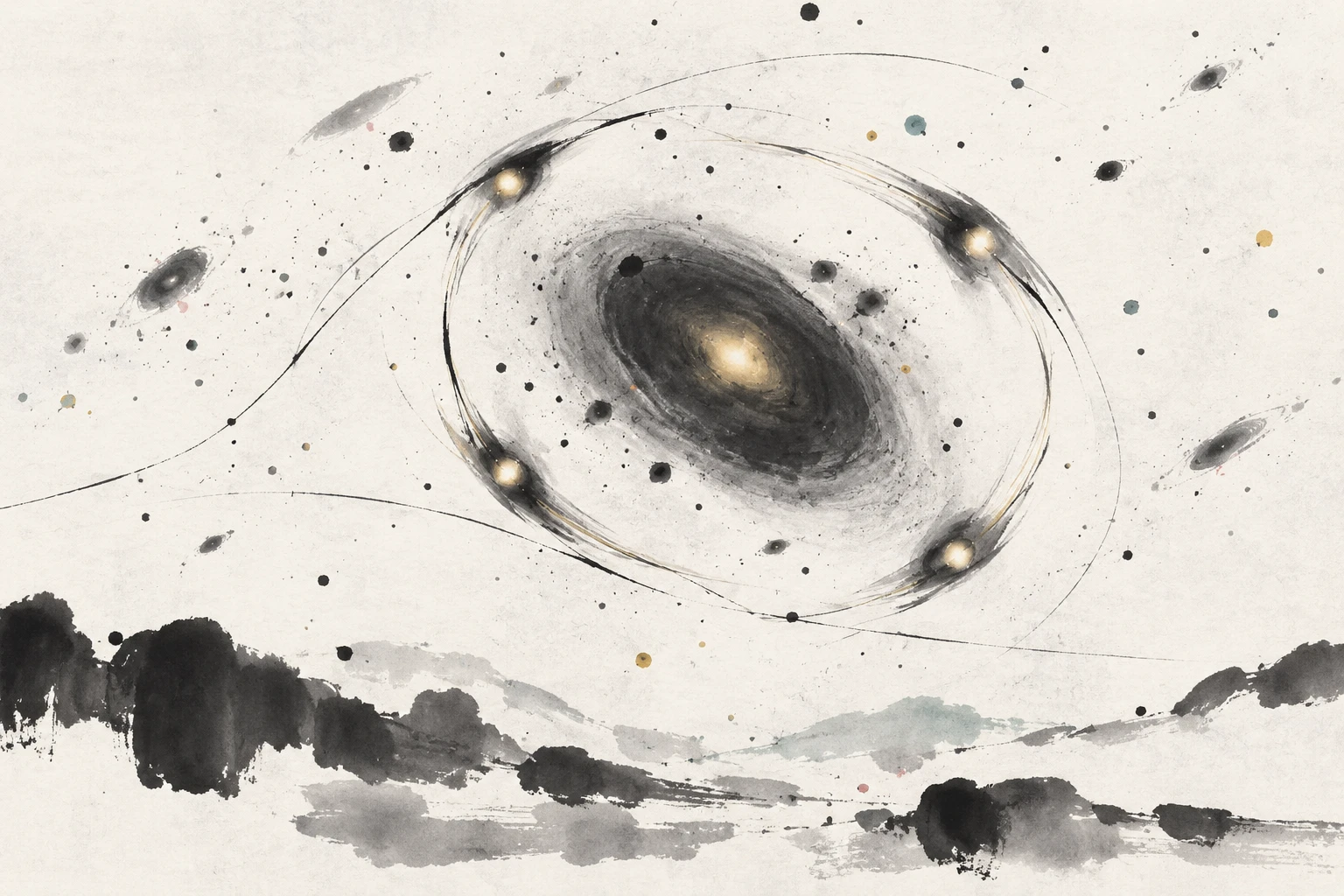
Imagine a single quasar shining behind a massive galaxy. The galaxy's gravity bends the quasar's light into four images, like a cosmic hall of mirrors. If a tiny clump of dark matter drifts near one light path, it can subtly change how bright that image appears relative to the others. That small mismatch is the signal a team of astronomers has used to place a new upper limit on the lowest mass scale at which dark matter halos can exist.
Dark matter does not emit light, but it shapes the universe. In the standard model of cold dark matter—slow-moving particles that clump—simulations predict thousands of low-mass halos around a galaxy like the Milky Way. Far more are expected than the dozens of faint satellite galaxies known. Many of those halos should be completely dark, containing no stars. Because the known satellites contain so few stars, directly weighing their dark matter halos is difficult.
Strong gravitational lensing offers another route. It responds to total mass, whether light or dark, and can be sensitive to small halos at cosmological distances, both inside the foreground lens galaxy and along the line of sight. The new study asks how low in mass current lensing data can push the floor of the halo mass function: the number of dark matter halos expected at each mass.
The Clue Is in Brightness, Not Position
Strong lensing produces multiple images of the same background object. Their positions are set mostly by the main lens galaxy's gravity. Small extra mass clumps—dark matter subhalos inside the lens or field halos along the line of sight—barely move the images, but they can magnify or demagnify individual images. Astronomers measure these relative brightnesses as flux ratios.
The team analyzed 28 quadruply imaged quasars from the JWST Lensed Quasar Dark Matter Survey. Twenty-six have warm dust flux ratios measured with the James Webb Space Telescope; two have narrow-line emission measurements. Imaging data from the survey, including Hubble Space Telescope observations, help pin down the main lens mass. The researchers then use forward modeling: they generate between 0.5 million and 20 million simulated dark matter and lens configurations per lens, compute expected brightness ratios, and compare them with observations.
Tidal stripping is crucial. When a small halo falls into a larger galaxy, gravity tears away its outer mass. The paper's model predicts that typical subhalos in the projected region of these lenses have lost about 95 percent of their mass since infall. Many surviving subhalos therefore end up below the cutoff scale being tested, so even a high field-halo cutoff can still leave a population of low-mass perturbers.
What 28 Lenses Can and Cannot Say
The study does not claim to detect a minimum halo mass. It tests an extreme model: cold dark matter's halo mass function and mass-concentration relation, with a sharp cutoff at some mass m_low at all redshifts. If the data required a higher cutoff, that would conflict with cold dark matter's prediction of abundant low-mass halos. If they allow a low cutoff, cold dark matter survives this test.
With the most agnostic prior on the subhalo mass function, the team finds m_low < 10^8.6 solar masses at 10:1 Bayesian odds, and < 10^8.4 at 95 percent confidence. Solar masses are units of our Sun's mass; 10^8.4 is about 250 million Suns. A prior from the semi-analytic galacticus model gives m_low < 10^8.3 at 10:1 odds. A prior from N-body simulations gives m_low < 10^8.2. These are upper limits: any sharp cutoff must lie below a few hundred million solar masses, with stronger priors pushing it below about 200 million.
These limits are comparable to, or stronger than, constraints from Milky Way satellite galaxies. A previous abundance-matching study by Nadler and colleagues reported m_low < 10^8.8 at 95 percent confidence using spectroscopically confirmed satellites, and < 10^8.4 including unconfirmed candidates. The new paper cautions that direct comparison is not straightforward because the analyses use different prior ranges and different definitions of halo mass, such as peak mass versus infall mass.
The result comes with caveats. The sharp-cutoff model is deliberately simple and is not tied to a realistic particle physics theory. It assumes cold dark matter concentrations down to the cutoff at all cosmic times. The normalization of the subhalo mass function—how many subhalos are present—differs by a factor of about two between N-body simulations and semi-analytic models, so the team explores two priors. The measurement is statistical, expressed as odds or confidence limits, not a direct detection. The paper is posted as an arXiv preprint.
The comparison with earlier results from the same lens sample is informative. A previous analysis found tighter limits on a warm dark matter half-mode mass—a scale below which warm dark matter suppresses small halos—around 10^7.2 to 10^7.4 solar masses at 10:1 odds. The new cutoff limit is weaker. The reason is not simply abundance. Warm dark matter halos are less concentrated, making them less effective gravitational lenses and more vulnerable to tidal disruption. The sharp-cutoff model keeps cold dark matter concentrations, so its low-mass halos perturb lensed images more efficiently. Concentration, as well as number, shapes the signal.
From 28 Lenses to 200
With 200 quadruply imaged quasar lenses, the paper forecasts a limit more than an order of magnitude stronger, reaching about 10^7 solar masses or below. Beyond roughly 120 lenses, the choice of prior on the subhalo mass function matters much less. A larger sample could directly constrain that normalization, removing a major source of uncertainty.
Such a sample is on the horizon. Rubin Observatory, Euclid, and Roman are expected to discover thousands of new strong lenses. The paper notes that about 200 quadruply imaged quasars may be readily observable in the next five years based on the expected year-one depth of Rubin's Legacy Survey of Space and Time.
For now, the smallest dark matter halos remain invisible. But their gravity can leave a faint, measurable whisper in the split light of distant quasars. As surveys multiply those split images, astronomers may finally map the lowest rungs of the cosmic dark matter ladder.