
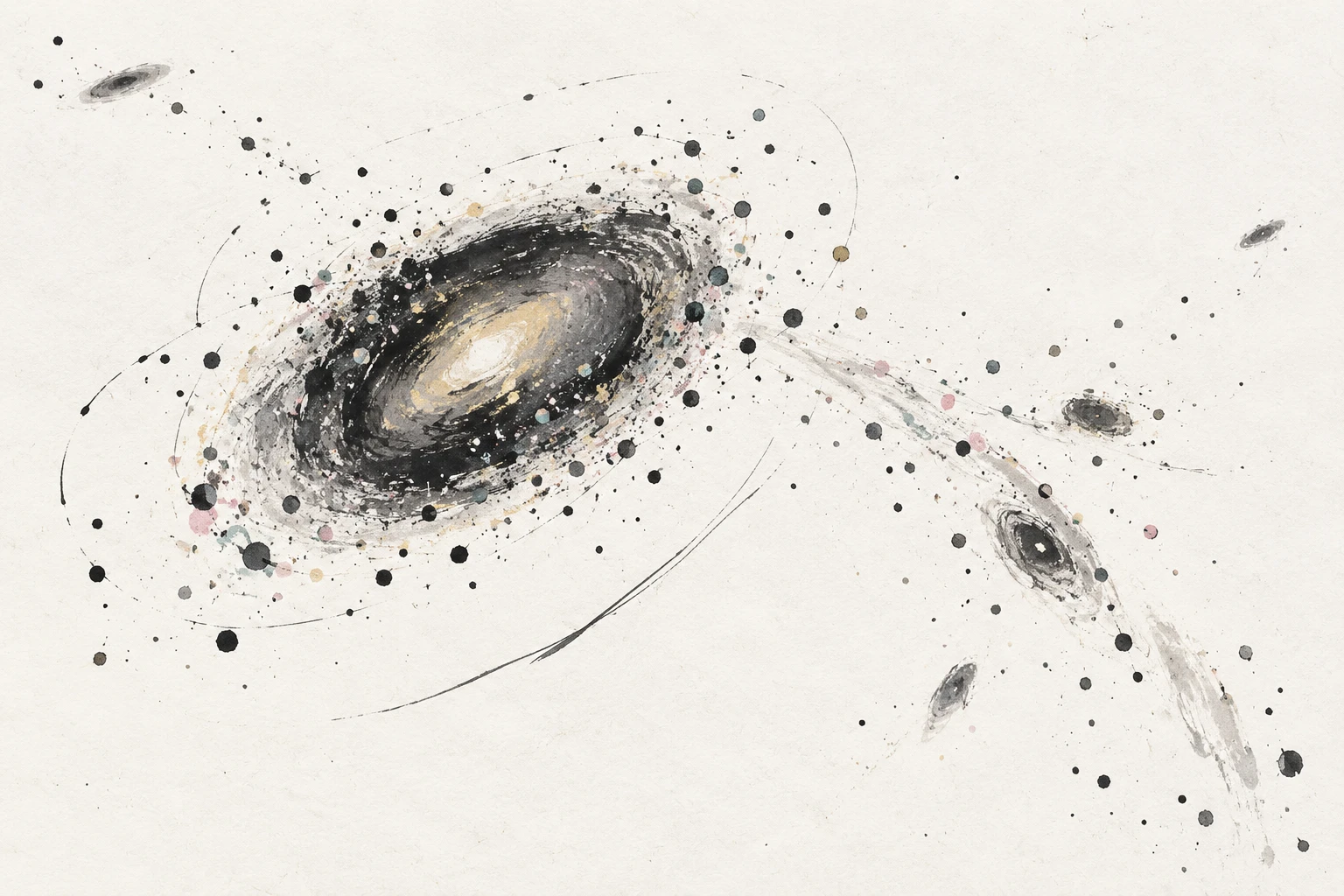
Globular Clusters May Reveal Which Compact Galaxies Are True Relics
A simulation of 17 compact massive galaxies suggests that the mass-weighted in-situ fraction of their globular clusters, not just their number, best records an early, quiet assembly history—and that cluster positions can flag later tidal stripping.
Apr 3, 2026
Imagine a galaxy that formed most of its stars in a furious burst when the universe was young, then stopped growing. No major mergers. No fresh gas. Just a compact, massive swarm of old stars sitting largely unchanged for billions of years. Astronomers call such objects massive relic galaxies, and they are among the closest things we have to fossils from the era when the first giant galaxies took shape.
Most massive galaxies did not stay frozen. In the standard two-phase picture, they first collapsed into compact, quiescent systems often called red nuggets, then grew larger by accreting smaller galaxies. Relics are the rare red nuggets that missed that second phase. The nearby galaxy NGC 1277 is a famous example.
Globular clusters offer a way to test that history. These dense, ancient star clusters orbit galaxies in swarms. In massive galaxies, they often come in two chemical families: metal-rich clusters that formed in situ, within the galaxy's main progenitor, and metal-poor clusters that were accreted along with satellite galaxies. A true relic should be dominated by the in-situ, metal-rich population, because it never accreted much material.
But not every compact galaxy is a true relic. Some may have been stripped down by gravity, losing their outer stars and clusters in dense environments. The question is whether globular clusters can tell the difference.
Testing Relics in a Simulated Universe
A new study led by Micheli T. Moura of the University of São Paulo and colleagues used the Illustris TNG100 simulation, a cosmological simulation that follows gravity, gas, stars, and dark matter as galaxies form. The team's final sample is 17 simulated compact massive galaxies with stellar masses above 10 billion Suns, half-mass radii (the radius containing half the galaxy's stars) smaller than 2 kiloparsecs, and a compactness cut based on surface density—roughly the compact scale seen in relic candidates.
The researchers then applied an analytical model for globular cluster formation and evolution. The model triggers cluster formation during rapid growth episodes, assigns each cluster a metallicity, and follows its orbit and tidal disruption over cosmic time. Only clusters more massive than 100,000 Suns that survived to the present day were analyzed. The work is a preprint posted to arXiv on 3 April 2026 and is based on simulations, not direct observations.
Weighing Clusters, Not Counting Them
The first result concerns how to read a galaxy's history from its clusters. The team compared the in-situ fraction of globular clusters—the share that formed in the main galaxy rather than arriving from satellites—with the in-situ fraction of the host galaxy's stars.
The mass-weighted in-situ fraction of the globular cluster population tracked the host much better than a simple count. The average mismatch was 0.162 for mass fractions, compared with 0.319 for number fractions. Massive clusters are harder to destroy, so they preserve the imprint of early accretion better. In practice, that means a galaxy's globular-cluster mass fraction may be a more faithful fossil record than the raw tally of clusters.
Three Simulated Relics—and Two Complicated Cases
Three simulated galaxies—identified as subhalos 60753, 69512, and 69530—stood out as strong relic analogs. They had high in-situ globular cluster fractions, narrow metallicity distributions, and compact cluster layouts. Their clusters were also old, with mean ages around 12 billion years, consistent with rapid early assembly.
Two more systems, 140732 and 118684, were interesting for different reasons. One appears to be a stripped relic: it lost much of its outer material yet still mimics a true relic in several properties. The other accreted only a small amount of material, but the accreted clusters were so massive that they left a clear metal-poor signature. These cases show that relic-like appearance can arise from more than one path.
The in-situ-dominated relic candidates also had narrower metallicity spreads (standard deviation of [Fe/H]), around 0.36–0.43 depending on whether the two additional candidates are included, compared with roughly 0.50–0.57 for the other compact galaxies. The three strongest relic analogs were more metal-rich on average, with mean iron abundance ([Fe/H]) near -0.9 versus about -1.1 for the remaining fourteen. That fits the idea that true relics formed quickly from chemically uniform gas and then largely stopped.
When Stripping Squeezes the Accreted Clusters
The study's third result links galaxy stripping to the spatial arrangement of clusters. Normally, accreted globular clusters are more spread out than those formed in situ. In the simulated sample, the ex-situ population was typically about six times more extended than the in-situ population, using the radius enclosing 80 percent of each population.
But in galaxies that had lost more than 20 percent of their stars to tidal stripping, that difference shrank dramatically, with a median extension ratio of about 2. Higher stripping fractions were associated with less extended accreted clusters. The team found a strong statistical anticorrelation, with a Spearman rank coefficient of -0.82 and a p-value of 1.1 × 10^-4.
That matters because stripped galaxies can masquerade as relics. If the result holds, the spatial profile of globular clusters could serve as a warning sign that a compact galaxy is not a pristine survivor but a survivor that had its outer layers torn away.
What TNG100 Can and Cannot Tell Us
These are simulated galaxies, not observed ones. The subhalo IDs are not names of real objects, and the globular cluster model relies on prescriptions for formation, metallicity, and disruption that have been tested against Milky Way-mass and dwarf-galaxy systems. The sample is small—17 galaxies—and the GC treatment is an analytical model applied within TNG100, not a direct observation.
Some cases already complicate the simple story. One simulated galaxy, 69530, had no accreted clusters yet still showed a broad metallicity spread. Another, 140732, was heavily stripped but retained strong relic-like features. Identifying true relics will likely require combining cluster chemistry, cluster positions, and the host galaxy's stellar assembly history.
The authors plan to follow up with globular cluster dynamics. They also call for observations of cluster kinematics and high-resolution metallicity maps, which could test whether the simulated diagnostics appear in real compact galaxies.
Relics are cosmic fossils, but fossils can be altered by later events. The new work suggests that globular clusters may record both the quiet early assembly and the violent stripping that came later. If the predictions hold, some of the oldest visible objects in a galaxy could help astronomers decide which compact galaxies are genuine survivors—and which only look the part.