
A Dirty Fireball? Einstein Probe Spots an Explosion With GRB-Like Energy but No Detected Gamma Rays
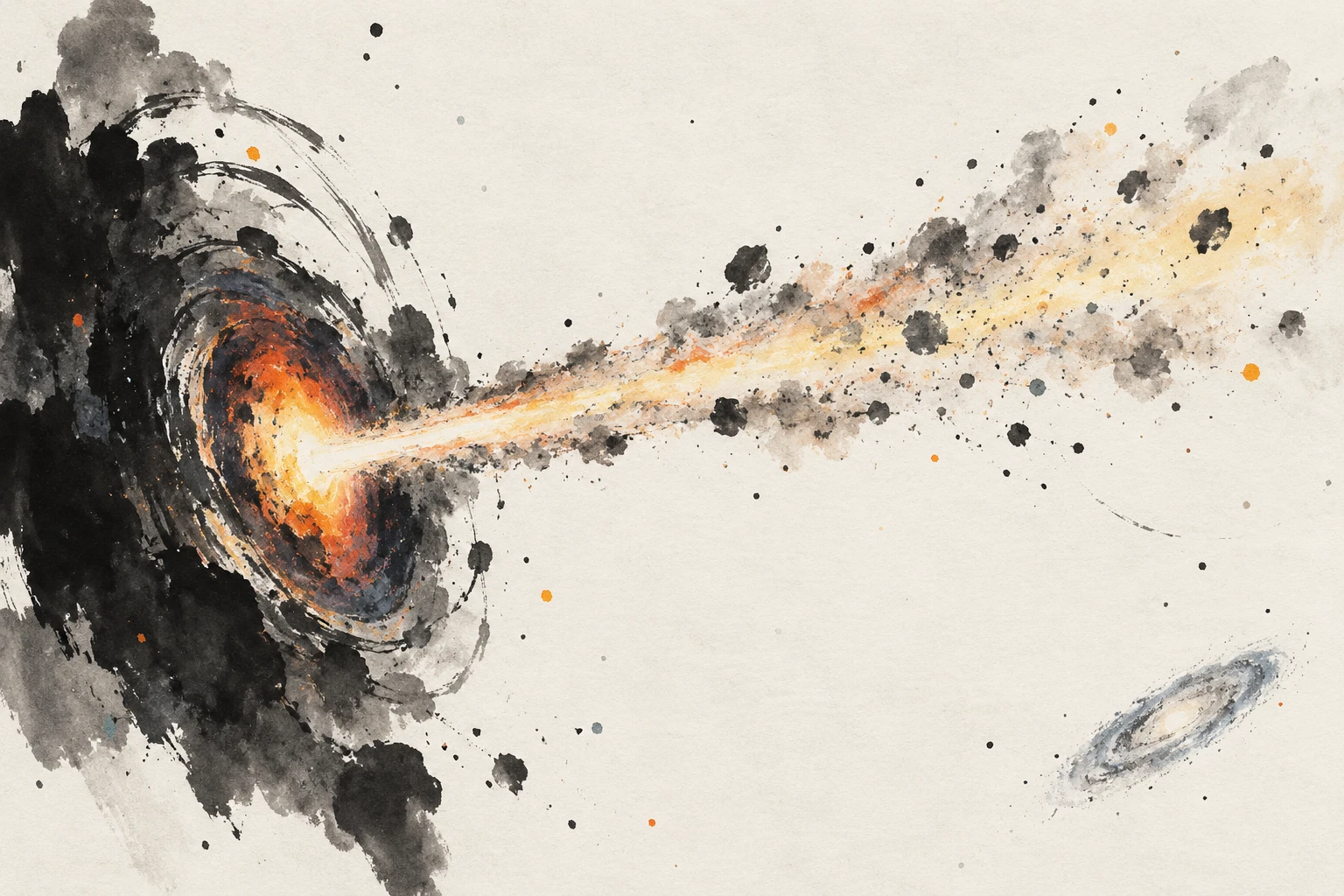
A soft X-ray transient detected by Einstein Probe may be the prototype of a long-sought 'dirty fireball': an energetic massive-star collapse whose jet appears to have been slowed by baryons and produced no detected gamma rays.
Mar 27, 2026
On 13 November 2024, the wide-field X-ray telescope (WXT) aboard the Chinese-led Einstein Probe satellite caught a brief, soft X-ray flash from the distant universe. The signal, named EP241113a, lasted about three minutes and came from a galaxy at redshift 1.53—a measure of cosmic distance that places it well beyond the local universe. The Fermi Gamma-ray Burst Monitor (GBM) had full spatial and temporal coverage of the same patch of sky. It found no significant gamma-ray signal.
That mismatch is the heart of the story. Astronomers have long known that some massive stars collapse into gamma-ray bursts, or GRBs, which unleash ultra-relativistic jets and bright gamma rays. They have also predicted that nature might make a slower, messier cousin—an energetic explosion whose jet is loaded with so much ordinary matter that it never reaches the extreme speeds needed for a classic GRB. Theorists called it a dirty fireball. Before this event, no prompt burst with the smoking-gun signatures of such a dirty fireball had been detected.
In a preprint posted to arXiv, an international team argues that EP241113a is the prototype they have been waiting for. The result has not yet been peer-reviewed, and it rests heavily on modeling. But if it holds, it opens a new drawer in the cosmic explosion cabinet.
An energy budget that looks like a GRB
The first clue is the raw power. At a redshift of 1.53, EP241113a released an isotropic X-ray energy of about 1.4 × 10^51 erg in the 0.5–4 keV band. Isotropic energy assumes the explosion radiated equally in all directions; the true energy is lower if the emission was beamed, as jets are. Even so, that value is comparable to the isotropic energy of many classical GRBs.
The second clue is the spectrum. The X-ray emission was unusually soft, peaking at a relatively low energy. The team's conservative 95% confidence upper limit places the spectral peak energy at 2.4 keV. Typical GRBs peak at much higher energies. The paper's best-fitting cutoff power-law model puts the peak near 1.3 keV, but the conservative limit is the safer claim.
This combination pushes EP241113a far outside a well-known pattern called the Amati relation. That relation links a burst's rest-frame peak spectral energy to its isotropic-equivalent gamma-ray energy for long GRBs, X-ray-rich GRBs, X-ray flashes, and low-luminosity GRBs. EP241113a has GRB-like energy but a much softer spectrum than the relation predicts. It lies outside the 3σ scatter region.
A jet that is fast, but not fast enough
After the prompt flash, Einstein Probe's Follow-up X-ray Telescope (FXT) began observing about two minutes later. The X-ray afterglow—the long-lived glow produced as the jet slams into surrounding gas—was detected until roughly 30 days after the trigger. Its light curve showed a steep decay, then a plateau, then a normal decay. That three-part shape is familiar from many Swift GRB afterglows.
The similarity suggested a jet origin. To infer the jet's speed, the team modeled the X-ray and optical afterglow as synchrotron emission from a forward shock expanding into a wind-like environment. Synchrotron emission is radiation produced by fast electrons spiraling around magnetic fields. The modeling points to a jet with a Lorentz factor of about 20. The Lorentz factor measures how relativistic the motion is; GRB jets typically have Lorentz factors above 100. The steep early decay also indicates that the jet was aimed close to our line of sight, not seen from the side.
A Lorentz factor near 20 is the dirty-fireball signature. In a clean fireball, only a tiny amount of matter is entrained, so the jet accelerates to extreme speeds. In a dirty fireball, more baryons—protons and neutrons—weigh the jet down. It still carries enormous energy, but it moves more slowly and radiates at lower energies. That is what EP241113a appears to do.
A host galaxy, a rare rate, and open questions
Optical follow-up helped pin down the distance. The Large Binocular Telescope and the Visible Telescope aboard SVOM detected a fading optical afterglow. A Keck spectrum showed a single weak emission line, which the team interprets as [O II] at redshift 1.53. A later Gran Telescopio Canarias image revealed the host galaxy, whose colors suggest a stellar mass around 10 billion Suns and a star-formation rate near 12 Suns per year.
From 15 months of Einstein Probe data, the team estimates a conservative lower limit on the event rate density for similar dirty fireballs: about 4 × 10^-3 per cubic gigaparsec per year. A gigaparsec is a billion parsecs; a cubic gigaparsec is a unit of volume. The true rate could be higher because many fast X-ray transients lack follow-up observations and confirmed distances.
The dirty-fireball interpretation depends on modeling and limited data. The X-ray spectrum has few counts, and the peak energy is an upper limit rather than a precise measurement. The jet speed comes from fitting afterglow models, not from direct imaging. Fermi saw no significant gamma-ray emission, but it can only place upper limits on any hidden emission. The redshift relies on a single emission line, though the host galaxy's photometric redshift agrees.
The team also cannot say exactly why this star's jet was dirty. Possible routes include a jet powered by neutrino annihilation around a hyperaccreting black hole, a newborn neutron star blowing a heavily mass-loaded wind, or a jet that picked up material while punching through the collapsing star. The paper lists these as possibilities rather than choosing among them.
Still, the broader picture is changing. Massive-star collapses appear able to produce not just classic GRBs and their softer cousins, but also energetic, slower jets that announce themselves mainly in soft X-rays. Einstein Probe's wide field and soft-X-ray sensitivity are well suited to finding more. Each new dirty fireball would turn a theorist's placeholder into a population—and show how many ways a dying star can shake the cosmos.