
Can Hot Gas Alone Drive M82's Galaxy-Scale Wind?
New XRISM measurements of the starburst galaxy M82 show that a 23-million-kelvin outflow carries enough power for hot gas pressure to drive its multiphase wind, so cosmic-ray pressure is not required.
Mar 25, 2026
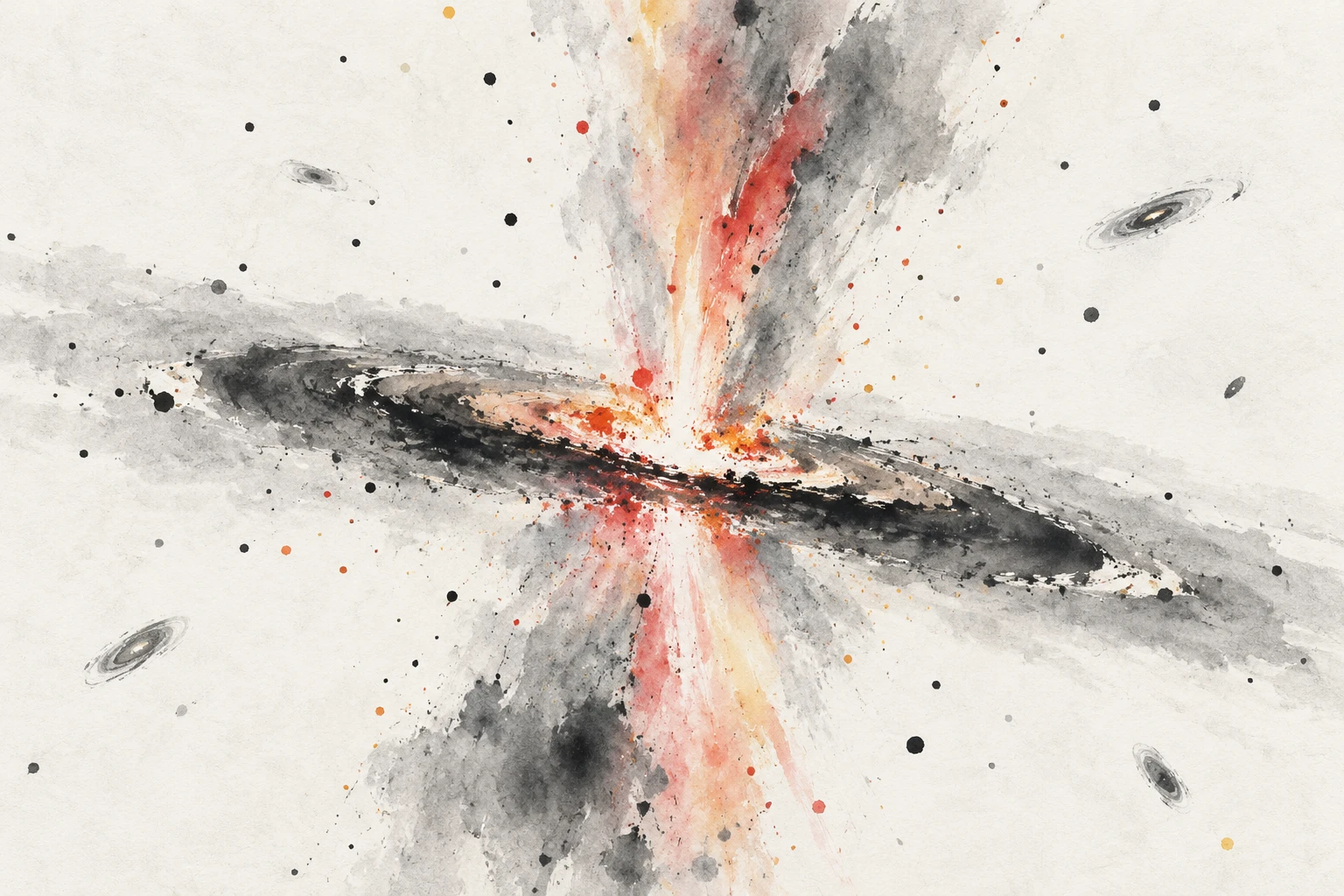
M82 is a galaxy with a spectacular, galaxy-scale wind: a flow of gas streaming out from its nuclear starburst. About 11 million light-years away, it hosts a compact region where stars form so rapidly that supernovae explode often, heating gas to tens of millions of degrees. That hot gas streams outward in a wind that extends thousands of light-years.
But what launches the wind? For decades, astronomers have debated whether the thermal pressure of hot gas is enough, or whether additional forces—cosmic rays, radiation, or even hotter gas—are required. In a preprint posted on arXiv, the XRISM Collaboration reports a direct measurement of the hot wind in M82 and concludes that thermal pressure alone can do the job.
A wind that leaves the galaxy
M82's wind is multiphase: it contains cold molecular gas, neutral atoms, warm ionized gas, and soft X-ray-emitting plasma. The molecular, neutral, and warm ionized phases carry at least 30 solar masses of material per year out of the galaxy. The engine is a population of young star clusters within a few hundred parsecs of the nucleus. (A parsec is about 3.26 light-years.) Supernovae and fast stellar winds from these clusters shock-heat the surrounding interstellar medium, creating a hot, high-pressure fluid.
The question is whether that hot fluid has enough power to drive the cooler phases. Previous X-ray observatories could not measure the hot wind's temperature and velocity precisely enough to tell. That changed with XRISM, the X-ray Imaging and Spectroscopy Mission, and its Resolve spectrometer.
Reading the wind in X-ray lines
XRISM's Resolve is a microcalorimeter: it measures the energy of individual X-ray photons with exquisite precision. In May 2024, it observed the nucleus of M82, collecting about 207,000 seconds of clean data. The spectrum showed strong emission from highly ionized iron (Fe XXV at 6.7 keV), sulfur (S XVI at 2.6 keV), and argon (Ar XVII at 3.1 keV). These lines are fingerprints of gas at millions of degrees.
Because the gas is moving, the lines are shifted and broadened. The width of the Fe XXV line revealed a line-of-sight velocity dispersion of about 595 kilometers per second—with a broad uncertainty, but even the lower end of the range is above the galaxy's escape velocity of roughly 450 kilometers per second. The team also measured the temperature of the hot gas: about 23 million Kelvin. That is cooler than some previous estimates, which ranged from roughly 30 million to 80 million Kelvin.
From the line strengths and the size of the emitting region, the researchers estimated the hot gas mass at about 600,000 solar masses, confined to an ellipsoidal thermalization zone roughly 300 by 350 by 75 parsecs. This zone is bounded by a molecular torus, which nozzles the outflow into a biconical wind. The resulting hot-gas outflow rate is about 4 solar masses per year, carrying an energy of about 2 × 10^42 ergs per second.
Enough power in the hot gas
The key comparison is energy. The hot wind carries roughly 2 × 10^42 ergs per second. The cooler, multiphase wind requires about 2.6 × 10^42 ergs per second to be heated and accelerated. Within the uncertainties, the hot wind has enough power to drive the cooler outflow. The authors also estimate that about 60% of the energy from supernovae must be thermalized in the hot gas. That is a high efficiency, but it is consistent with independent counts of supernova remnants in M82.
If correct, the result means that additional driving mechanisms, such as cosmic-ray pressure, are not needed to launch the wind. Cosmic rays are still present—M82 has a synchrotron radio halo—but they are not required to explain the wind's energy budget. The hot gas is the primary engine.
The hot wind also has consequences beyond the galaxy. Some of it will spend its energy heating and accelerating cooler phases and will not escape, but up to about 2 solar masses per year may retain enough energy to escape into intergalactic space. Over the roughly 10 million years since the onset of the recent starbursts, that could amount to up to 20 million solar masses of metal-enriched gas. M82 is thus a modest but concrete example of how starburst galaxies pollute and heat their surroundings.
What the geometry does not yet pin down
The result comes with caveats. The mass and energy outflow rates depend on the assumed geometry of the emitting region, the volume filling factor, and the chemical abundances. The authors treat these as approximations. If the hot gas has a non-solar abundance pattern—say, enriched by core-collapse supernovae—the inferred mass and energy could be lower by factors of a few, though mixing likely makes the pattern closer to solar.
The measured velocity is a line-of-sight dispersion, not the true outflow speed. M82's disk is highly inclined, and the wind is biconical along the minor axis, so much of the outflow is in the plane of the sky. The true speed is likely larger than 595 kilometers per second, which would increase the inferred kinetic energy, though the total energy budget is dominated by thermal energy. The escape velocity estimate is also complicated by M82's gravitational interaction with its neighbor M81.
The free-wind model that matches the data is one-dimensional and does not include turbulence or interactions with the molecular torus. It under-predicts the velocity inside the driving region. And a 3σ upper limit on even hotter gas means that a very hot, rarefied component could exist but cannot dominate the outflow.
Finally, this is one galaxy. The analysis is posted as a preprint on arXiv. Similar experiments on a sample of nearby starburst galaxies will provide constraints on how stellar feedback is treated in hydrodynamical simulations.
For now, M82 offers a clear picture: a galaxy's own supernova-heated gas can generate a wind fast enough to escape, without additional driving mechanisms. The wind is not just a local leak; it is a channel through which a galaxy reshapes its surroundings.