Einstein Survives 91 Gravitational-Wave Signals—But the Tests Are Getting Sharper
The LIGO-Virgo-KAGRA collaboration reports that 91 confident gravitational-wave events, including 42 from O4a, show no evidence of deviations from general relativity in four broad consistency checks.
Mar 19, 2026
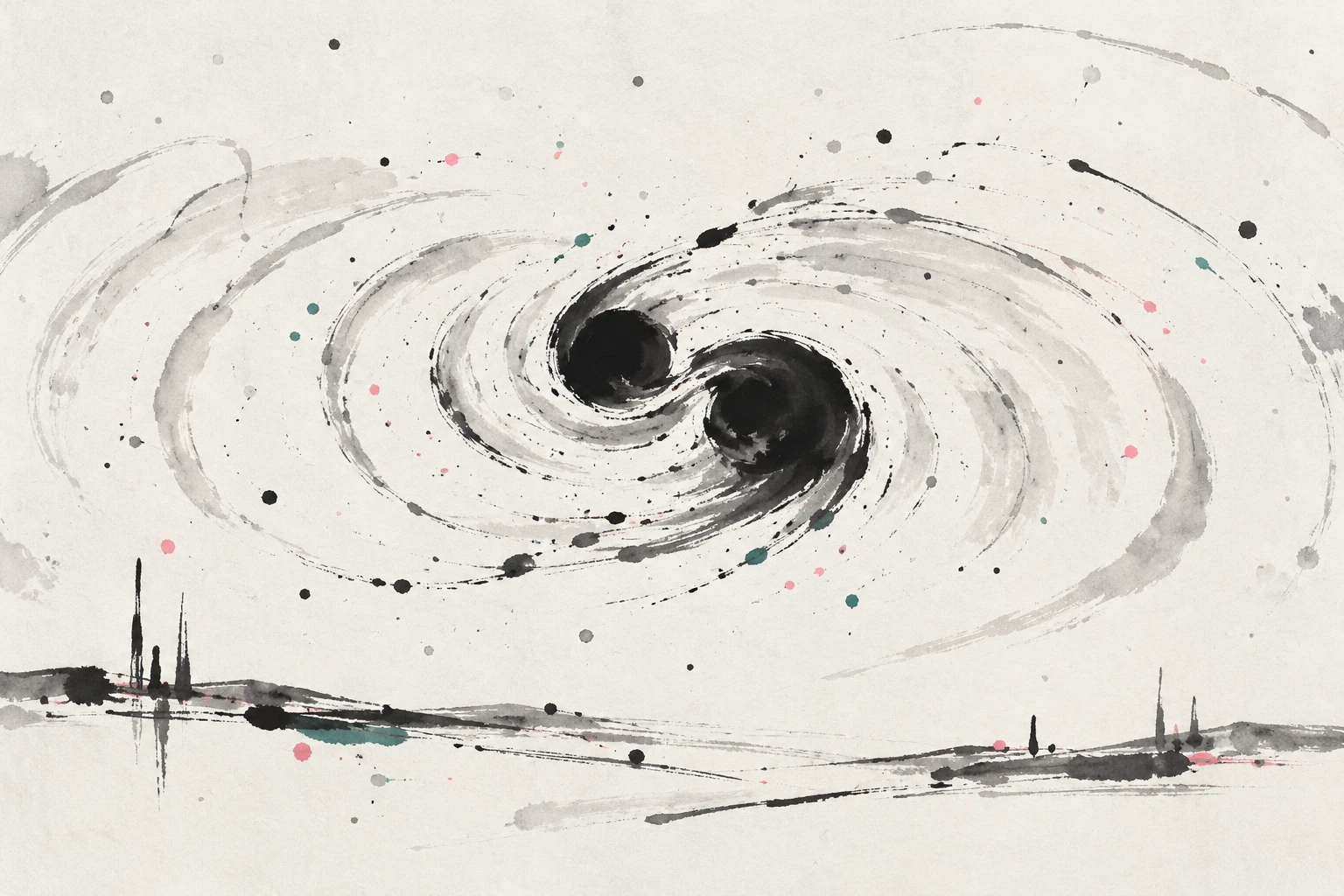
Two black holes, each heavier than the Sun, spiral together and merge. In the last fraction of a second, they shake spacetime hard enough that ripples reach Earth. Those ripples—gravitational waves—are not just confirmation that the event happened. They are a stress test for Einstein's theory of general relativity in a regime no laboratory can reach.
The LIGO–Virgo–KAGRA collaboration has now applied that stress test to its largest set of confident signals yet. In a new arXiv preprint, the team reports that 91 gravitational-wave events—42 of them from the first part of the fourth observing run, called O4a—show no evidence of deviations from general relativity in four broad consistency checks. The work is the first of three papers on the catalog, known as GWTC-4.0.
The result does not prove that general relativity is the final word on gravity. It does mean that the theory continues to survive the most extreme collisions astronomers can observe.
A Catalog That Keeps Growing
The latest catalog combines signals from earlier observing runs with O4a, which ran from 2023 May 24 to 2024 January 16. For the general-relativity tests, the collaboration selected events with a false alarm rate no higher than about one in a thousand per year and with data from at least two detectors. That left 91 events, including 42 new ones from O4a.
During O4a, the two Advanced LIGO detectors—in Hanford, Washington, and Livingston, Louisiana—were the workhorses. Virgo and KAGRA were mostly offline for upgrades, so every O4a event used here was measured by the two LIGO detectors. That matters for tests that need a network of detectors to separate genuine gravitational-wave polarizations from noise.
The events themselves are compact binary coalescences: pairs of black holes, neutron stars, or mixed pairs spiraling together and merging. Each merger produces a waveform whose shape encodes the masses, spins, and geometry of the source. If general relativity is correct, that waveform should follow a predictable pattern from the slow inspiral to the violent merger and final ringdown.
Four Ways to Check Einstein's Playbook
The first paper in the trio focuses on general tests that ask whether the data are internally consistent with general relativity. One test subtracts the best-fitting general-relativity waveform from the data and examines what remains. If the model captured the signal, the leftover data should look like instrumental noise.
A second test, applied to events passing its selection criteria, splits each signal into low-frequency and high-frequency portions. The low-frequency part comes mostly from the inspiral; the high-frequency part comes from the merger and ringdown. General relativity predicts that both portions should point to the same final black hole mass and spin. The collaboration infers those values independently from each part and compares them.
A third test examines subdominant multipole moments—the weaker harmonic patterns in the gravitational-wave signal. The loudest part comes from the dominant quadrupole pattern, but weaker harmonics also appear, especially when the two objects have unequal masses. General relativity makes specific predictions for their amplitudes. If those amplitudes were different, it could signal new physics.
A fourth test looks at polarization—the different ways a gravitational wave can stretch and squeeze spacetime. General relativity allows two tensor polarization modes, often called plus and cross. Some alternative theories predict scalar or vector modes as well. By combining detector data in a way that should cancel a pure tensor signal, the team searches for excess power that would reveal other polarizations.
What the Detectors Did—and Did Not—Find
Across all four general tests, the data remained consistent with general relativity.
In the residual test, no event left behind coherent power louder than expected from noise. The collaboration found that the distribution of residual p-values matched what would be expected if the subtracted signals were described correctly. In other words, the model did not leave an obvious fingerprint of missing physics.
In the inspiral–merger–ringdown consistency test, the final mass and spin inferred from the low- and high-frequency parts of the signals agreed. For the events that passed this test's selection criteria, the combined joint posterior gave a fractional deviation in final mass of about 0.00 with an uncertainty of 0.05, and a fractional deviation in final spin of about minus 0.04 with an uncertainty of 0.07. Both are consistent with zero, the general-relativity expectation. The joint posterior's GR quantile was 89.1%, where smaller values mean better consistency with general relativity.
For subdominant multipole amplitudes, the tightest constraint in this paper came from the older event GW190814; GW190412 was also analyzed. For GW190814, the measured deviation in the amplitude of the (3, ±3) multipole was about minus 0.21, with an uncertainty large enough to include zero. The distribution was bimodal, however, reflecting a known degeneracy between the amplitude deviation, the binary's inclination, and its orbital phase. That bimodality means the data cannot yet fully separate a true deviation from source geometry.
In the polarization test, tensor modes won decisively. Compared with the tensor hypothesis, the scalar hypothesis was disfavored by a base-10 log Bayes factor of about minus 14.7; vector modes were disfavored by about minus 5.3; and vector-scalar modes by about minus 5.2. Combined hypotheses that include tensor modes, such as tensor-scalar or tensor-vector-scalar, remained less informative because the tensor hypothesis is nested inside them.
Where the Real Tension Lives
The collaboration is careful not to overclaim. A few individual events place general-relativity parameters outside the 90 percent credible region, but with so many events and so many tests, some statistical outliers are expected. One event, GW231123, showed apparent deviations in multipole tests, but the paper attributes them to waveform systematics rather than new gravity.
The companion papers that analyze parameterized deviations and ringdown signals also find broad consistency with general relativity. More than 90 percent of events are consistent at the 90 percent credible level. One ringdown analysis finds general relativity in the tails of its combined result, but the paper notes that this may be due in part to catalog variance—the particular mix of events in this catalog rather than a real physical effect.
There are other caveats. A late-discovered error in how a data windowing correction entered the likelihood affected some analyses. Several were rerun or reweighted with the corrected likelihood, and the paper says the shifts were small and did not change the overall conclusion. Some analyses still use older calibration or likelihood treatments, with expected small or negligible effects. And because O4a had only two detectors for these events, the polarization analysis was limited to a single effective polarization mode; Virgo and KAGRA were mostly offline for upgrades.
What Would It Take to Break Einstein?
General relativity has now passed another, larger gauntlet. The value of the result is not that the theory has been proven, but that its room to fail has narrowed. The strong-field, dynamical regime around merging black holes is one where alternatives to Einstein's theory can differ. So far, those differences have not shown up.
Future observing runs will bring more events, louder signals, and better detector networks. Each new merger adds another chance for gravity to surprise us. For now, the universe's most violent collisions continue to speak in Einstein's language—clearly, and with no obvious accent of new physics.