
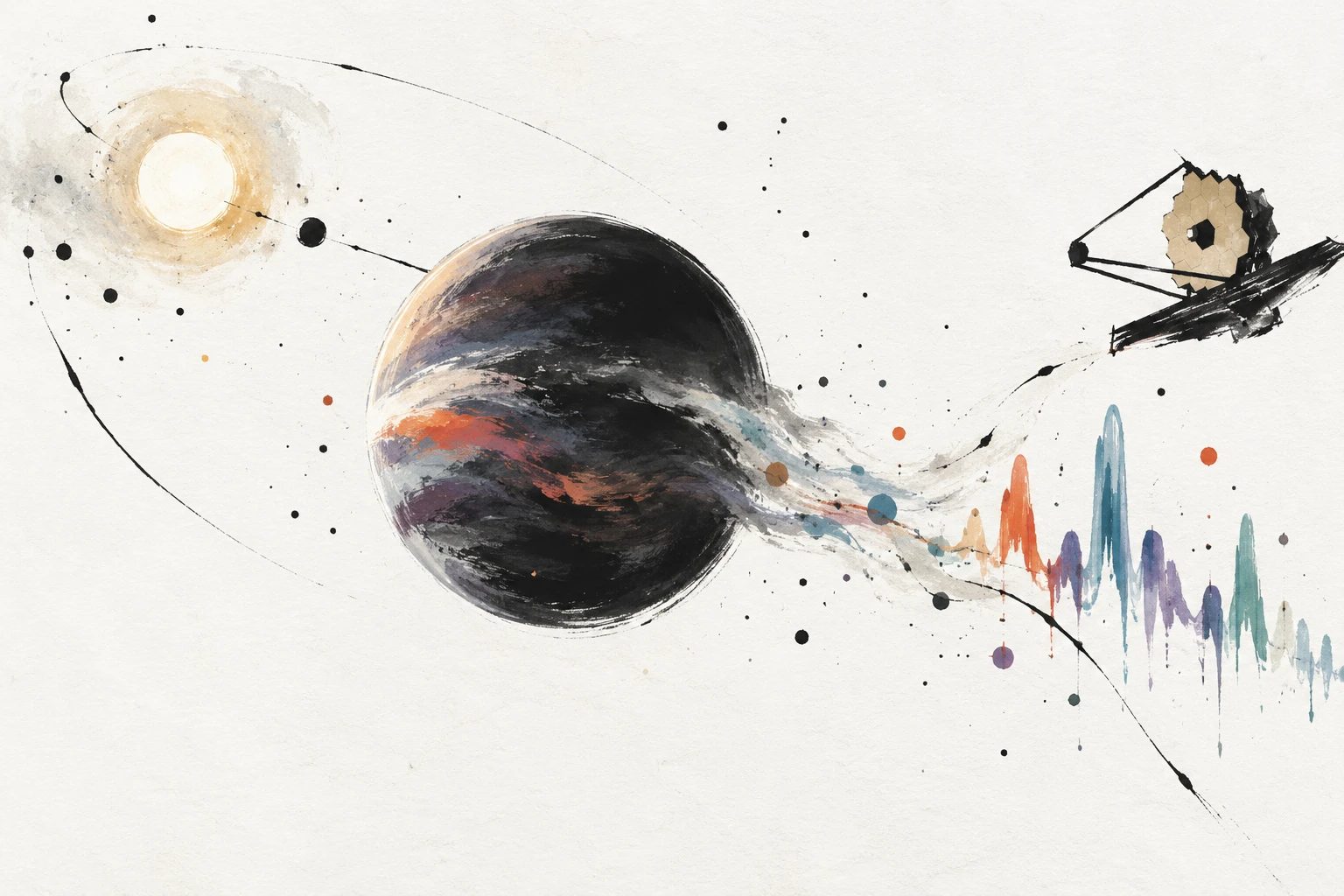
JWST's Molecular Mapping Hints at Ammonia—and a Possible Heavier VHS 1256 b
In a preprint, astronomers report robust water and carbon monoxide, tentative ammonia and methane, and a possible mass above the deuterium-burning limit for the young planetary-mass companion VHS 1256 b, using cross-correlation on JWST/MIRI data.
Mar 13, 2026
On July 5, 2022, the James Webb Space Telescope observed the faint point of light VHS 1256 b with its Mid-Infrared Instrument. The object lies about 21 parsecs from Earth and orbits a tight pair of small stars at a projected distance of roughly 179 astronomical units—about six times Neptune’s distance from the Sun. It is young, around 140 million years old, and still warm from formation, which makes it a stand-in for the giant planets astronomers are beginning to image around other stars.
A new preprint uses this favorable target to test whether molecular mapping—a cross-correlation technique—can chemically fingerprint a planetary-mass companion. VHS 1256 b is not a hard case: its host stars lie outside the MIRI field of view, and its spectrum is not contaminated by starlight. That makes it an ideal testbed for a method the authors expect to matter in future, higher-contrast observations where extracting a planet’s spectrum from a star’s glare is much harder.
By cross-correlating JWST/MIRI spectra with Exo-REM model atmospheres, the team robustly detects water and carbon monoxide, finds tentative signs of ammonia and methane, and extracts an ammonia abundance and a carbon isotope ratio. The ammonia measurement also points toward a mass above the deuterium-burning limit, though the authors emphasize that this mass inference is model-dependent.
A Test Case for Reading Chemical Echoes
VHS 1256 b was the first planetary-mass companion observed with JWST’s MIRI using its Medium-Resolution Spectrometer, or MIRI MRS. The instrument covers mid-infrared wavelengths from 4.9 to 18 micrometers and produces a spectrum for each pixel in a small field of view. The MIRI observations lasted about 26 minutes. After reducing the data and subtracting background light, the researchers had a high-quality spectral cube.
They then applied molecular mapping. Instead of extracting the planet’s spectrum first, they cross-correlated each pixel’s spectrum with model spectra from the Exo-REM atmospheric grid. Cross-correlation is a pattern-matching exercise: it measures how well the bumps and dips produced by molecules in a model line up with the bumps and dips in the data. The team compared this approach with a one-dimensional cross-correlation of the extracted spectrum.
Water and Carbon Monoxide Are Clear; Ammonia and Methane Are Faint
The robust detections are water and carbon monoxide. Water reaches a signal-to-noise of about 76, carbon monoxide about 25. These are molecules expected in a hot, young giant planet atmosphere. Ammonia and methane are much weaker, each near signal-to-noise 3, which the team treats as tentative. Methane showed up in the one-dimensional cross-correlation but was not reliable in the two-dimensional maps because noise artifacts mimicked its signal. Ammonia was marginal but survived a noise test.
The paper also tests whether cross-correlation can measure trace gases and isotopic ratios. It derives an ammonia volume mixing ratio of log10[NH3] = -5.73 (+0.15, -0.14), meaning roughly two ammonia molecules per million atmospheric molecules. That agrees with an independent retrieval analysis. It also measures the carbon isotope ratio 12C/13C = 77.8 (+13, -10). That is between the local interstellar medium’s value of about 69 and the solar system’s value of about 88, though the result depends on which wavelengths are used.
From a Faint Molecule to a Mass Estimate
Ammonia has another use. In models, its abundance is sensitive to surface gravity, which is tied to mass when temperature and radius are known. For VHS 1256 b, the team combines the measured ammonia with a temperature of 1150–1250 kelvin and a radius of 1.27 Jupiter radii. The result points to a surface gravity of log g at least 5.0 and a mass above 20 Jupiter masses. That would place the object above the deuterium-burning limit, the mass threshold at which an object can fuse deuterium. Earlier evolutionary models had produced a bimodal mass estimate of about 12 or 16 Jupiter masses. The ammonia measurement favors the higher end, but the authors stress that this inference is strongly model-dependent.
Where Silicate Clouds and Noise Interfere
The study also maps the method’s limits. The correlation is weaker in bands around 8.7 to 13.5 micrometers, a region affected by silicate absorption that can mute molecular features; the paper notes that this may also reflect poorer model matches there. The authors find that noise can create spurious correlations, especially at low signal-to-noise, so they subtract a featureless model map to check. Metallicity and surface gravity remain degenerate—different combinations can fit the data—and the exact result depends on how the smooth continuum is removed. The 12C/13C value can shift with wavelength range. And because this is a preprint, the results have not yet completed peer review.
Why It Matters for the Next Generation of Planet Hunting
The value of the work is not only what it says about VHS 1256 b. It shows that molecular mapping can recover a planet’s chemical fingerprint without extracting a spectrum, a step that will become harder as astronomers target planets closer to bright stars. Upcoming JWST programs will use MIRI MRS on GJ 504 b, the four giant planets of HR 8799, and the cold companion Eps Ind b. Future extremely large telescopes with high-resolution mid-infrared instruments could extend the approach further.
VHS 1256 b is not a familiar world. It is a young, cloudy, self-luminous object near the boundary between planets and brown dwarfs. But in its mid-infrared glow, astronomers have found a way to read chemistry, isotopes, and perhaps mass from a point of light. The next test will be whether that reading holds up in noisier, more crowded systems—where planets closer to bright stars are waiting.