
The Most Metal-Poor Stellar Stream Known May Be a Fossil of an Early Star-Forming Burst
Chemical analysis of 14 stars in the C-19 stream reveals a rapid, early burst of star formation with no evidence of later generations, offering a nearby analogue to primordial star formation in the early universe.
Mar 2, 2026
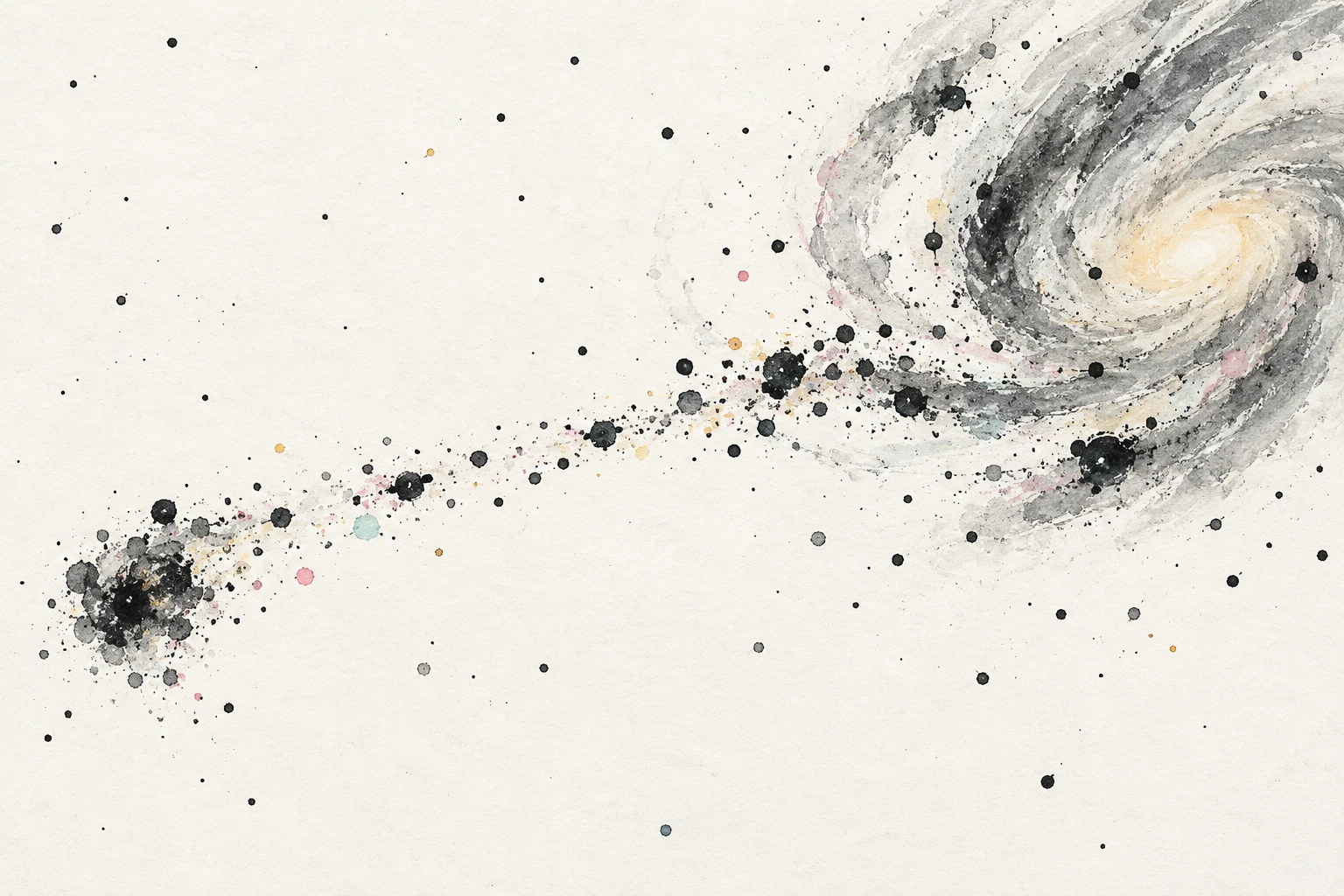
Across more than 100 degrees of the sky, a faint ribbon of stars arcs through the Milky Way's halo. It is the shredded remains of a small system called C-19. Its stars contain less than one-thousandth the Sun's iron-to-hydrogen ratio. That makes C-19 the most metal-poor stellar stream known, and a rare fossil from early star formation.
In astronomy, metals are elements heavier than helium. C-19's iron abundance, written [Fe/H], is about -3.3 on a logarithmic scale where 0 is the Sun's iron-to-hydrogen ratio. In plain terms, these stars formed from gas that had been enriched by very few previous generations of stars, or perhaps just one.
A ribbon of stars with an uncertain origin
Stellar streams are the debris of compact star systems stretched out by the Milky Way's tides. By studying their stars, astronomers can reconstruct what the original object was like billions of years ago. C-19 has been especially puzzling. It has properties that resemble both a globular cluster and an ultra-faint dwarf galaxy. Either way, its extremely low metallicity indicates that its stars formed within roughly the first billion years after the Big Bang.
What fourteen stars reveal
To understand C-19's origin, Kim A. Venn and colleagues used high-resolution spectroscopy, which splits starlight into detailed wavelengths so that the fingerprints of individual chemical elements can be measured. The team obtained new high-resolution spectra for eight stars, mostly with the GHOST spectrograph at Gemini South, and combined them with six previously published high-resolution analyses. The result is a sample of 14 C-19 members.
The stars have a mean iron abundance of [Fe/H] = -3.31, with a metallicity spread of less than 0.18 dex at 95% confidence. A dex is a logarithmic unit; the small spread means the stars are remarkably uniform in iron. That uniformity is important. It suggests they formed quickly from gas that experienced only mild, incomplete mixing during a short burst of star formation, rather than over an extended history.
The light elements tell a similar story. Sodium, magnesium, and aluminum show only narrow dispersions. Aluminum varies by about 0.3 dex, while magnesium and sodium vary by only about 0.1 dex, and calcium shows no significant spread. More tellingly, the stars do not show the magnesium-aluminum anti-correlation or the sodium trends seen in Milky Way globular clusters. Those patterns are signatures of a second generation of stars, formed from gas recycled through massive stars. C-19 appears to lack that second generation.
Heavier elements point the same way. Strontium and barium in C-19 have small dispersions, more like stars in globular clusters than the wider spreads seen in ultra-faint dwarf galaxies. The relatively high strontium-to-barium ratio favors production by the weak rapid neutron-capture process, or the weak slow neutron-capture process, in massive stars. Together with the light-element results, this points to mild, incomplete mixing of material ejected by massive stars in an early, rapid star-forming event.
A single, short burst, but from what?
The team then compared C-19's average chemistry with predicted yields from supernovae. Many core-collapse supernova models for Population III stars, the first stars with no metals, fit the observed abundances within three standard deviations of the best-fit model. The successful models cluster around a progenitor mass near 20 solar masses, an explosion energy of about 1 to 3 times 10^51 erg, and only light mixing. Models of rapidly rotating massive stars also reproduce the pattern. The data therefore do not identify a unique source. A single metal-free supernova is plausible, but so is enrichment by typical Pop II or Pop III massive stars in a very early, short-lived system.
One thing the observations do not support is a long, quiet history. There is no evidence for later star formation, multiple stellar populations, or extended chemical evolution. The chemical pattern looks like a first generation in a small, early system, forming rapidly and then stopping.
A chemical fossil with a dynamical puzzle
That chemical picture fits a globular-cluster-like birth. But C-19's motion is harder to explain. Its velocity dispersion is about 10 kilometers per second, dynamically hot compared with what astronomers would expect from the stream of a typical baryon-dominated cluster. That has led to suggestions that C-19's progenitor was a dwarf galaxy, or that it was disrupted inside a low-mass halo before the Milky Way pulled it apart.
Computer simulations support part of this idea. An N-body model of rapid gas expulsion and later tidal disruption can reproduce the stream's width on the sky and its velocity dispersion. In that scenario, the original cluster formed stars with very low efficiency, about 6 percent, and was gravitationally unbound as gas was expelled. But the simulations are not observations, and star cluster formation at such early times is still not well understood.
What the stream cannot yet tell us
There are important caveats. The chemical analysis rests on 14 stars, a modest sample, though unusually detailed for such a faint stream. The progenitor itself is gone, so its identity must be inferred from debris. The supernova-yield comparisons are non-unique: several models and combinations can fit the data. And the current optical spectra are insensitive to nitrogen, which is one element that might distinguish competing scenarios for early star formation.
That limitation matters because JWST has found very distant galaxies with elevated nitrogen abundances, possibly produced by Population III supernovae or rapidly rotating massive stars. C-19 cannot yet test that prediction directly. But the elements astronomers can measure in C-19 point to the same broader picture: a primordial, rapid burst of star formation.
C-19 is now only a ribbon of stars in the Milky Way's halo. Yet its chemistry preserves a moment when a small cloud of gas was quickly transformed by massive stars and then left alone. For astronomers, that makes this faint stream a local time capsule, complementary to the high-redshift galaxies JWST is revealing at the edge of cosmic time. The work is reported in an arXiv preprint, with a companion detailed spectral analysis in preparation.