
A Black Hole's Inner Disk May Reach the Brink Before Its X-Ray State Changes
A new review of X-ray observations finds that bright hard-state black hole X-ray binaries can host accretion disks extending close to the innermost stable circular orbit before the hard-to-soft state transition, while X-ray polarimetry complicates the picture of the corona.
Feb 28, 2026
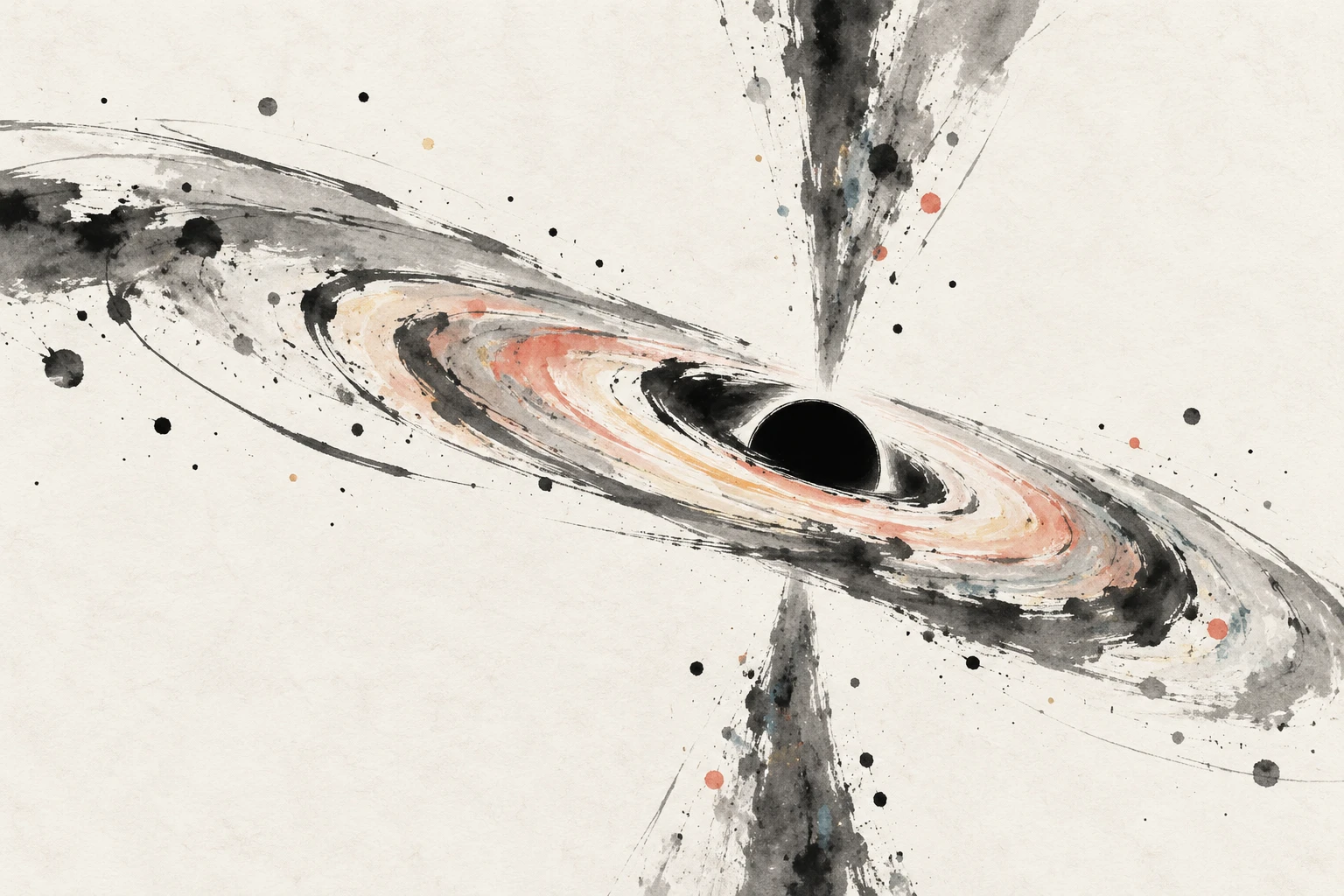
A black hole pulling gas from a companion star can brighten by orders of magnitude in X-rays. Astronomers describe that outburst as a journey through a hard state, dominated by high-energy emission from a hot corona, and a soft state, dominated by cooler thermal emission from the accretion disk. The standard picture has been that in the low hard state the disk is truncated far from the black hole, and in the soft state it reaches the innermost stable circular orbit, or ISCO—the last radius where matter can orbit stably.
A new review of X-ray observations, posted to arXiv by Honghui Liu of the University of Tübingen, argues that the disk may arrive early. In the bright hard state, before the source switches to the soft state, X-ray spectroscopy can find the inner disk edge close to the ISCO. The review synthesizes published measurements rather than presenting new observations, but the pattern changes the timeline of how a black hole's accretion flow rearranges itself—and complicates efforts to use X-rays to measure black hole spin and test gravity.
A stellar-mass black hole as a strong-gravity laboratory
Black hole X-ray binaries are systems in which a stellar-mass black hole, typically several to tens of times the mass of the Sun, feeds on gas drawn from a companion star. The gas forms an accretion disk. Close to the black hole, it can become hot enough to glow in X-rays.
The X-ray light comes mainly from two regions. The disk emits a thermal spectrum peaking in soft X-rays. A hot plasma called the corona, with temperatures around 100 keV, up-scatters seed photons—often from the disk, but also from internal processes in the corona itself—to higher energies. Some coronal light reflects off the disk, creating a broad iron line and a Compton hump that carry fingerprints of the inner disk radius, inclination, and corona shape.
The inner disk can arrive before the state change
At very low accretion rates—around 0.1% of the Eddington limit, a standard maximum brightness for a given black hole mass—the disk appears truncated beyond 100 times the ISCO radius. As the accretion rate rises, the inner edge moves inward but often remains around 10 gravitational radii (R_g, a length scale set by the black hole's gravity) while the Eddington ratio stays below 1–2%. A hot inner flow likely fills the gap and acts as the corona.
The surprise comes at higher accretion rates. In the bright hard state, when the Eddington ratio rises above roughly 3–4%, X-ray spectroscopy indicates the disk can extend close to the ISCO. In the review's compilation of hard-state measurements above 3% Eddington, 18 of 23—about 78%—are consistent with an inner radius smaller than four times the ISCO, and 10 of 23—about 43%—are consistent with less than twice the ISCO, including three upper limits.
That means the disk is not necessarily truncated in the bright hard state. The disk-corona geometry is already evolving before the hard-to-soft transition, not only during it. The old sequence—truncated disk in the hard state, ISCO disk only after the transition—is too clean.
Timing and polarimetry disagree about the corona
X-ray timing offers one view of the corona. In the hard state, reverberation lags—the delays between direct coronal X-rays and reflected X-rays from the disk—decrease as the source brightens, consistent with the disk moving inward and the corona contracting radially. Once the disk reaches the ISCO in the bright hard state, the lag amplitude can keep falling while the disk radius stays put. That suggests the corona is shrinking vertically.
During the hard-to-soft transition, the trend reverses: soft lags tend to grow, and model fits suggest the corona expands vertically. That expansion may be linked to transient jet ejections.
X-ray polarimetry tells a different story. Since the Imaging X-ray Polarimetry Explorer, or IXPE, launched in December 2021, it has observed a dozen black hole X-ray binaries. In several hard and intermediate states, the polarization angle aligns with the radio jet direction. A simple lamppost corona—a compact corona above the black hole—or a spherical lamppost often predicts too little polarization compared with IXPE. A corona extended sideways along the disk plane fits better.
So spectral timing points upward, while polarimetry points sideways. One possible reconciliation is a dual corona: a horizontally extended component that shapes the spectrum, plus a vertically extended component that dominates the lags. The review notes that this idea is not yet backed by a self-consistent theoretical framework. Other possibilities include scattering off jet walls, jet synchrotron emission, returning radiation, or disk winds.
The soft state still has a polarimetric surprise
In the soft state, the standard picture is more settled. The disk is expected to extend to the ISCO, and the observed relation between disk luminosity and temperature supports a constant inner radius. Polarization data have begun to constrain black hole spin in a few sources, with high spins inferred in some and a low upper limit in LMC X-3.
But one source, 4U 1630–47, stands out. Its soft-state polarization degree of about 8.6% is incompatible with a standard thin accretion disk. Proposed explanations—returning radiation, an outflowing disk atmosphere, or anisotropic electron or ion distributions—do not yet fully account for the observation. Simulations also suggest that emission from the plunging region inside the ISCO could affect continuum-fitting spin measurements, though the practical impact is still under study.
The review is careful about the limits of the evidence. It combines results from different X-ray missions and models, which assume simplified disk and corona geometries. X-ray polarimetry is still young, and IXPE has observed only about a dozen bright black hole X-ray binaries. Some IXPE results agree with the older spectral-timing picture; others challenge it.
XRISM and eXTP may map the hidden choreography
Upcoming and recent observatories may break the deadlock. XRISM, launched in September 2023, carries a high-energy-resolution microcalorimeter called Resolve, which can separate broad iron lines from narrow features. Early results from Cygnus X-1 hint at a warped disk. The enhanced X-ray Timing and Polarimetry mission, eXTP, planned for launch in 2030, will carry three polarimeters with a total effective area five times that of IXPE, plus a spectrometer for simultaneous spectral and timing data.
The black hole does not wait for its most obvious state change to rearrange the disk at its doorstep. The next generation of X-ray telescopes will try to watch that hidden choreography directly.