
Citizen Scientists Catalogued ~800 Occulting Galaxy Pairs—But Which One Is in Front?
A new preprint reports 765 morphologically classified occulting galaxy pairs from DESI Legacy Survey images, offering dust researchers a larger target list while showing where volunteer classifications remain uncertain.
Feb 25, 2026
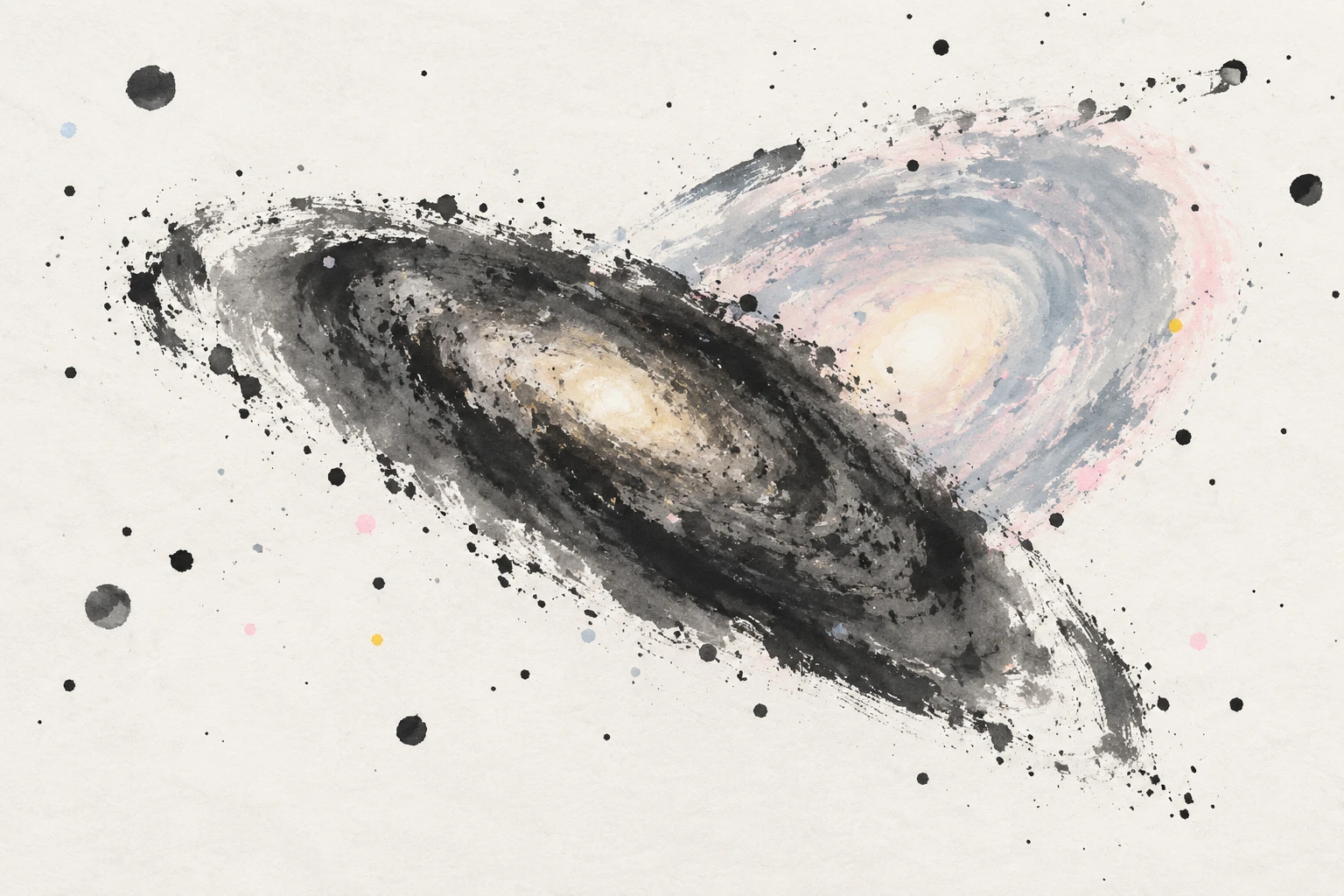
Two galaxies can line up by accident. When a foreground galaxy partly covers a background galaxy, the overlap becomes a natural experiment in dust. Dust in the foreground absorbs and scatters starlight, casting a shadow on the galaxy behind. Astronomers call these occulting pairs. They are rare, and a new citizen-science project has just catalogued hundreds more.
In a preprint posted to arXiv on Feb. 25, 2026, T. Butrum and colleagues describe Overlap Zoo Beta. The work has not yet been peer reviewed. It does not measure dust directly; it identifies and sorts likely pairs from DESI Legacy Survey images, giving future studies a larger target list.
A Rare Alignment That Lets Dust Cast a Shadow
Dust is a small fraction of the interstellar medium—the gas and dust between stars—but it shapes how we see galaxies. It absorbs and scatters starlight in a wavelength-dependent way, an effect called dust attenuation. Astronomers often treat attenuation as a nuisance parameter: an uncertain correction that can shift estimates of star-formation rates and stellar mass.
A universal attenuation law has been hard to find. Geometry, metallicity, and other factors may change how dust dims starlight. Occulting pairs offer a direct test. If a foreground galaxy partly covers a background galaxy, researchers can model the light from both and infer what light is missing in the overlap. The missing light reveals the foreground dust's shadow. Before this work, the main catalogue held about 2,400 suitable pairs.
From Galaxy Zoo Votes to a Catalogue of 765 Pairs
The team began with galaxies volunteers had flagged as 'overlapping' in Galaxy Zoo DECaLS. After strict cuts and removing 54 obvious artifacts, 2,380 candidates remained. They used images from Data Release 10 of the DESI Legacy Survey, scaled to 500 by 500 pixels for the Zooniverse platform. Volunteers completed a short tutorial, then answered branching questions about each pair—first classifying the pair as spiral-spiral, spiral-elliptical, elliptical-elliptical, or other, then, depending on the branch, judging which galaxy was in front and how deeply they overlapped.
Each image was retired after four classifications. The project collected about 9,500 classifications from 15 registered and 47 unregistered participants. Because four votes can split, about 23 percent of classifications tied (a rate that rose when 'Other' answers were excluded). The team resolved ties using each user's consistency with the majority. In all, 551 pairs needed tie correction on at least one question.
The result has three parts: classifications for all 2,380 candidates; 1,428 pixel-based annotations, including duplicates, such as centers and ellipses for the two galaxies; and morphological classifications for 765 pairs that could be sorted into categories from earlier work by W. C. Keel and colleagues.
Those categories include face-on spirals over smooth background galaxies, edge-on disks backlit by ellipticals, crossing edge-on disks, spiral-spiral pairs, and elliptical or S0 pairs. The catalogue also records overlap degree, redshifts, and magnitudes where available. Among the 765 pairs, 342 are elliptical or S0 systems—a large increase over the 59 in the earlier Keel et al. sample, though several other categories are smaller. About 17 percent have known redshift differences large enough to rule out interaction.
What Volunteers Got Right—and Where the Beta Catalogue Still Struggles
Volunteers did better when the two galaxies had larger redshift differences, within the low-redshift range the paper could test. Redshift measures how the expansion of the universe stretches light, so a larger difference usually makes foreground and background easier to separate. At the smallest separations, correct and incorrect identifications were nearly equally common. At larger separations, the sample was too small to confirm the trend.
Brightness mattered too. When the foreground galaxy was brighter, volunteers identified it correctly about 69 percent of the time and incorrectly about 31 percent. When it was fainter, they were more often wrong: about 58 percent incorrect versus 42 percent correct. Faint foreground galaxies can blend with the background.
Comparing with an expert catalogue, only 49 of 189 occulting pairs—about 26 percent—had matching morphological classifications. That low number is not simply a failure. The DESI Legacy Survey images are deeper than the Sloan Digital Sky Survey images used in the earlier expert work, by about 1.5 to 2 magnitudes, so features such as merging can show up in the new images but be invisible in the old ones. The expert also had redshifts; volunteers were deliberately not shown them, because the project aimed to test what people could infer from images alone.
Against Galaxy Zoo DECaLS single-galaxy classifications, agreement was high for spiral-spiral systems (about 81 to 85 percent) and elliptical or S0 systems (about 73 to 83 percent using raw vote fractions). Crossing edge-on pairs showed the lowest agreement in the paper's comparison, roughly 59 to 82 percent; the paper notes that low vote counts, image quality, or redshift bias could contribute.
This is a beta catalogue. Four votes per pair is far below the 40 or more common in large Galaxy Zoo projects, and the low count produced many ties. The workflow could misidentify edge-on spirals as ellipticals, and some false overlaps involving stars or merging systems likely remained. JPEG compression may have blurred subtle features. Many pairs lack spectroscopic redshifts, and the team avoided photometric redshifts because they can be unreliable for overlapping systems. The catalogue is best used as a target list, not a final dust measurement.
Scale is the point. Occulting pairs are so rare that hundreds of new candidates can change what studies are possible. A larger sample makes it easier to find ideal geometries and to move from analyzing one pair at a time to comparing populations. It can also help train machine-learning tools to find more overlaps. The team aims to refine the workflow, reclassify pairs with more votes, and apply the approach to future surveys such as Euclid, SPHEREx, LSST, and the Nancy Grace Roman Space Telescope.
Each pair is an accident of perspective: two galaxies that happen to line up from our vantage point. But where they overlap, dust leaves a shadow. With hundreds of candidate occulting pairs now catalogued, astronomers have a larger target list for studying the dust that shapes what we see across the universe.