The First Iron Meteorite With a Known Orbit—and the 75-Meter Ricochet That May Have Ended Its Fall
A 2020 fireball over Sweden became the first instrumentally documented iron meteorite fall with a derivable orbit. Simulations suggest the recovered 13.8 kg mass may have ricocheted off a boulder before coming to rest about 75 meters away.
Feb 17, 2026
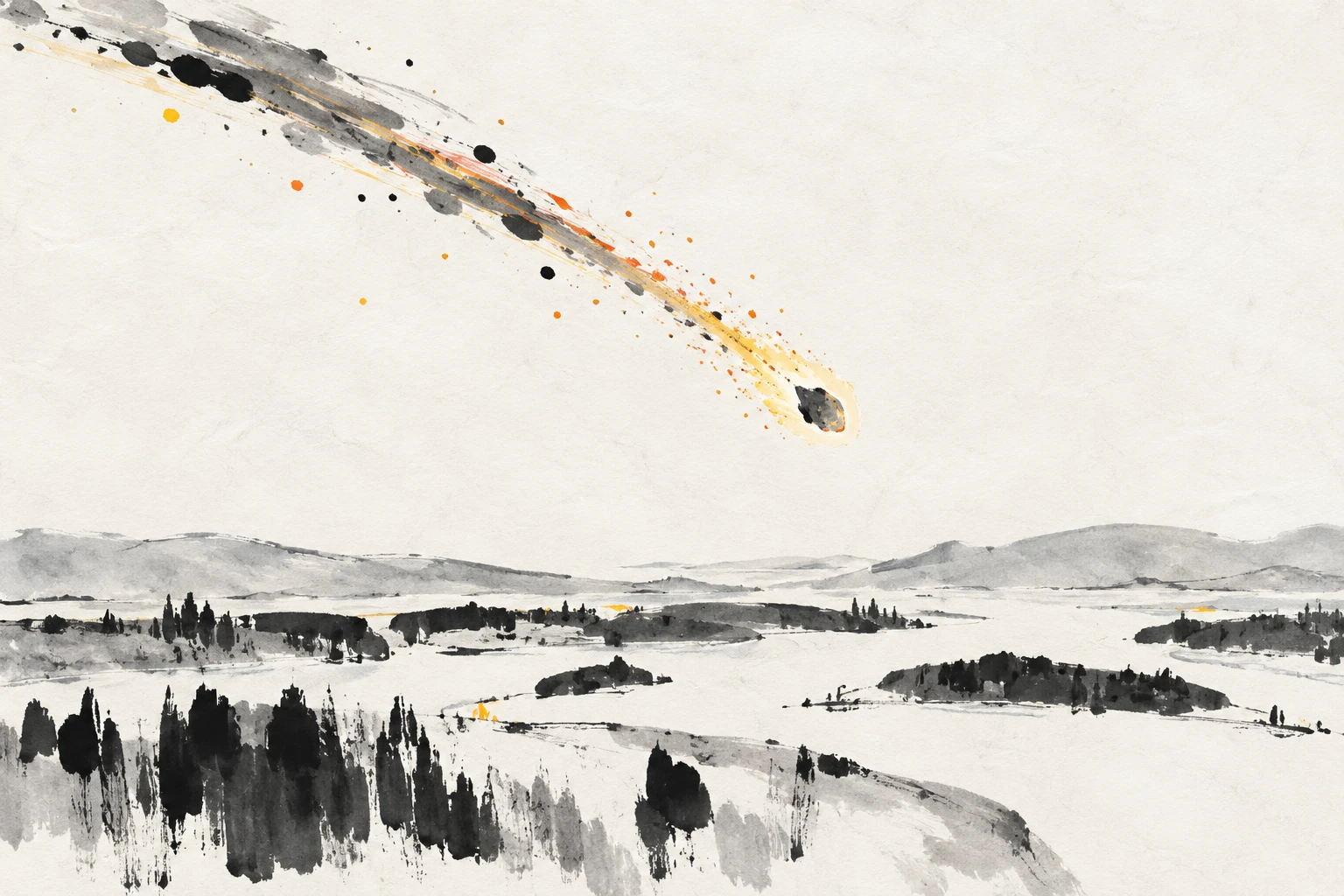
At 21:27:04 UTC on 7 November 2020, a fireball lit the sky over Sweden. It lasted about 4.2 seconds, and its luminous trail ended at an altitude of 11.28 km—the lowest terminal height recorded for a well-documented fireball. That deep penetration was the first clue that this was no ordinary stony meteoroid.
A fireball that fell too low to ignore
Iron meteorites are rare among witnessed falls, making up about 3.9 percent of known falls with approved names. They are the metallic remnants of molten cores or pools inside early planetesimals. Before 2020, no iron meteorite fall had been instrumentally recorded well enough to calculate a reliable pre-atmospheric orbit—its path around the Sun before hitting Earth. Without an orbit, researchers cannot link a recovered iron to a source region in the Solar System. The Swedish event changed that.
The metal rock in the forest
After a month-long recovery effort, a 13.8 kg iron meteorite was found near Ådalen, Sweden. It was the first instrumentally recorded and recovered fall of its type. Small fusion-crust fragments had also been discovered near a boulder bearing an impact mark. X-ray fluorescence analysis of surface fragments and photographs confirmed an iron composition. The main mass is at the Natural History Museum of Sweden in Stockholm, but the meteorite still lacks official classification and an approved name; a legal dispute over ownership delayed study. A Swedish Supreme Court ruling in August 2025 assigned the meteorite to its finders, and the authors hope classification can now proceed.
Four cameras, five seismometers, one lucky security video
The paper combines optical, acoustic and seismic records. Finnish Fireball Network cameras, Norwegian meteor cameras, observations reported through the Ursa Astronomical Association, and International Meteor Organization eyewitness reports all contributed; NASA's CNEOS database also logged it. Four key camera stations—Kyyjärvi, Nyrölä and Tampere in Finland and Larvik in Norway—allowed the team to triangulate the luminous trajectory with their FireOwl software. Reports came from as far as 665 km away.
The reconstruction put the start of the visible trajectory at 81.53 km altitude and 17.52 km/s, ending at 11.28 km. A home security camera in Björkbacken, about six kilometers from the fall site, did not see the fireball directly, but it recorded flashes and a series of loud booms. The team used brightness changes in the video as a rough light curve and timed the sounds. At least eight clear sonic booms appear, with more than 50 boom-like signals when slowed down; the authors attribute three of the loudest to three separate fragments. Five Swedish seismometers 15–70 km away recorded air-pressure waves, not ground shaking. By using arrival times and triangulating wavefronts, the researchers estimated a mean sound speed of about 295 m/s.
The first loud sonic boom likely came from a fragment slowing to subsonic speed at about 8.7 km altitude; the next two loud booms came from altitudes of about 9.9 km and 10.6 km. Because the entry was steep—about 72 degrees—large fragments stayed supersonic unusually low. The result was that sonic booms were heard less than 29 seconds after the fireball's light faded, a stark contrast to Chelyabinsk, whose shock wave took more than two minutes to reach the ground.
Why iron doesn't fall like stone
To predict where fragments landed, the team ran dark-flight Monte Carlo simulations. Dark flight is the unpowered, non-luminous phase after the fireball ends; Monte Carlo means repeated simulations with randomized variations. They used an iron meteorite density of about 7.4 g/cm³ (7,500 kg/m³ with a ±500 kg/m³ uncertainty in the simulations), within the 7–8 g/cm³ range the paper cites for iron meteorites.
A single simulation produced nine fragments from 0.10 to 13.8 kg. The nominal 13.8 kg mass landed about 440 m from the actual recovery point—a close match for such a chaotic process. Ten combined simulations produced 114 fragments from 0.01 to 22.0 kg, with an average total ground mass of 34.6 kg per run.
But the recovered meteorite's shape matters. It is a lopsided, wedge-like iron with a broad rounded end, a flatter broken side and well-developed regmaglypts—shallow hollows sculpted by atmospheric ablation. Its aerofoil-like, asymmetric form departs from the default fragment shapes. To test shape effects, the authors ran simulations with drag coefficients—values in their model representing air resistance—of 3 and 4 instead of the default 1.5. Large fragments then landed earlier, shifting the predicted area for masses over 10 kg nearly a kilometer southwest and widening it. The message is not that the old model is useless, but that iron meteoroids may need iron-specific entry parameters. The simulations still ignore lift and asymmetric drift, and one recovered fragment cannot define a full strewn field—the area where fragments land.
A boulder, a scar, and a 75-meter ricochet
The 13.8 kg meteorite came to rest about 75 ±1 m from a boulder with an impact scar, and about 3 m higher. The meteorite itself has a crack, and tiny fragments were found near the boulder. The authors tested whether the iron struck the boulder and ricocheted. Their simulations suggest that a 13.8 kg mass could travel that distance and land higher if it left the boulder at a shallow angle. Plausible ricochet velocities range from roughly 29 to 65 m/s depending on angle. A direct free-fall arrival seems less likely: at the speeds needed, it would probably have damaged the ground, and passing beneath a thin birch root would have been almost impossible. An alternative ditch on the ground might have been made by wild boars or meteorite hunters, and a thick pine root cuts across it. The ricochet off the boulder is the authors' preferred scenario, but it remains an inference, not a certainty.
What the Ådalen fall does—and does not—settle
The Ådalen event gives researchers their first instrumentally documented iron meteorite fall with a derivable heliocentric orbit—an orbit around the Sun. That makes the specimen a benchmark for iron ablation, density and atmospheric behavior. It also shows how much can be recovered from a steep, low-ending fireball when cameras, microphones and seismometers happen to be listening.
The caveats are as important as the result. This study is an arXiv preprint, and its ricochet and strewn-field scenarios are simulations. The meteorite still lacks official classification, only one large mass has been recovered, and the dark-flight model cannot yet account for every aerodynamic force acting on an irregular iron. More fragments would help map the true strewn field and test the predictions. Still, the object now sits in a museum and in orbital calculations—a chunk of an ancient planetesimal core that crossed space, blazed through the Swedish night, may have ricocheted off a boulder, and finally left scientists a trail they could follow.