SPHEREx Spectra Reveal a Hidden Infrared Sky: Two New FU Ori Outbursts and a Missed Nova
In a proof-of-concept study, SPHEREx spectra of eight NEOWISE-discovered infrared transients suggest two new FU Ori outbursts and one previously missed Galactic nova, showing how all-sky infrared spectroscopy can help classify dust-obscured eruptions.
Feb 6, 2026
Some stellar eruptions are easy to miss. They happen behind so much dust that visible light never escapes. That is why astronomers have turned to the infrared, where dust glows rather than simply blocks. The NEOWISE mission spent more than a decade surveying the entire sky at mid-infrared wavelengths, and its searches have found thousands of time-varying sources. But finding a flare is not the same as knowing what it is. Many of the dustiest outbursts are too obscured for ground-based spectroscopy.
NEOWISE Finds Them; SPHEREx Reads Their Spectra
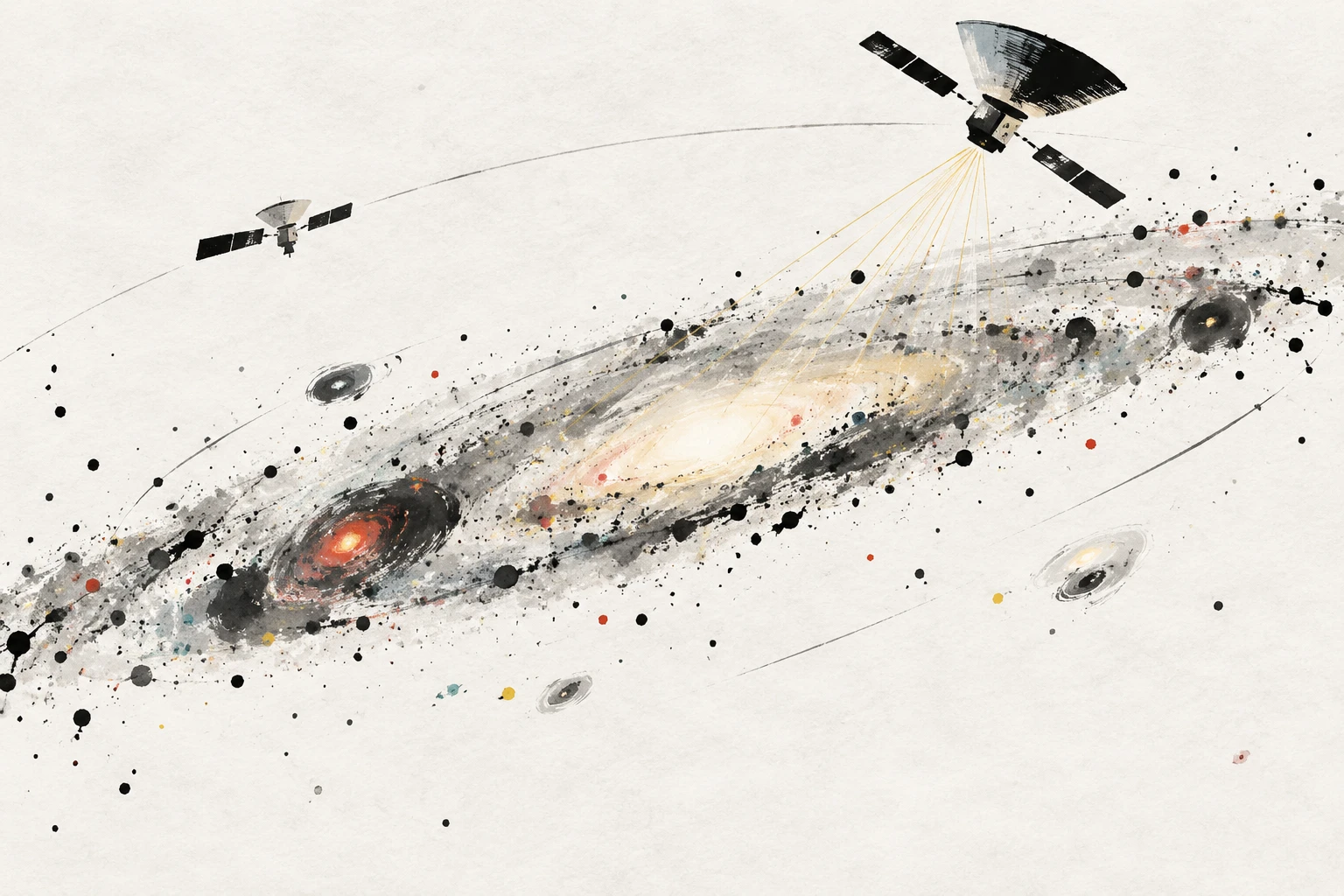
NEOWISE observed at 3.6 and 4.5 micrometers from 2014 to 2024. With the earlier WISE survey used as a reference, this provided a fifteen-year baseline of mid-infrared images. Its all-sky coverage makes it excellent at discovering slow, dusty outbursts. The newly launched SPHEREx space mission adds a missing piece: it is a spectrophotometer, meaning it collects low-resolution spectra of every pixel on the sky from 0.75 to 5 micrometers, and it plans to cover the whole sky four times over two years. Its mid-infrared sensitivity is comparable to NEOWISE's, and its public data and tools let astronomers extract spectra for sources of interest.
A team led by Viraj Karambelkar of Columbia University tested that combination. They selected eight bright Galactic infrared transients from NEOWISE's final years, including sources discovered after 2023. Then they used the public SPHEREx spectrophotometry tool on calibrated images from SPHEREx's first all-sky survey, which was completed in December 2025. The goal was simple: can low-resolution SPHEREx spectra reveal what these hidden outbursts are?
The Spectral Fingerprints: Ice, Molecules, and Emission Lines
The answer appears to be yes. The team first examined five transients with known classifications, two FU Orionis-type outbursts and three classical novae, to see whether SPHEREx recovered their key spectral features.
FU Orionis-type objects, or FUOrs, are young stars that undergo large-amplitude, long-duration brightenings. In SPHEREx spectra, the known FUOrs showed red continua and clear absorption from cool molecules. One showed strong water-ice absorption at 3.05 micrometers and carbon-dioxide ice absorption at 4.25 micrometers. The other was less obscured and lacked those ice features, but still matched the expected infrared behavior of an FUOr.
The known classical novae looked completely different. Their SPHEREx spectra were dominated by strong emission lines—sharp bright features at specific wavelengths—from hydrogen, carbon, aluminium, and calcium. Most intriguingly, all three showed their strongest feature near 4.5 micrometers. That wavelength range is blocked from the ground by Earth's carbon-dioxide atmosphere, and the authors say it has not previously been reported in novae. They suggest it may come from magnesium and aluminium ions and neutral carbon atoms.
Two New FU Ori Outbursts in Dusty Star-Forming Clouds
Using those known sources as templates, the team identified two new likely FUOrs: WTP16aakapb and WTP15aaavof. Both had NEOWISE light curves with the characteristic two-step brightening of FUOrs, rising by roughly a factor of ten over about fourteen years. Their SPHEREx spectra resembled the known FUOrs, with red continua and strong water and carbon-dioxide ice absorption.
Both sit near active star-forming regions in the Perseus arm. Their dust obscuration is extreme. The team estimates visual extinction of about 29 magnitudes for WTP16aakapb and about 40 magnitudes for WTP15aaavof, meaning most visible light is lost. Their estimated peak luminosities, roughly 50 and 130 Suns, are consistent with other FUOrs.
As follow-up, the team obtained medium-resolution near-infrared spectra with the SPeX spectrograph on NASA's Infrared Telescope Facility. Those spectra showed carbon-monoxide absorption bands, a signature of FUOrs that SPHEREx's low resolution cannot resolve. The authors therefore suggest the two sources are new FUOrs, while noting that higher-resolution spectra covering shorter wavelengths and detailed modeling are still needed to cement the classification.
A Nova That Slipped Through the Cracks
The team also found one likely missed Galactic nova, WTP24abacpo. It appeared only in the final NEOWISE visit to its field in July 2024. Archival ATLAS observations revealed an optical outburst beginning about sixty days before and lasting until about forty days after that NEOWISE epoch. The source had red colors, suggesting heavy dust obscuration, and it was not detected in later ATLAS images.
In SPHEREx, WTP24abacpo was seen only between 4 and 5 micrometers, where it showed the same strong emission feature near 4.5 micrometers as the confirmed novae. Its bright, fast-changing light curve and spectral similarity led the authors to suggest it is a previously missed Galactic nova. The source had not been reported to the Transient Name Server and does not appear in compilations of confirmed Galactic novae.
What This Pilot Does, and Does Not, Settle
This is a proof-of-concept study, posted as an arXiv preprint on 6 February 2026 and not yet peer-reviewed. It examines only eight transients. The new classifications are suggestions based on spectra, light curves, locations, and limited follow-up, not final verdicts. Higher spectral and spatial resolution observations will be needed for the most compelling events.
There are also practical limits. SPHEREx has a relatively coarse pixel scale, which makes spectroscopy difficult in crowded Galactic regions or against bright host galaxies. Because SPHEREx builds a spectrum over roughly two weeks or longer, variability on similar or shorter timescales can be imprinted on the spectrum. And severely obscured events will remain challenging for ground-based follow-up.
From a Small Sample to a Dynamic Infrared Sky
Even so, the pilot shows a path forward. NEOWISE has already cataloged thousands of time-varying mid-infrared sources, and many could be similarly classified with SPHEREx spectra. Repeated SPHEREx observations over its two-year mission could track how these outbursts change over time. The approach may also complement other infrared surveys, such as Palomar Gattini IR, WINTER, PRIME, and the planned Cryoscope, while setting the stage for NEO Surveyor and the Nancy Grace Roman Space Telescope.
For now, the result is a reminder that the sky has a dusty, infrared side that visible-light surveys often miss. A mission built to study cosmology, galaxy evolution, and cosmic ices can also serve as a classifier for hidden stellar eruptions, turning faint mid-infrared brightenings into recognizable stories of young stars and novae.