
Same JWST Photons, Different Planet? WASP-39b's Atmosphere Depends on How You Reduce the Data
Six independent reductions of the same JWST/NIRSpec observation of WASP-39b produce atmospheric molecular abundances that can differ by more than an order of magnitude, and temperatures that vary by roughly 300 K, according to a new preprint.
Feb 6, 2026
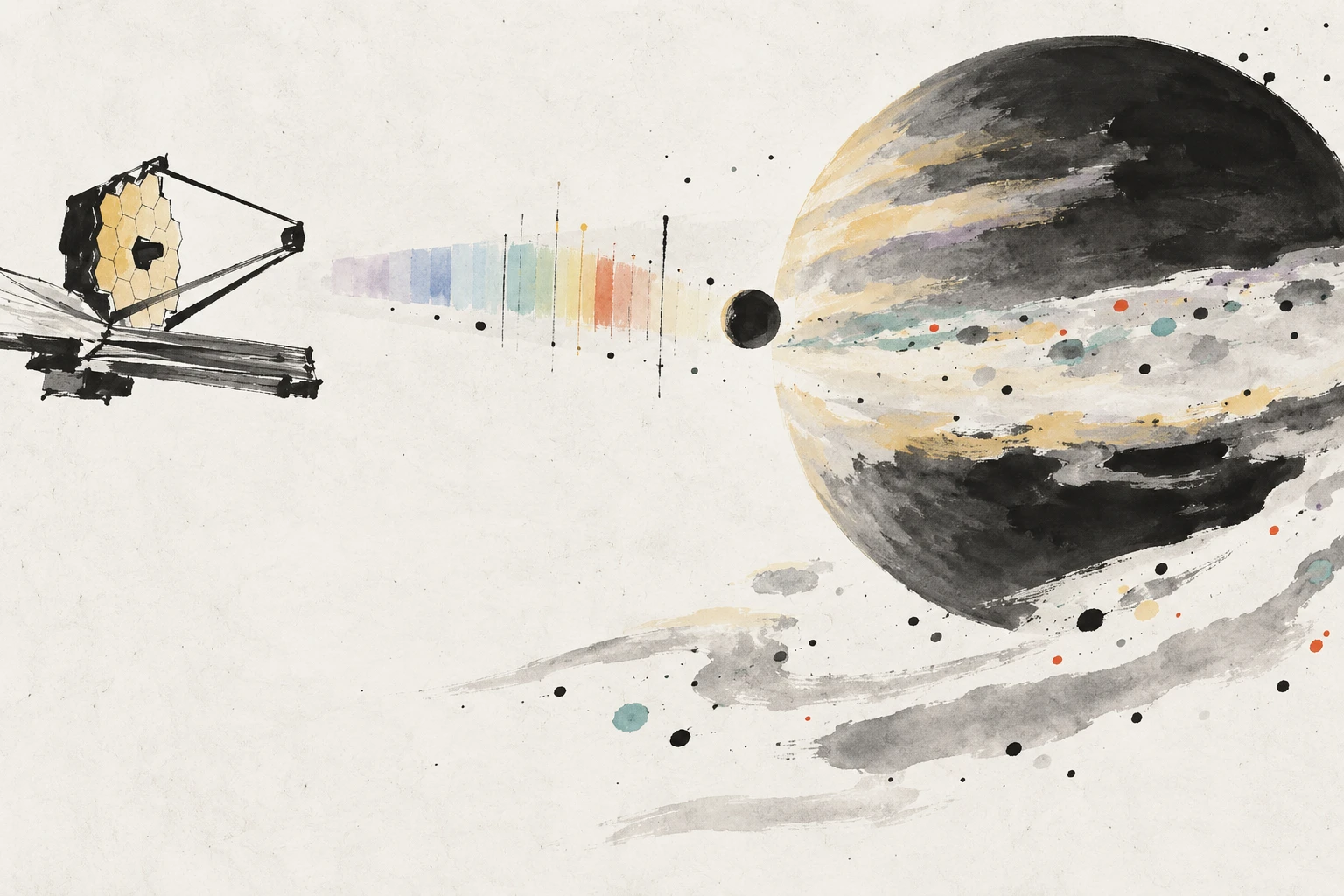
On 10 July 2022, the James Webb Space Telescope watched WASP-39b cross the face of its star for 8.23 hours. The planet is a Saturn-mass gas giant, about 0.28 times Jupiter's mass and 1.27 times its radius. As starlight skimmed through its atmosphere, molecules left absorption fingerprints in the spectrum. Earlier observations of WASP-39b had found water, sodium, and potassium; JWST's Early Release Science observations added carbon dioxide, carbon monoxide, and sulfur dioxide, with hints of hydrogen sulfide.
But raw JWST data do not arrive as a finished spectrum. They arrive as detector images that must be corrected, calibrated, binned, and fitted. Different teams make different choices. A new preprint by J. Roy-Perez and colleagues at the Universidad del País Vasco asks how much those choices matter. For WASP-39b, the answer is not subtle: the same observation can yield molecular abundances that differ by more than an order of magnitude.
One transit, six reductions
The study uses the Early Release Science observation of WASP-39b taken with JWST's NIRSpec PRISM mode, a near-infrared spectrometer. The authors compared six independently reduced versions of that single transit observation. Four came from the original ERS analysis and used the FIREFLy, Tshirt, Tiberius, and Eureka!+ExoTEP pipelines. Two came from a later reanalysis by Carter et al. The names label the spectra, not a ranking; the authors stress they are not judging the pipelines themselves.
Each spectrum was fed into an atmospheric retrieval. In exoplanet science, a retrieval works backward from a measured spectrum to plausible atmospheres. It explores many combinations of temperature, molecular abundances, cloud opacity, and other properties, then reports which combinations fit the data and how uncertain they are. The team used a nested-sampling method called MultiNest and forward models from the Planetary Spectrum Generator. They also used Bayesian evidence, a score that balances fit quality against model complexity, to compare cloud models.
The planet changes with the recipe
At first glance, the six spectra look similar. Their differences often sit below the error bars, though the Carter spectra also show an offset along much of the spectrum. But when those subtle differences are pushed through a retrieval, they grow into distinct planets.
Retrieved atmospheric temperatures spanned roughly 300 K, from Tiberius at the hot end to Carter Modified at the cold end. Molecular abundances varied even more. In some cases they shifted by more than one order of magnitude, and sometimes by up to two. The FIREFLy reduction systematically produced higher abundances, along with an anomalously high mean molecular weight and a gravity value incompatible with the other retrievals.
Whether hydrogen sulfide was required by the fit also depended on the reduction. Half of the retrievals constrained its abundance to some precision. The other half were compatible with no hydrogen sulfide at all. Planetary diameter and stellar radius remained robust across the board, but temperature, composition, gravity, and cloud opacity did not.
Why a saturated detector matters
Part of the story lies in the detector itself. During the NIRSpec/PRISM observation, a region of the detector saturated at wavelengths between 0.63 and 2.06 micrometers. The saturation was not uniform: in the worst areas, up to four of the five groups in each integration were affected. Teams used custom steps to recover the lost information.
The authors reran their retrievals after removing the persistently saturated 0.69–1.91 micrometer range. That change reduced the disagreement between pipelines. But it increased degeneracies, meaning different combinations of temperature and molecular abundance could fit the remaining data equally well. Water is especially affected: some of its absorption features lie in the removed range. Without it, water abundance leans on a 2.8 micrometer feature shared with carbon dioxide and hydrogen sulfide, and on the red end of the spectrum, which is dominated by carbon monoxide. Sulfur dioxide and sodium were mostly unaffected.
So removing the saturated region trades scatter for ambiguity. The paper suggests a better correction of the saturated region, or a reliable independent source of data over the same wavelengths, would be the only solution for removing the degeneracies.
Clouds do not rescue the picture
The team also tested three ways to describe cloud opacity. One treats extinction as flat across wavelength. Another uses an Ångström law, a simple power-law change with wavelength. The third uses Mie scattering from spherical particles with a size distribution, computed with the MOPSMAP database.
Bayesian evidence favoured a non-flat aerosol extinction over the flat model for every spectrum. That supports the idea that JWST data can probe how aerosols behave across wavelength. But which non-flat model was preferred depended on the data reduction. For FIREFLy, Tiberius, and Eureka!, the Mie model was strongly favoured. For Tshirt and Carter, the Ångström model scored higher, though not decisively so.
Crucially, the spread introduced by cloud-model choices was comparable to the spread introduced by data reduction. Different choices led to two broad families of possible atmospheres: a hotter, more extended, lower-gravity planet with significant cloud optical depth across the spectrum, or a cooler, more compact, higher-gravity planet with optically thin clouds in some regions. The data did not statistically decide between them.
What the result does and does not say
This is a preprint, and it studies one planet in one JWST instrument mode. The retrievals also make simplifying assumptions: an isothermal temperature profile, a uniform cloud layer, fixed aerosol refractive indices and size-distribution variance in the Mie model, and free chemistry without composition constraints. The result does not mean JWST's WASP-39b data are unreliable. It means that a retrieved atmosphere is not a direct photograph. It is the end of a chain of choices.
WASP-39b has been extensively studied, and JWST has clearly shown its power. But the paper argues that robust, homogeneous calibration is essential. Until that calibration improves, the same photons from a distant planet can describe more than one world. The task is to keep those worlds side by side, and to know exactly how each one was built.