
Could Dark Matter Have Given Early Quasars a Million-Solar-Mass Head Start?
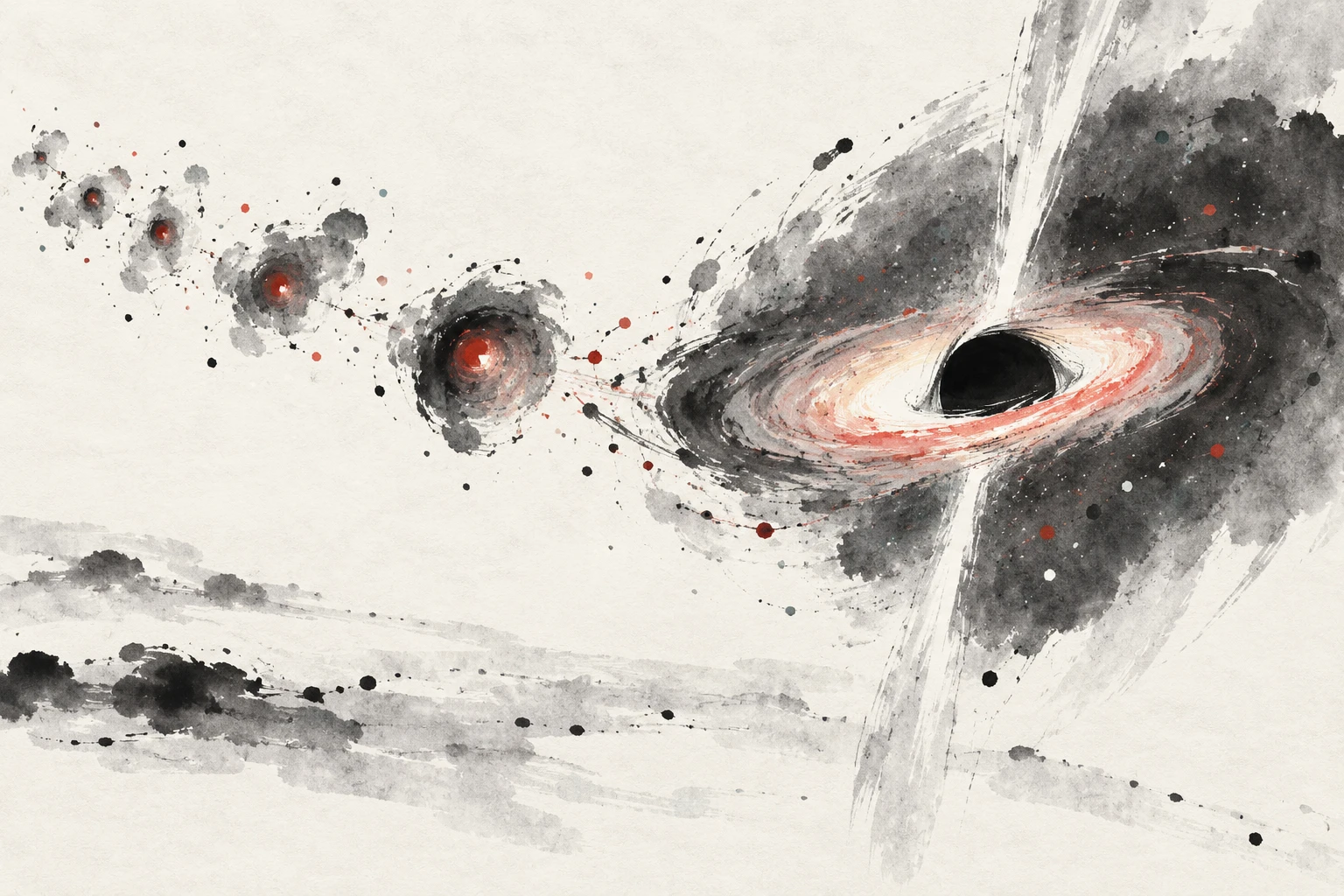
A new preprint suggests two early quasars could have grown from roughly million-solar-mass seeds in dense primordial gas, without sustained Eddington-limited accretion or any super-Eddington episodes.
Feb 4, 2026
A timing problem written in billion-solar-mass black holes
Imagine a quasar blazing less than a billion years after the Big Bang. Its central black hole already weighs more than a billion Suns. How did it get so massive so quickly?
That is the puzzle at the heart of a new preprint by Yu Wang and Remo Ruffini, posted on arXiv on Feb. 4, 2026. The work has not yet been peer-reviewed. It asks whether the first quasars grew from small seeds by feeding at extraordinary rates, or whether they were born heavy in unusually dense pockets of the early universe.
Redshift, written as z, measures how much cosmic expansion has stretched light. Larger z means earlier in cosmic history. Quasars at z greater than 6 are observed when the universe was less than about a billion years old. Growing a billion-solar-mass black hole from a typical stellar-mass seed in that time is difficult, especially if accretion is intermittent or limited by radiation.
Little Red Dots and the case for pre-galactic seeds
The study is motivated by a population of compact, red objects discovered by the James Webb Space Telescope. These Little Red Dots, or LRDs, are small, reddish sources seen in the early universe. Some appear to host black holes with masses of order a million Suns, and many seem to lack mature host galaxies.
That matters because it suggests black holes could become active before a settled galaxy disk or bulge has formed. The central black holes in LRDs also appear to account for a surprisingly large fraction of the stellar mass, far above the tiny ratio seen in nearby galaxies. In this picture, LRDs may be closer to naked black holes accreting gas in pre-galactic environments than to miniature versions of modern galaxies.
Wang and Ruffini use that idea as a starting point. Instead of placing a black hole inside an already formed galaxy, they place a massive seed inside overdense primordial gas left over from the Big Bang.
A simple tug of war: gas supply versus radiation pressure
The model follows two competing limits. The first is the Bondi inflow rate, which describes how quickly gas can fall toward the black hole from its surroundings. It depends on the black hole mass and the local gas density. The second is the Eddington limit, the rate at which radiation pressure from infalling matter balances gravity, beyond which it can drive gas away.
The actual growth rate in the model is the smaller of the two. Early on, dense gas may allow a very high Bondi rate, but radiation pressure caps growth at the Eddington limit. As the universe expands, the average gas density drops. The supply of gas then becomes the tighter constraint, and growth enters a long supply-limited phase.
The authors fit this model to two well-studied high-redshift quasars. J0313-1806 lies at z=7.64 and hosts a black hole of about 1.6 billion solar masses, with a luminosity of about 1.4 times 10^47 ergs per second. J0100+2802 lies at z=6.30 and hosts a black hole of roughly 12.4 billion solar masses, with a luminosity of about 1.6 times 10^48 ergs per second.
Using Bayesian inference, a statistical method that compares model predictions with observations and returns probability ranges for unknown parameters, the authors infer two key quantities: the initial seed mass and how much denser the surrounding baryonic gas was than the cosmic average.
The fit prefers a heavy start
The preferred solution starts with a seed of roughly a million solar masses. The most plausible formation window in the fit is around z=20 to 30, when the universe was still young but not impossibly early. The fit favors gas overdense by a factor greater than about 50 compared with the cosmic mean, with the two quasar fits clustering near 80.
Under those conditions, the model can reproduce the observed quasar masses without requiring continuous Eddington-limited accretion. It also does not need any super-Eddington episodes, in which a black hole briefly swallows matter faster than the standard radiation-pressure limit would allow.
Instead, the growth history has phases. At very high redshift, gas is so dense that accretion is Eddington-limited. Around z=40, the expansion of the universe dilutes the gas enough that the Bondi supply takes over. For most of the relevant cosmic time, growth is supply-limited. Later, as the black hole becomes extremely massive, its gravity helps pull in gas efficiently again, and the Eddington ratio can rise toward unity.
The key shift is conceptual. Early quasars may not have been starving black holes that had to gorge continuously. They may have started heavy enough, and in dense enough gas, that ordinary accretion could do the rest.
Where dark matter enters the story
The inferred seed mass scale is consistent with a more speculative idea: that some early black holes formed from the collapse of quantum-degenerate fermion dark matter cores. In that scenario, dark matter particles behave somewhat like electrons in a white dwarf, resisting compression until a critical mass is reached. For fermion masses around 300 keV, the critical mass in the paper's formula is about several million Suns (roughly 7 million), in the same broad range as the inferred seed scale.
The paper does not prove that fermion dark matter made these seeds. The authors present it as a physically motivated pathway that naturally supplies the right mass scale. Other seed channels, such as the remnants of Population III stars or direct collapse of gas, are not ruled out. The fermion dark matter model itself remains a hypothesis, though the authors note it has been used to describe the Galactic Center and stellar orbits around Sgr A*.
What could undercut the picture
The model is deliberately simple. It assumes roughly spherical gas inflow, neglects angular momentum and disk formation, ignores galaxy mergers and duty cycles, and holds the gas sound speed constant at 10 kilometers per second. Each of those choices could affect the inferred seed mass and overdensity.
The fit relies on only two quasars, albeit two well-measured ones. The seed-formation probability at z greater than 30 is expected to be very low, so most early black holes would not experience every phase in the modeled history. And the fermion dark matter connection is a consistency argument, not a detection.
Directly catching seeds at z=20 to 30 would also be hard. The paper estimates that a quasar with luminosity around 3 times 10^44 ergs per second at z=20 would appear at roughly magnitude 29, while one with luminosity around 2 times 10^44 ergs per second at z=30 would be fainter than magnitude 30.5. Standard JWST programs are unlikely to detect such objects without ultra-deep exposures or gravitational lensing.
Follow-up work will need to calculate where and when fermion cores could actually collapse, and to build a unified picture linking quasars and Little Red Dots. For now, the study offers a way to think about the first giant black holes: not as late bloomers, but as heavy seeds born in crowded, gas-rich pre-galactic environments.