
Could Halogens Help Turn Interstellar Ethanol into Acetaldehyde?
New quantum calculations and hot-core models suggest fluorine and chlorine can strip hydrogen from ethanol, opening a gas-phase route that may modestly boost acetaldehyde in Sgr B2(N) and leave an ethanol radical as a potential target for radio searches.
Feb 3, 2026
In the crowded chemical inventory of Sagittarius B2(N), a hot core—a warm, dense knot of gas and dust near the Milky Way's center—ethanol and acetaldehyde sit in the same molecular family tree. Ethanol (CH3CH2OH) is an alcohol; acetaldehyde (CH3CHO) is an aldehyde. The question is how one might become the other.
For years, astrochemists have favored a bottom-up route: start with an aldehyde, add hydrogen atoms on the icy surfaces of dust grains, and build an alcohol. That works well for formaldehyde (H2CO) turning into methanol (CH3OH). But the same recipe is messier for acetaldehyde and ethanol. Recent calculations suggest that making acetaldehyde on grain surfaces is unfavorable. Acetaldehyde also appears in cold prestellar cores, and recent quantum calculations indicate it resists further hydrogenation. That has pushed researchers to look for other chemical connections, including gas-phase ones.
Fluorine and chlorine attack ethanol's hydrogens
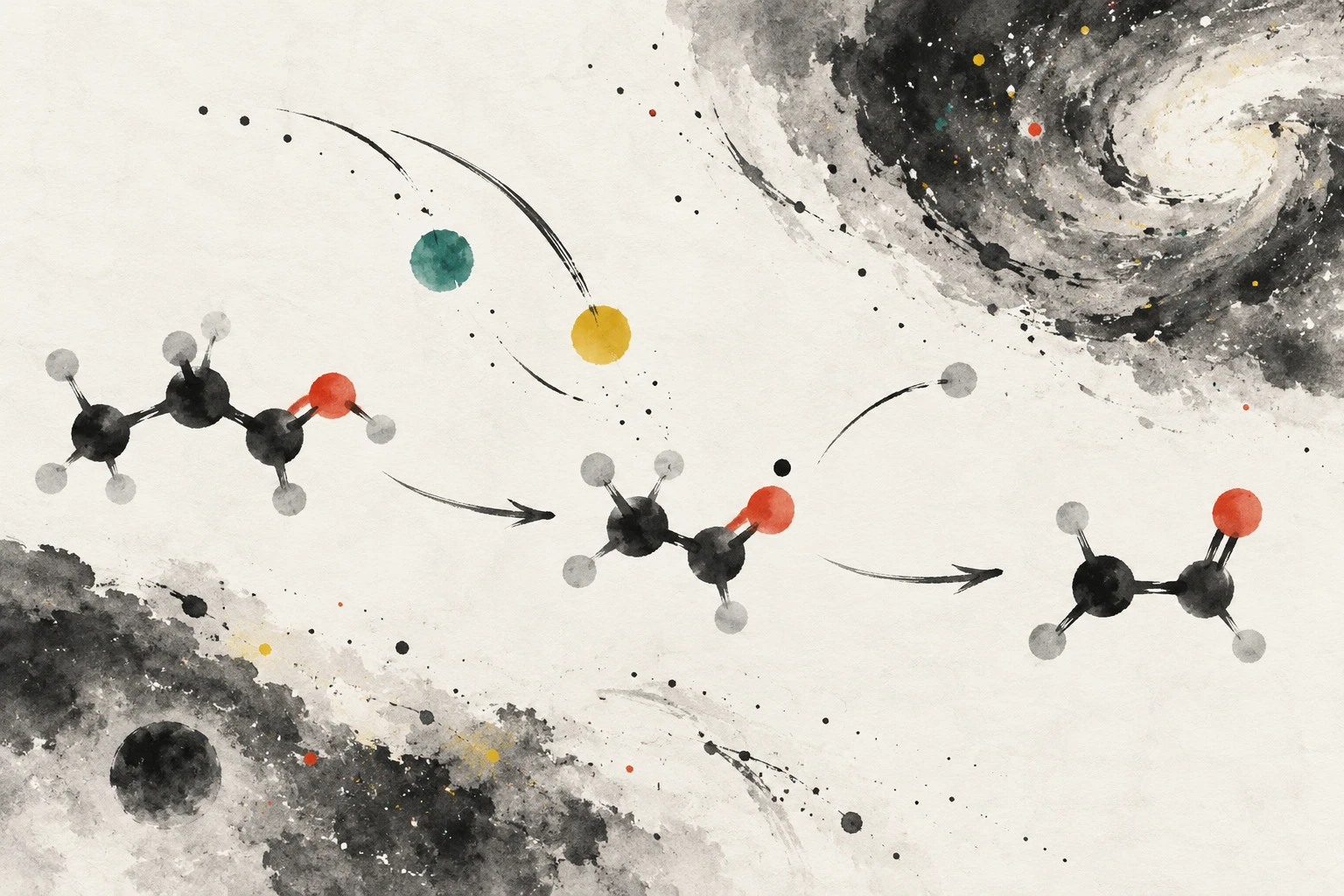
A new preprint posted to arXiv on 3 February 2026 explores a top-down route: instead of building alcohols from aldehydes, it asks whether alcohols can be converted into aldehydes. The authors focus on ethanol in Sgr B2(N), and they introduce an unexpected chemical accomplice: the halogen atoms fluorine and chlorine.
Halogens are not the first species most people associate with interstellar chemistry. But HCl and HF have been detected toward Sgr B2, and fluorine and chlorine atoms can be more reactive than hydrogen atoms in some reactions. Previous modeling has included methanol reactions with F and Cl, but not ethanol.
The team used quantum-chemical calculations, including density functional theory (DFT)—a computational method for mapping a reaction's energy landscape—plus higher-level energy refinements, to see whether F or Cl can pull a hydrogen atom off ethanol. They calculated the pathways for removing each distinct hydrogen, then derived reaction rates over temperatures from 30 to 500 kelvin. Finally, they inserted those rates into an astrochemical model of Sgr B2(N), simulating the collapse of a prestellar cloud, the warm-up of a hot core, and a later static phase.
The calculations found that both halogens can abstract hydrogen from ethanol, though not equally. With fluorine, all three hydrogen-abstraction channels are effectively barrierless: the reaction can proceed without climbing a significant energy hill. With chlorine, only one channel, leading to the CH3CHOH radical, is truly barrierless; the others face barriers that make them much slower. At low temperatures, the total fluorine reaction is about 2.8 times faster than the chlorine one.
That first step matters because it creates ethanol radicals—molecules with an unpaired electron. The model then allows those radicals to react with atomic hydrogen, and some of those reactions yield acetaldehyde. Among the radicals, CH3CHOH becomes the most abundant. At some model times, its abundance approaches that of ethanol itself.
A modest acetaldehyde bump when hot-core ethanol thaws
In the Sgr B2(N) model, the new chemistry produces a modest increase in acetaldehyde around a model time of 10^6 years. That is not an arbitrary moment. By then, the simulated gas and dust have warmed to roughly 175 K, releasing ethanol that had been frozen onto grain mantles—icy coatings on dust grains. Once ethanol enters the gas phase, the halogen reactions can act. The boost is not dramatic, but it appears around the time gas-phase ethanol becomes available.
The work does not replace the bottom-up picture. Instead, it adds a complementary route. If grain-surface chemistry can build alcohols from aldehydes, this gas-phase path can help break alcohols back down into aldehydes in hot cores. Together, the two directions could make the chemical relationship between these two families more dynamic than a one-way assembly line.
A radical target still missing its spectral fingerprint
The most intriguing consequence may be observational. The models suggest that CH3CHOH might be detectable in the interstellar medium, particularly in hot molecular cores or cold dark clouds, depending on which spectral lines are strongest. Its strongest predicted transitions may fall in the radio to centimeter range or the millimeter to submillimeter range.
But there is a catch. To search for a molecule with radio telescopes, astronomers need a laboratory spectrum that tells them the exact frequencies to look for. No laboratory spectrum for CH3CHOH exists, according to the authors, though a related study has calculated relative energies. Without that spectral fingerprint, a detection remains a possibility, not a result.
The study also carries specific caveats. The destruction rates for the ethanol radicals with H, OH, and NH2 were assumed to proceed at a typical barrierless rate, an approximation that follow-up studies could revise. The kinetic treatment simplifies some details, such as possible roaming pathways and different ethanol conformations. The capture theory used for barrierless reactions can overestimate rates. And because the paper is a preprint, its conclusions have not yet been through peer review.
Still, the result points to a concrete target. If laboratory scientists can measure the spectrum of CH3CHOH, and radio observatories can then find it in Sgr B2(N) or another star-forming region, it would support the proposed top-down chemical link operating in space. It would also suggest a subtle shift in how we picture interstellar chemistry: not just molecules being built up atom by atom on ice, but alcohols being taken apart in the gas and rearranged into aldehydes.
For now, the link lives in calculations and models. But it offers a reminder that in the molecular clouds where stars are born, the same atoms can travel more than one road. Sometimes the question is not only how a molecule forms, but how it changes its identity along the way.