Can Three Numbers Capture a Neutron Star’s Hidden Interior?
A new preprint shows a variational autoencoder can compress ten-parameter Skyrme equations of state into three variables while reconstructing the maximum mass and the radius of a 1.4-solar-mass neutron star to about 0.1–0.15%.
Jan 29, 2026
Neutron stars contain matter at extreme densities, and their interiors are hidden. Their structure is governed by an equation of state—a rulebook that relates pressure to energy density. At the high densities inside a neutron star’s core, that rulebook remains uncertain.
A preprint posted to arXiv by Alex Ross, Tianqi Zhao, and Sanjay Reddy at the Institute for Nuclear Theory, University of Washington, explores a new way to navigate that uncertainty. Instead of constructing a single equation of state by hand, they train a machine-learning model to learn the space of possible equations of state and then generate new, physically valid candidates on demand. The central result is striking: a ten-parameter nuclear model can be compressed into just three numbers, two of which are tied directly to neutron-star quantities computed from each EOS.
Why the Core Is the Hard Part
The equation of state (EOS) describes how pressure relates to energy density in cold, stable neutron-star matter. At low densities near the crust, nuclear theory and experiments provide tight constraints. At the highest densities, beyond those found in neutron stars, a different theory—perturbative quantum chromodynamics—takes over. The trouble lies in between, in the intermediate-to-high densities that make up neutron-star cores.
Phenomenological models such as the Skyrme nuclear model can extrapolate nuclear interactions to these densities. But such models have adjustable parameters—the Skyrme model has ten—and EOSs that satisfy low-density constraints can still diverge significantly at high density. The result is a wide range of predicted neutron-star masses, radii, and tidal deformabilities—the way a star stretches in a gravitational field. That spread motivates data-driven approaches that can explore EOSs consistent with theory and observation.
Teaching a Network to Speak in Sound Speeds
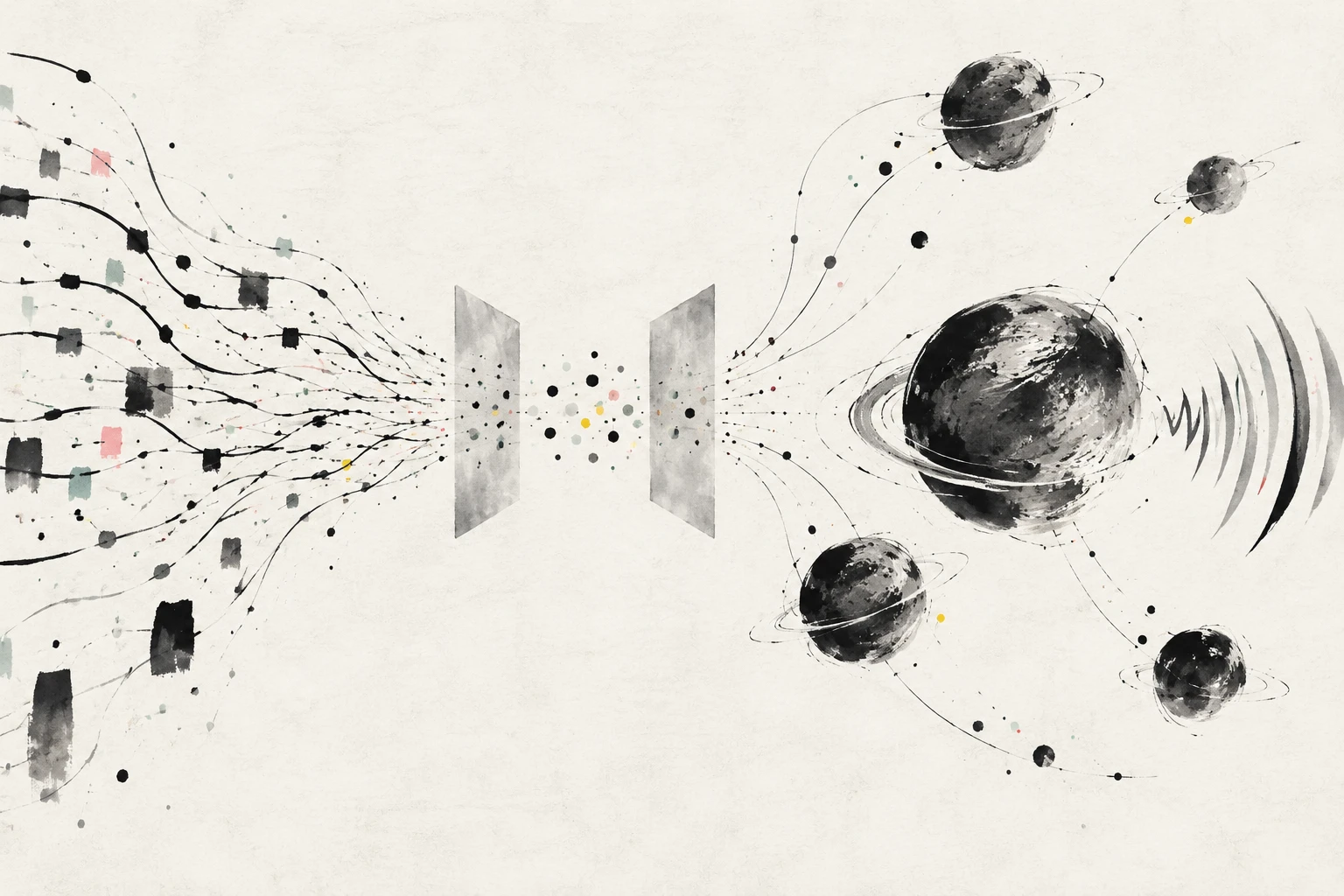
The new work uses a structured variational autoencoder, or VAE. A VAE is a type of neural network that compresses complex data into a lower-dimensional latent space and then reconstructs the original data from that compressed representation. In this case, the input for each EOS is an array of 107 numbers: 101 values of the sound speed across a pressure grid from the crust-core transition to the central pressure of the maximum-mass configuration, plus six boundary conditions at those two ends. The sound speed here is the speed at which pressure disturbances travel through dense matter; its square is the slope of pressure versus energy density.
The encoder maps each EOS into a latent space. Two latent variables are supervised—that is, during training they are tied to two neutron-star quantities computed from each EOS: Mmax, the maximum stable mass of a non-rotating star, and R1.4, the radius of a 1.4-solar-mass neutron star. A third latent variable, z0, is a free random variable that the network learns on its own. The decoder then reconstructs the full EOS from these latent numbers.
The authors trained the model on a dataset of Skyrme EOSs, using about 70 percent of the data for training, 15 percent for validation, and 15 percent for final testing. After training, they could sample the latent space to generate new EOSs that are causal and thermodynamically stable—meaning sound speeds stay below the speed of light and the EOS remains stable against small disturbances. They then solved the Tolman-Oppenheimer-Volkoff equations, which describe hydrostatic equilibrium in a spherical star, to compute each EOS’s mass-radius relation.
Three Dials, Three Density Regions
The trained model offers a compact control panel for neutron-star interiors. Varying Mmax mainly changes the stiffness of the EOS at high densities: larger maximum masses require greater pressure support in the core. Varying R1.4 leaves the high-density core relatively unchanged but shifts the EOS near and just above nuclear saturation density—the density characteristic of atomic nuclei—where the radius of a 1.4-solar-mass star is especially sensitive. Varying z0 produces smaller changes at low-to-intermediate densities, near the crust-core transition. Those changes mostly affect the radii of lower-mass stars.
The mapping from these three parameters to density regions is not imposed by hand. It emerges from the training data and the network’s architecture, and it matches physical expectations from earlier nuclear theory. In effect, the VAE has learned a three-parameter map of a ten-parameter model family, while keeping the map smooth and interpretable.
Recreating a Known Star Model
As a test, the authors asked the decoder to reproduce SLy4, a known Skyrme parameterization. They passed in SLy4’s values of Mmax = 2.046 solar masses and R1.4 = 11.717 kilometers, along with a fixed latent value z0 = 0.0487. The VAE returned Mmax = 2.043 ± 0.002 solar masses and R1.4 = 11.715 ± 0.0176 kilometers—closely. Across the selected model, the decoder’s mean absolute percentage errors were about 0.1 percent for maximum mass and 0.15 percent for R1.4. These are reconstruction errors, not errors on real observations.
What the Shortcut Does—and Doesn’t—Settle
The work is a framework demonstration. It is trained only on Skyrme equations of state, so its generated candidates live inside that model family. It does not yet include other nuclear models or first-order phase transitions that could produce sharp features, such as a sound speed dropping toward zero. The paper also does not perform a full Bayesian analysis using LIGO/Virgo gravitational-wave data or pulsar mass-radius measurements; it lays out a framework that could support such inference by generating candidate EOSs on demand. Future work will need to compare its speed against traditional methods and test whether it can handle more complex physics. The preprint has not yet been peer-reviewed.
Even with those caveats, the result points to a broader possibility: the space of allowed neutron-star interiors may have a compact, learnable geometry. If so, multimessenger observations—gravitational waves from LIGO/Virgo and mass and radius measurements of pulsars—could be matched against large numbers of machine-generated equations of state, turning a hidden interior into a problem of navigation. The three dials are not the star itself, but they may be a useful map.